
Quick answer: Al-Farghani (Latinized Alfraganus) was a 9th-century astronomer of the Islamic Golden Age. Working in Abbasid Baghdad, he wrote the Elements of Astronomy — the clear summary of Ptolemy's Almagest that served as the standard astronomy textbook in the Islamic world and medieval Europe for roughly 700 years, guiding thinkers from Dante to Columbus.
Al-Farghani came from Farghana, in present-day Uzbekistan, and became one of the towering figures of the Islamic Golden Age. His figures for the sizes and distances of the planets, his value for the Earth's circumference, and his work on the astrolabe carried Greek astronomy into the West — and this guide covers who he was, what he achieved, and why his fingerprints are still on modern astronomy.
You may see his name written as al-Farghani, Alfraganus, Alfraghani, or Alfragano — all refer to the same astronomer. The lunar crater Alfraganus is named in his honor.
Why Al-Farghani Still Matters in 2026
Some scientists are remembered for a single discovery. Al-Farghani is remembered for something rarer: he made the entire science of the heavens understandable. At a time when Ptolemy's Almagest was a dense, mathematically forbidding masterpiece that almost no one could read, al-Farghani distilled it into clear prose a student — or a caliph — could follow.
That instinct, to take something complex and make it usable, is the same one behind every modern tool that puts the night sky within reach. When a beginner opens a planetarium app, aligns a GoTo mount, or watches plate-solving software identify a star field in seconds, they are living out al-Farghani's core idea: the cosmos becomes navigable only once someone organizes it clearly. He did not just preserve astronomy — he made it portable.
Who Was Al-Farghani? Early Life and Background
Al-Farghani was born in the late 8th or early 9th century in Farghana (Fergana), a fertile valley in what is now eastern Uzbekistan — the region that gave him his name. His full name was Abu'l-Abbas Ahmad ibn Muhammad ibn Kathir al-Farghani, and like many scholars of his age he was drawn to Baghdad, the intellectual capital of the Abbasid Caliphate and home to the House of Wisdom.
There, under Caliph al-Ma'mun (r. 813–833) and his successors, al-Farghani joined a remarkable community of astronomers, mathematicians, and translators rendering Greek, Persian, and Indian science into Arabic — and pushing it forward. He took part in the systematic observations al-Ma'mun sponsored to test and refine the values inherited from Ptolemy.
He worked among giants. The mathematician al-Khwarizmi — whose name gave us the word “algorithm” — moved in the same circles, and his fellow astronomer Al-Battani would soon push observational precision even further. Where al-Battani became the meticulous measurer, al-Farghani became the master synthesizer — the one who organized what was known into a form the whole world could use. That pairing of measurement and clear teaching is exactly why both men rank among the most famous astronomers in history.
What Did Al-Farghani Achieve? Seven Contributions That Shaped Astronomy
His influence runs through cosmology, observation, instrument-making, and even practical engineering. Here are the seven that matter most.
1. The “Elements of Astronomy” — His Masterwork
Al-Farghani's great work was the Kitab fi Jawami' ilm al-nujum (“A Compendium of the Science of the Stars”), known in the West as the Elements of Astronomy. In thirty concise chapters he summarized the Almagest — the geometry of the heavens, the motions of Sun, Moon, and planets, the sizes of the celestial spheres — but stripped of Ptolemy's heavy mathematical proofs. The result was the first genuinely accessible astronomy textbook, and for centuries it was taught from in classrooms from Baghdad to Bologna.
2. Carrying Greek Astronomy into Europe
The Compendium's clarity made it the bridge by which Ptolemaic astronomy reached the medieval West. It was translated into Latin twice in the 12th century — by John of Seville (1137) and again by Gerard of Cremona — and into Hebrew by Jacob Anatoli. For roughly 700 years it was the standard introduction to astronomy in European universities, shaping how the medieval world pictured the cosmos: the nested spheres, the order of the planets. It was still being printed in the Renaissance.
3. Measuring the Cosmos — Sizes and Distances of the Planets
Al-Farghani laid out a complete, widely cited set of cosmic dimensions: the diameters and distances of the planets and the sizes of the celestial spheres. Building on Ptolemy, he gave scholars a concrete, quantitative scale of the universe — the medieval equivalent of a to-scale map of the solar system — that became the accepted picture in both Islamic and European thought.
4. Refining Ptolemy — Obliquity and Precession
He did not merely copy Ptolemy; he updated him. Al-Farghani reported an improved value for the obliquity of the ecliptic — the tilt of Earth's axis — of about 23°35′, closer to the truth than Ptolemy's figure, and he addressed the precession of the equinoxes, the slow wobble that shifts the stars over millennia. These corrections reflected the Golden Age method: trust observation over inherited authority, and revise the record when the sky demands it.
5. The Earth's Size — and the Error That Sent Columbus West
Among the figures al-Farghani recorded was the size of the Earth, derived from the survey al-Ma'mun commissioned, in which astronomers measured the length of a degree of latitude on the Mesopotamian plains. His value for the Earth's circumference was excellent for the 9th century.
It also had an unintended consequence. Centuries later, Christopher Columbus leaned on al-Farghani's figure for the length of a degree — but mistook al-Farghani's Arabic miles for shorter Roman ones. The error convinced Columbus that the Earth was far smaller than it is, and that Asia lay a short sail to the west. He was wrong about the distance, but that miscalculation — rooted in al-Farghani's centuries-old number — helped launch the voyage that reached the Americas.
6. The Astrolabe — the Analog Sky Computer
Al-Farghani wrote a treatise on the astrolabe, the elegant brass instrument that was the smartphone of medieval astronomy: it told time, found the direction of prayer, measured star altitudes, and modeled the rotating sky. He set out the mathematical theory behind its construction in clear terms.
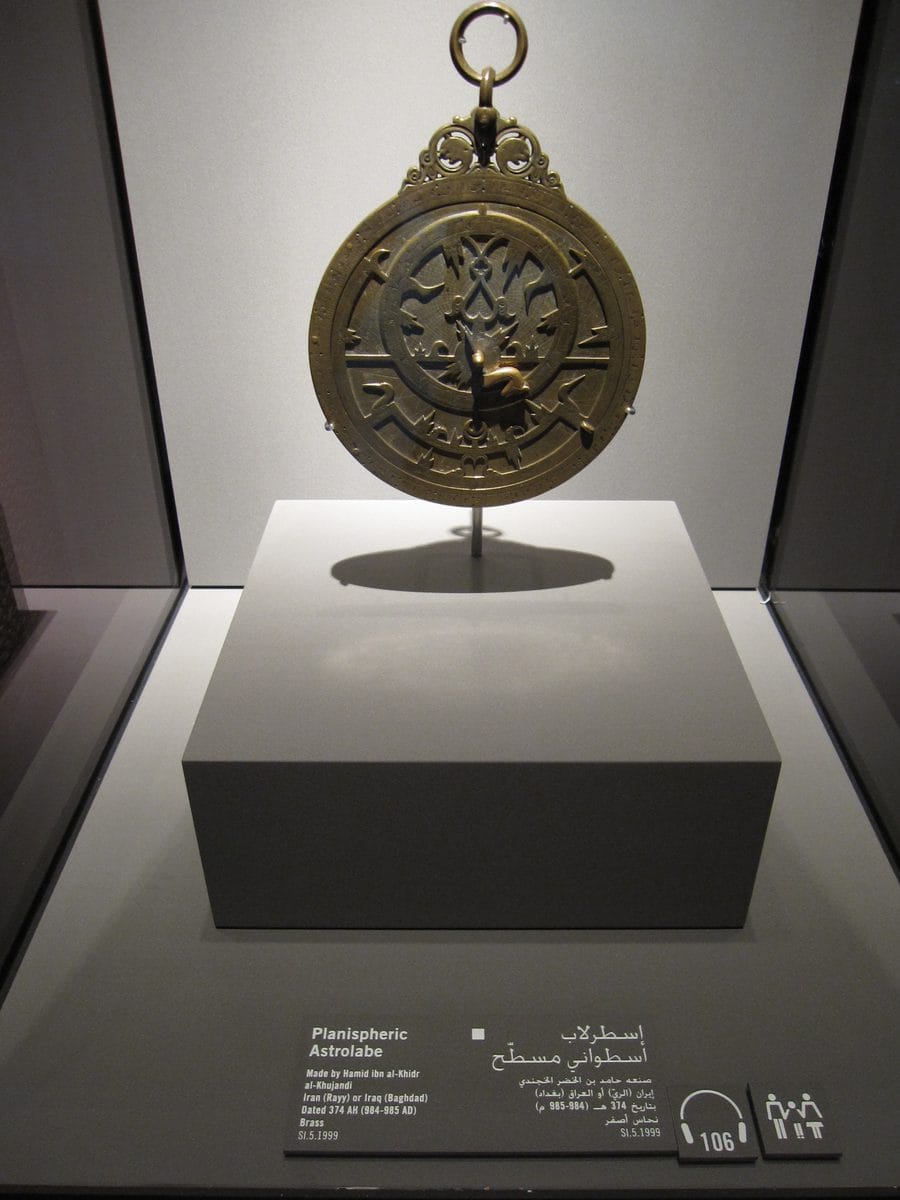
The astrolabe was, in essence, an analog computer for the celestial sphere — and its descendants are everywhere in astrophotography: the GoTo mount that slews to a target, the planetarium app that renders the sky for any time and place, the pointing model that corrects for your latitude. All do digitally what the astrolabe did in brass.
7. Practical Astronomy — the Nilometer
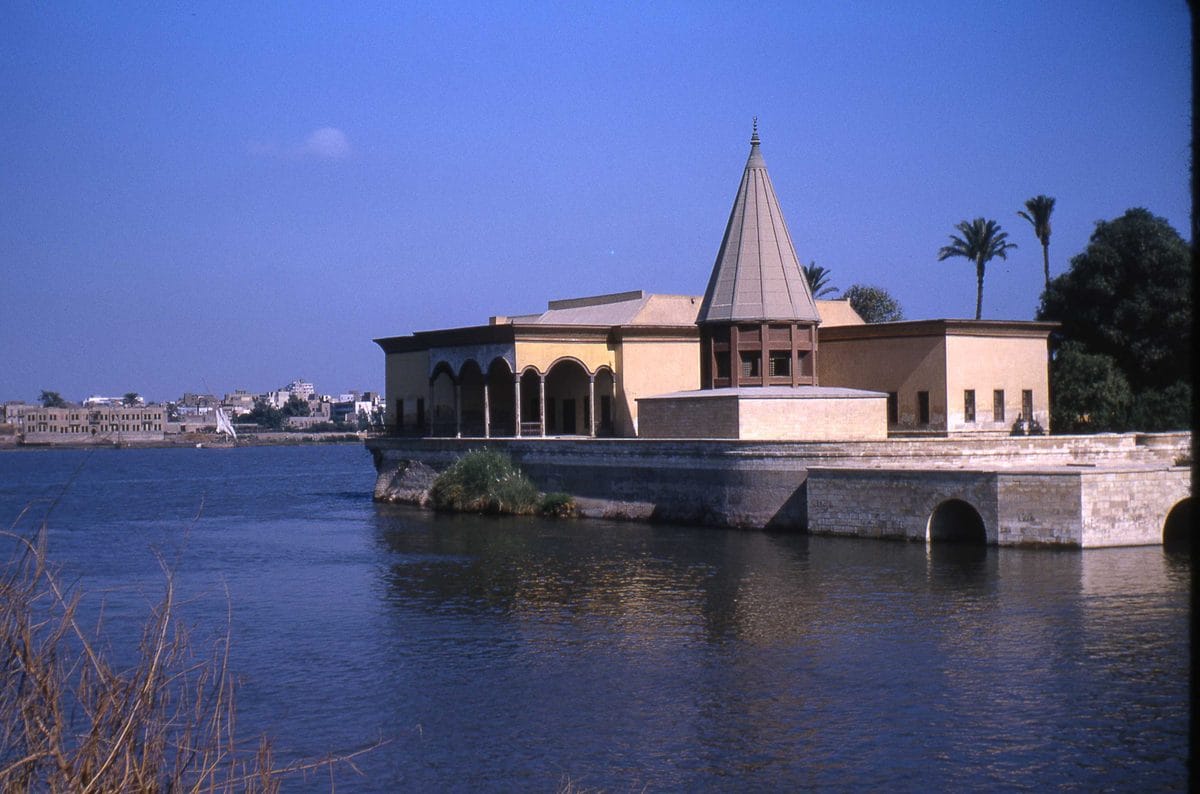
Al-Farghani was no armchair theorist. Around 861 CE, in Egypt, he supervised construction of the New Nilometer on Roda Island in Cairo — a graduated column for gauging the Nile's flood, on which the entire agricultural year (and the state's tax revenue) depended. Historical sources also recall a humbling moment: tasked with a canal project, he reportedly miscut the slope at its head — a reminder that even the era's great minds worked at the ragged edge of their tools. Any astrophotographer who has fought a misaligned mount will recognize the feeling.
How Accurate Was Al-Farghani's Astronomy?
Strikingly accurate for a scientist working a millennium before the telescope. Checked against modern values, his headline numbers hold up:
- Tilt of Earth's axis (obliquity): al-Farghani reported about 23°35′. For his epoch that was essentially spot-on — Earth's tilt drifts slowly over millennia, and in the 9th century it really was close to 23°35′, while the older figure of 23°51′ inherited from Ptolemy was clearly too large.
- Length of one degree of latitude: the al-Ma'mun survey he reported gave 56 2/3 Arabic miles — about 111.8 km. The modern mean value is 111.3 km, an error of less than half a percent, which implies an Earth circumference within a few hundred kilometers of the true 40,008 km.
- Precession of the equinoxes: he affirmed that the whole starry sphere drifts slowly against the calendar — the same precession that epoch-J2000 star charts and GoTo alignment models still correct for today. His colleague al-Battani soon measured its rate with even greater precision.
The direct answer: al-Farghani's numbers were among the best available anywhere in the world in the 9th century — and, just as important, he published them in a form everyone could actually use.
How Did Al-Farghani Influence Later Scientists?
- Medieval Europe learned its astronomy from him. His Compendium underpinned Johannes de Sacrobosco's De sphaera — the next great textbook — and was studied by Regiomontanus and generations of university scholars.
- Dante Alighieri drew on al-Farghani — “Alfragano” — for the astronomical scaffolding of his Convivio and Divine Comedy.
- Christopher Columbus carried al-Farghani's Earth measurement (and its fateful unit error) into the Age of Exploration.
- Johannes Kepler and later astronomers inherited the clarified Ptolemaic framework that al-Farghani did so much to transmit and preserve.
In a real sense, al-Farghani is part of why the Scientific Revolution had a foundation to build on at all.
Al-Farghani's Legacy in the Modern Sky — Then and Now
| Al-Farghani's Era | Modern Equivalent |
|---|---|
| The Compendium — a clear summary of the cosmos | Planetarium apps & astronomy field guides |
| Tables of planetary sizes and distances | Ephemeris databases and orrery simulators |
| The astrolabe — modeling the rotating sky | GoTo mounts and plate-solving software |
| A degree of latitude measured on the ground | GPS and satellite geodesy |
| Teaching astronomy in plain language | Open tutorials, forums, and tools that make the hobby accessible |
The instruments changed; the mission — making the sky knowable and shareable — did not.
How Did Al-Farghani Improve on Ptolemy?
The common assumption is that Golden Age astronomers merely copied the Greeks. Al-Farghani's work shows how wrong that is. He updated the obliquity of the ecliptic to a better value; he recomputed and clarified the dimensions of the cosmos; and — crucially — he made Ptolemy's near-impenetrable system teachable. That is itself a scientific contribution: knowledge that cannot be transmitted is knowledge that dies. By organizing the Almagest so clearly, he exposed it to the scrutiny and refinement of everyone who came after.
Why Is Al-Farghani Important to Modern Astronomy?
His importance is structural rather than headline-grabbing. Every time an astrophotographer relies on a clean coordinate system to find a target, consults a chart of where the planets sit tonight, or trusts software to translate the sky into something a telescope can point at, they are standing on the framework al-Farghani helped standardize and spread.
His deeper legacy is the idea that science advances not only through new measurements but through the clear communication of them. The astrophotography community runs on exactly that principle — shared tutorials, documented workflows, open tools that turn an intimidating hobby into an accessible one. Al-Farghani was doing it for the cosmos eleven centuries ago.
Death and Legacy
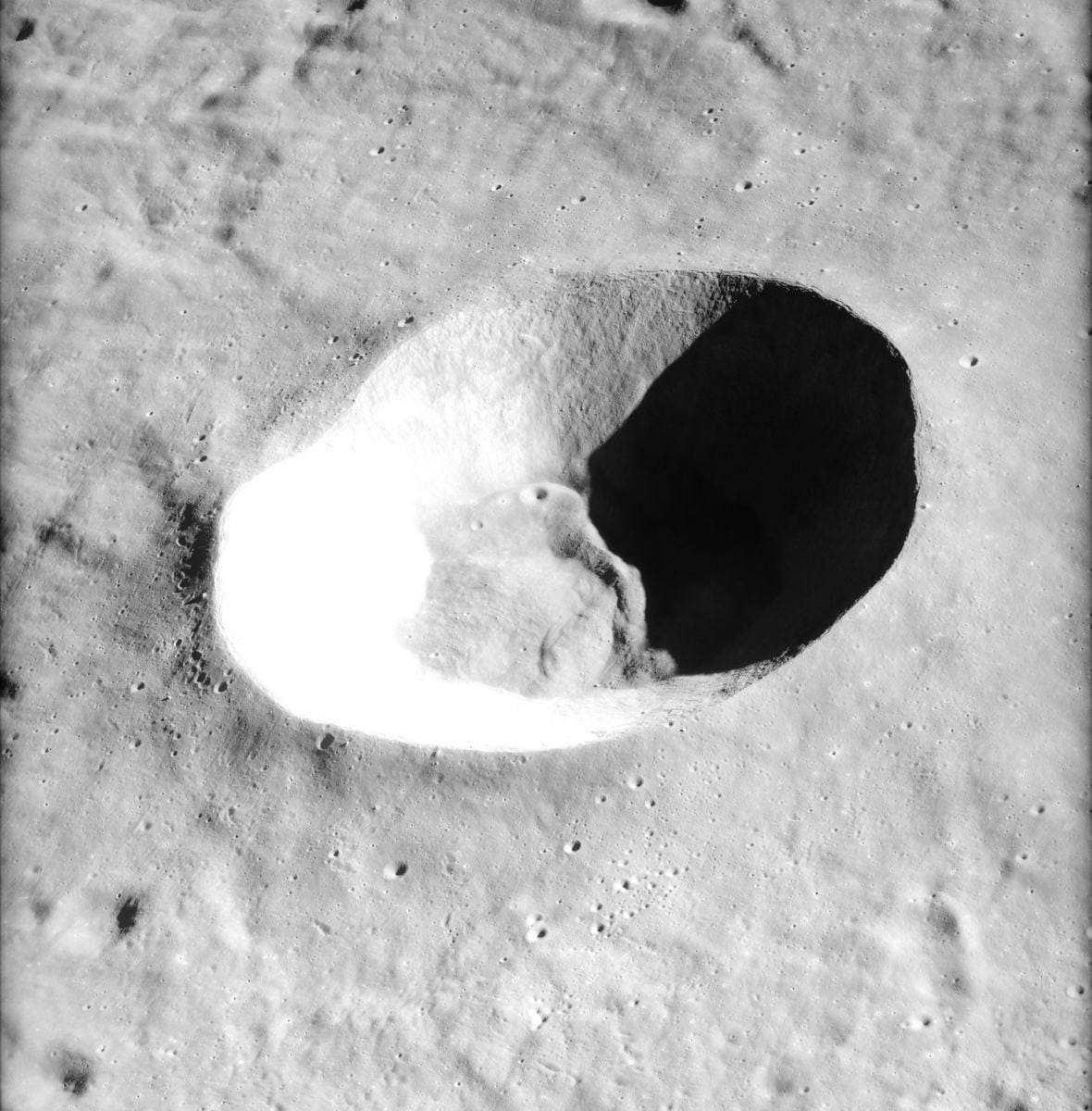
Al-Farghani died after 861 CE, likely in Egypt, having served the Abbasid court across Baghdad, Samarra, and Cairo. His Compendium long outlived him — copied, translated, printed, and taught across three continents for the better part of a millennium. His name endures in the sky itself: the lunar crater Alfraganus, about 20 km wide in the highlands southwest of the Sea of Tranquility, honors a man who spent his life mapping the heavens for everyone else to follow.
His memory has only grown in the modern era. In 1998, on the 1,200th anniversary of his birth, Uzbekistan celebrated al-Farghani as a national scientific hero, and monuments in his honor stand in Fergana and in Quva — the town some medieval sources name as his birthplace — while a statue presented by Uzbekistan stands in Cairo, the city where his Nilometer still survives.
Common Misconceptions
Misconception: He was just a copyist of Ptolemy. He was a synthesizer and corrector — he updated Ptolemy's values and reorganized the whole science into a teachable form, something Ptolemy's own work never achieved.
Misconception: His Earth measurement was wrong and misled Columbus, so it failed. The measurement was good; Columbus's error came from misreading the units. Al-Farghani's figure was among the most accurate of its age.
Misconception: His work has no link to modern astronomy. His clarified celestial framework, his cosmic dimensions, and his astrolabe theory are direct ancestors of the coordinate systems, ephemerides, and pointing software used in astronomy and astrophotography today.
Frequently Asked Questions
Who was Al-Farghani?
Al-Farghani, Latinized as Alfraganus, was a 9th-century astronomer of the Islamic Golden Age, born in the Farghana valley of present-day Uzbekistan. Working in Abbasid Baghdad, he wrote the Elements of Astronomy, the standard astronomy textbook of the Islamic world and medieval Europe for roughly 700 years.
What is Al-Farghani's most famous work?
His Compendium of the Science of the Stars, known in Latin as the Elements of Astronomy. Its thirty concise chapters summarized Ptolemy's Almagest without the heavy mathematics, which made it the most widely taught astronomy textbook of the Middle Ages.
Why is Al-Farghani also called Alfraganus?
Alfraganus is the Latinized form of his name, adopted in Europe after his Compendium was translated into Latin twice in the 12th century, by John of Seville in 1137 and by Gerard of Cremona.
When and where was Al-Farghani born?
He was born in the late 8th or early 9th century in Farghana, a fertile valley in present-day eastern Uzbekistan. He worked in Baghdad, Samarra and Cairo, and died after 861 CE, most likely in Egypt.
What did Al-Farghani contribute to astronomy?
He wrote the most influential astronomy textbook of the Middle Ages, improved Ptolemy's value for the tilt of Earth's axis, published a widely used table of planetary sizes and distances, explained the theory of the astrolabe, and supervised the Nilometer built at Cairo in 861 CE.
Did Columbus really use Al-Farghani's work?
Yes. Columbus relied on al-Farghani's value for the length of a degree of latitude but mistook the longer Arabic miles for shorter Roman ones. That error made the Earth seem far smaller than it is and convinced him that Asia lay within sailing distance to the west.
Is there a lunar crater named after Al-Farghani?
Yes. The crater Alfraganus, about 20 kilometers wide, lies in the lunar highlands southwest of the Sea of Tranquility and was photographed up close by Apollo 16.
How is Al-Farghani different from Al-Battani?
Both were astronomers of the Islamic Golden Age, but al-Battani was the meticulous observer who sharpened the measurements, while al-Farghani was the master synthesizer and teacher whose clear Compendium carried Greek astronomy into medieval Europe.
Keep Exploring
Al-Farghani's story is one thread in a much larger tapestry. He stands alongside the 30 most famous astronomers in history; his Golden Age colleague Al-Battani sharpened the measurements he popularized; Nicolaus Copernicus rebuilt the Ptolemaic cosmos al-Farghani transmitted; and Kepler finally replaced its perfect circles with true ellipses.
For deeper source material, the Wikipedia article on al-Farghani is an excellent starting point.



%3A%20The%20Astronomer%20Who%20Taught%20Europe%20the%20Sky%20(2026)&body=Al-Farghani%20(Alfraganus)%3A%20The%20Astronomer%20Who%20Taught%20Europe%20the%20Sky%20(2026)%20%E2%80%94%20Discover%20Al-Farghani%20(Alfraganus)%2C%20the%209th-century%20astronomer%20whose%20compendium%20of%20the%20stars%20refined%20Ptolemy%20and%20carried%20Greek%20astronomy%20into%20medieval%20Europe.%20https%3A%2F%2Fstellarnomads.com%2Fal-farghani-also-known-in-the-west-as-alfraganus%2F%20Image%3A%20https%3A%2F%2Fstorage.ghost.io%2Fc%2Fbf%2F0d%2Fbf0d5d59-0433-4995-b3fa-4f41b743ef1b%2Fcontent%2Fimages%2F2026%2F07%2Fal-farghani-hero.jpg)