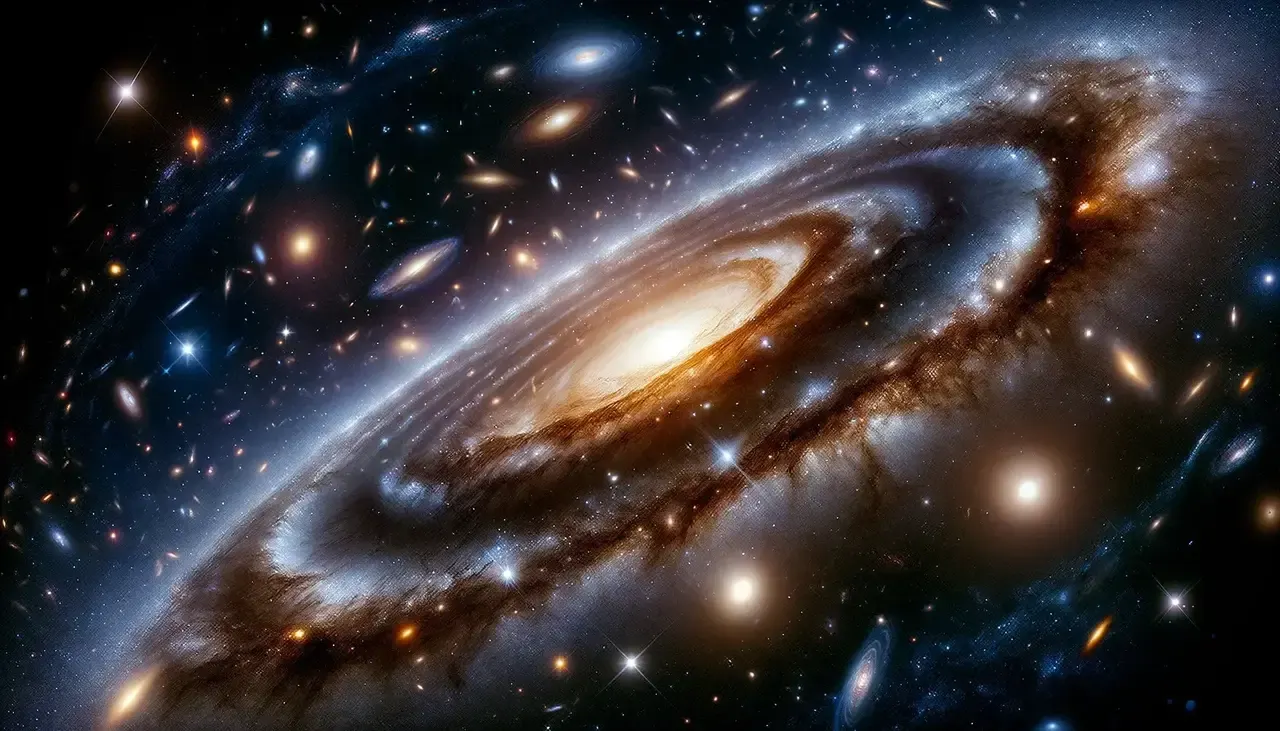
Quick answer: Dark matter is invisible material that makes up about 27 percent of the universe — more than five times all ordinary matter combined. It emits no light, but its gravity holds galaxies together, bends light around clusters, and shaped the cosmic structures we see today. What it is actually made of remains one of the biggest unsolved problems in physics.
Ask what is dark matter, and the honest answer is: the most abundant material in the universe — and we still do not know what it is. We only know it must exist, because without it, galaxies would fly apart, light would not bend the way it does, and the universe's large-scale structure could never have formed. This guide walks through the evidence, the suspects, the searches, and where the hunt stands in 2026.
What Is Dark Matter?
Dark matter is matter that neither emits, absorbs nor reflects light — it interacts with the rest of the universe, as far as we can tell, only through gravity. According to measurements of the cosmic microwave background by the Planck satellite, the universe's energy budget breaks down roughly as: 68 percent dark energy, 27 percent dark matter, and just 5 percent ordinary matter — the atoms that make up stars, planets and us.
In other words: everything astronomy has ever photographed — every star, nebula and galaxy — is a thin luminous frosting on a cake made of something else entirely.
The name can mislead, so be precise about what it is not: dark matter is not antimatter (which annihilates in flashes we would easily detect), it is not ordinary black holes (which betray themselves gravitationally), and it is not merely dim gas (which absorbs starlight and glows in the infrared). It is something that, as far as five decades of observations can tell, does exactly one thing: gravitate.
How Do We Know Dark Matter Exists?
The direct answer: four independent lines of evidence all point to the same invisible mass.
- Galaxy clusters move too fast. In 1933, Fritz Zwicky measured galaxies whipping around the Coma Cluster far too quickly for the visible matter to hold them — and coined the term dunkle Materie, dark matter.
- Galaxies spin too fast. In the 1970s, Vera Rubin showed that stars at the edges of spiral galaxies orbit as fast as those near the center. Visible matter cannot explain those flat rotation curves; a vast halo of unseen mass around every galaxy can.
- Light bends around invisible mass. Massive objects warp spacetime and act as gravitational lenses. Clusters routinely bend background light far more than their visible matter allows — and lensing maps reveal where the hidden mass actually sits.
- The Big Bang's afterglow requires it. The pattern of ripples in the cosmic microwave background — the relic radiation predicted by George Gamow — can only be reproduced in models where dark matter outweighs ordinary matter about five to one.
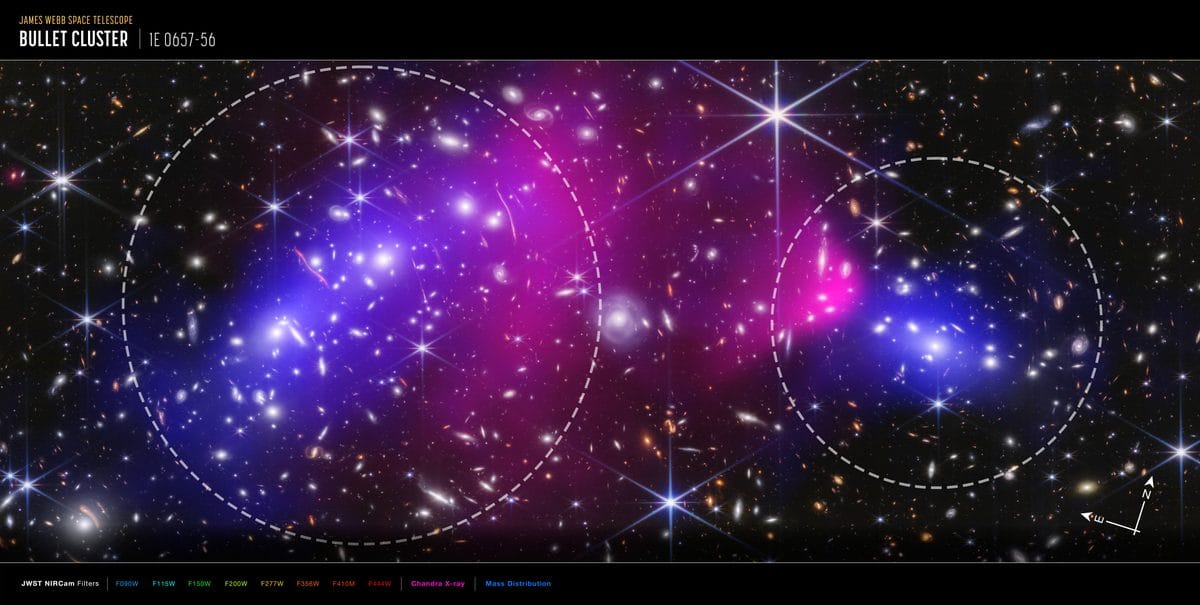
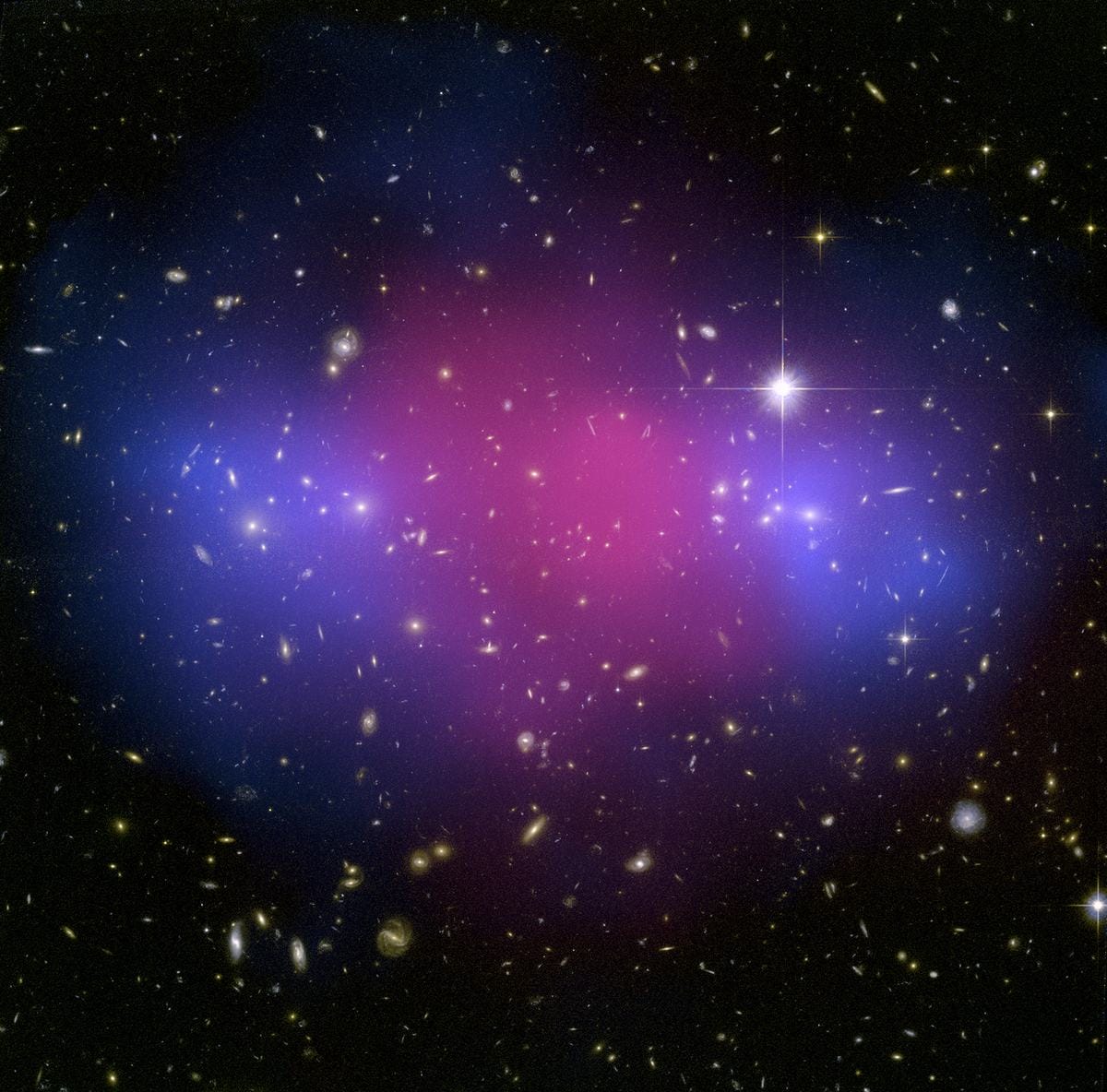
The Bullet Cluster above is the showpiece: two galaxy clusters collided, the hot gas (most of the ordinary matter) slammed together and lagged behind, while the mass revealed by gravitational lensing sailed straight through. Whatever carries that mass barely interacts with anything — exactly how dark matter should behave.
What Dark Matter Is Not
Decades of searching have crossed the mundane suspects off the list:
- Not hidden ordinary matter. Faint stars, cold gas and rogue planets would still betray themselves at some wavelength — and the CMB independently caps how much ordinary matter can exist.
- Not mostly black holes or dead stars. Microlensing surveys watched millions of stars for the telltale brightening such compact objects would cause; they found far too few events.
- Not ordinary neutrinos. They are too light and too fast — a neutrino-dominated universe would have smeared out the fine structure we observe.
- Probably not a flaw in gravity. Modified-gravity theories can mimic rotation curves, but they struggle badly with the Bullet Cluster and the CMB, where mass and gas visibly separate.
What Could Dark Matter Be Made Of?
The leading candidates are all new particles beyond the Standard Model:
- WIMPs (weakly interacting massive particles) — heavy particles that interact only via gravity and the weak force. The classic favorite, now squeezed hard by ever-more-sensitive detectors.
- Axions — extremely light particles first proposed to fix a puzzle in particle physics; they could pervade the galaxy as a subtle field.
- Sterile neutrinos — heavier cousins of ordinary neutrinos that ignore every force but gravity.
- Primordial black holes — black holes born in the first instants of the Big Bang; mostly ruled out, but a few mass windows remain open.
The Hunt: How Scientists Search for Dark Matter
The search runs on three fronts. Direct detection: ultra-quiet detectors deep underground — like LUX-ZEPLIN in South Dakota and XENONnT in Italy — wait for a dark matter particle to nudge an atomic nucleus. Production: the Large Hadron Collider at CERN tries to create dark matter particles in collisions and spot the energy they carry away. Indirect detection: gamma-ray and cosmic-ray observatories look for the debris of dark matter particles annihilating in space.
So far, every result is a null result — but each one shrinks the territory where the particle can hide, which is genuine progress. Physics has hunted invisible particles before: the neutrino took 26 years from prediction to detection.
There is even a finish line of sorts: the neutrino fog, the sensitivity at which detectors begin registering ordinary neutrinos from the Sun and sky. The next generation of experiments will reach it — and will either finally catch a WIMP on the way down, or force the field to reinvent its favorite suspect.
A Short History of the Dark Matter Problem
- 1933: Fritz Zwicky finds the Coma Cluster's galaxies moving impossibly fast and coins dunkle Materie. The result is largely ignored for forty years.
- 1970s: Vera Rubin and Kent Ford publish flat rotation curves for dozens of spiral galaxies; by the decade's end the astronomical establishment concedes the unseen mass must be real.
- 1980s: Cold dark matter becomes the backbone of cosmology — computer simulations seeded with it reproduce the observed cosmic web of galaxies.
- 1998–2006: Gravitational lensing matures into a precision mapping tool, culminating in the Bullet Cluster result that visibly separates dark mass from ordinary gas.
- 2013: The Planck satellite pins down the cosmic recipe: 26.8 percent dark matter, 4.9 percent ordinary matter, the rest dark energy.
- 2021–2025: The largest WIMP detectors report null results at unprecedented sensitivity, pushing theorists toward lighter candidates like axions — while JWST's surprisingly mature early galaxies sharpen questions about how dark matter builds structure.
- Today: Euclid and the Rubin Observatory begin charting dark matter across cosmic history, turning a missing-mass mystery into a precision map.
Dark Matter vs Dark Energy
| Dark matter | Dark energy | |
|---|---|---|
| Share of the universe | ~27% | ~68% |
| What it does | Pulls — holds galaxies and clusters together | Pushes — accelerates the expansion of the universe |
| Where it clumps | In halos around galaxies and clusters | Spread perfectly evenly, everywhere |
| Evidence | Rotation curves, lensing, CMB, clusters | Distant supernovae, CMB, large-scale structure |
They share a word, but they are opposite characters in the cosmic story: dark matter builds structure; dark energy drives it apart.
Why Dark Matter Matters
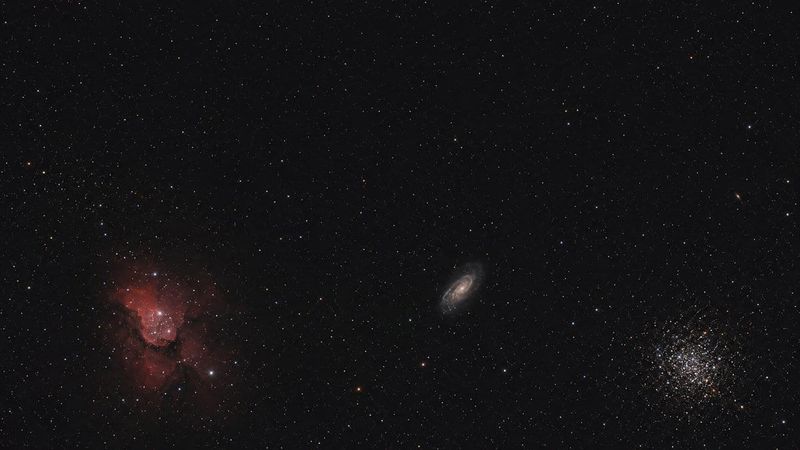
Without dark matter, we would not be here. In the young universe, ordinary matter was locked in a tug-of-war with radiation and could not clump. Dark matter, immune to radiation pressure, began collapsing first — building the gravitational scaffolding into which gas later fell to form galaxies, stars and eventually planets. Every galaxy you can photograph, including the Whirlpool Galaxy, sits inside a dark halo several times its visible size.
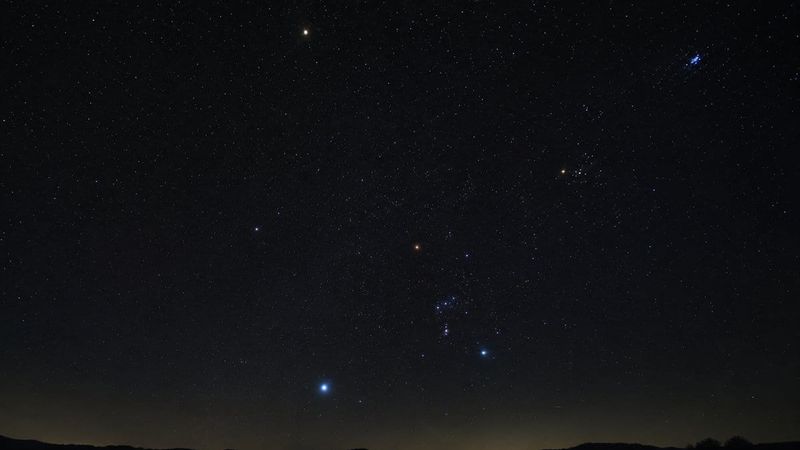
That includes home. The Milky Way's disk of stars is embedded in a dark halo estimated at roughly a trillion solar masses, and dark matter is streaming through the room you are sitting in right now — the local density works out to about one proton's worth of mass in every few cubic centimeters of space. It is far too thin to feel, yet summed over the galaxy it outweighs every star in the sky. When you photograph the Milky Way arching over a landscape, most of what you are inside of is invisible.
The Search in 2026: Euclid and Rubin
Two new machines make this a genuinely exciting moment. ESA's Euclid space telescope, launched in 2023, is mapping the shapes of billions of galaxies to chart dark matter across a third of the sky through gravitational lensing — its first survey data releases have already produced the largest 3D maps of the dark universe ever made. And in Chile, the Vera C. Rubin Observatory — named for the astronomer who made dark matter undeniable — began its ten-year Legacy Survey of Space and Time in 2025, photographing the entire southern sky every few nights. Between them, the 2020s will map dark matter's distribution more precisely than every previous decade combined — and any crack between the maps and theory could finally reveal what the universe is mostly made of.
For anyone who photographs the night sky, there is something quietly poetic in all this: every long exposure of a galaxy is also a portrait of dark matter at work, holding that spiral together frame after frame.
Frequently Asked Questions
What is dark matter in simple terms?
Dark matter is invisible material that outweighs ordinary matter about five to one. It gives off no light at all, but its gravity holds galaxies together and bends light around galaxy clusters. We can map where it is, but we do not yet know what it is.
What is dark matter made of?
Nobody knows yet. The leading candidates are undiscovered particles such as WIMPs, axions or sterile neutrinos. Ordinary explanations like faint stars, gas, black holes and normal neutrinos have been effectively ruled out by observations.
What is the difference between dark matter and dark energy?
Dark matter pulls: its gravity binds galaxies and clusters together and makes up about 27 percent of the universe. Dark energy pushes: it drives the accelerating expansion of the universe and makes up about 68 percent. Ordinary matter is just 5 percent.
Who discovered dark matter?
Fritz Zwicky found the first evidence in 1933, when galaxies in the Coma Cluster moved far too fast for their visible mass. In the 1970s Vera Rubin made the case overwhelming by showing that spiral galaxies rotate as if embedded in huge halos of unseen matter.
Can we see dark matter?
Not directly, at any wavelength. But astronomers map it through gravitational lensing, the way its mass bends light from background galaxies. Missions like Euclid are using this effect to chart dark matter across billions of light-years.
How much of the universe is dark matter?
About 27 percent of the total energy content of the universe, based on measurements of the cosmic microwave background. Dark energy accounts for roughly 68 percent, and everything we can see, all ordinary matter, is only about 5 percent.
Is dark matter just black holes?
Almost certainly not. Surveys that watch for the gravitational lensing black holes would cause have found far too few events for them to account for the required mass, although primordial black holes in a few specific mass ranges are not fully excluded.
Why is it called dark matter?
Because it neither emits nor absorbs light, it is dark in the most literal sense. Fritz Zwicky coined the term dunkle Materie, German for dark matter, in 1933 to describe the unseen mass his cluster measurements demanded.
Keep Exploring
Dark matter's story is inseparable from the people who found it: read how Vera Rubin proved it with spinning galaxies and how Fritz Zwicky saw it first in 1933 — then see the cosmic background radiation story through George Gamow, whose predicted afterglow now provides some of dark matter's strongest evidence.


&body=What%20Is%20Dark%20Matter%3F%20The%20Universe's%20Missing%2027%25%2C%20Explained%20(2026)%20%E2%80%94%20Explore%20the%20enigma%20of%20dark%20matter%20in%20this%20insightful%20essay%3A%20its%20discovery%2C%20role%20in%20cosmic%20structure%2C%20and%20the%20quest%20to%20unravel%20its%20mysteries%20https%3A%2F%2Fstellarnomads.com%2Fdark-matter%2F%20Image%3A%20https%3A%2F%2Fstorage.ghost.io%2Fc%2Fbf%2F0d%2Fbf0d5d59-0433-4995-b3fa-4f41b743ef1b%2Fcontent%2Fimages%2F2026%2F07%2Fdark-matter-1-1.webp)