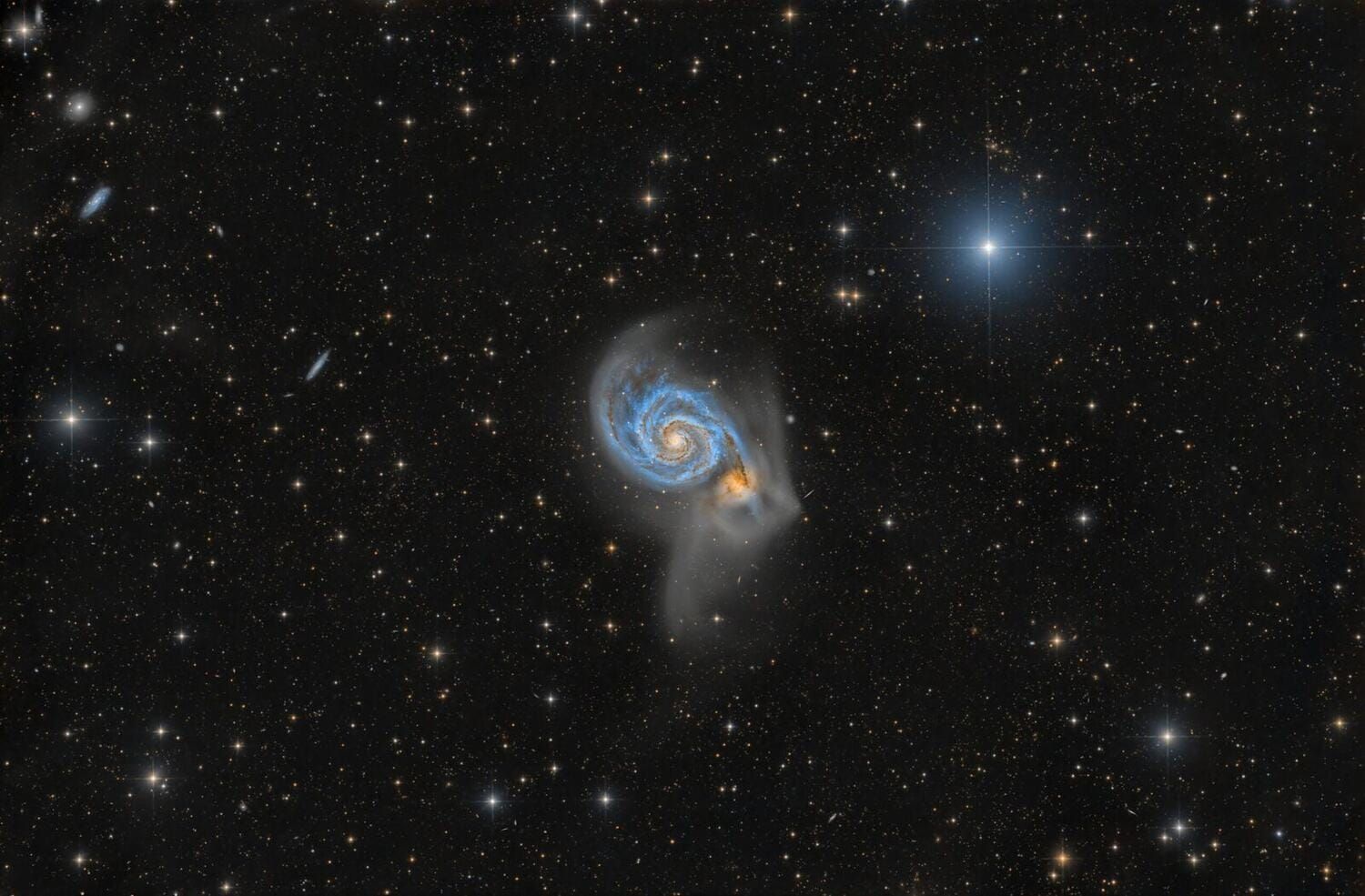
Quick answer: The Whirlpool Galaxy (Messier 51) is a grand-design spiral galaxy 23–31 million light-years away in Canes Venatici, locked in a gravitational embrace with its companion galaxy NGC 5195. At magnitude 8.4 it is one of the easiest spiral galaxies to find, observe and photograph — and one of the most beautiful.
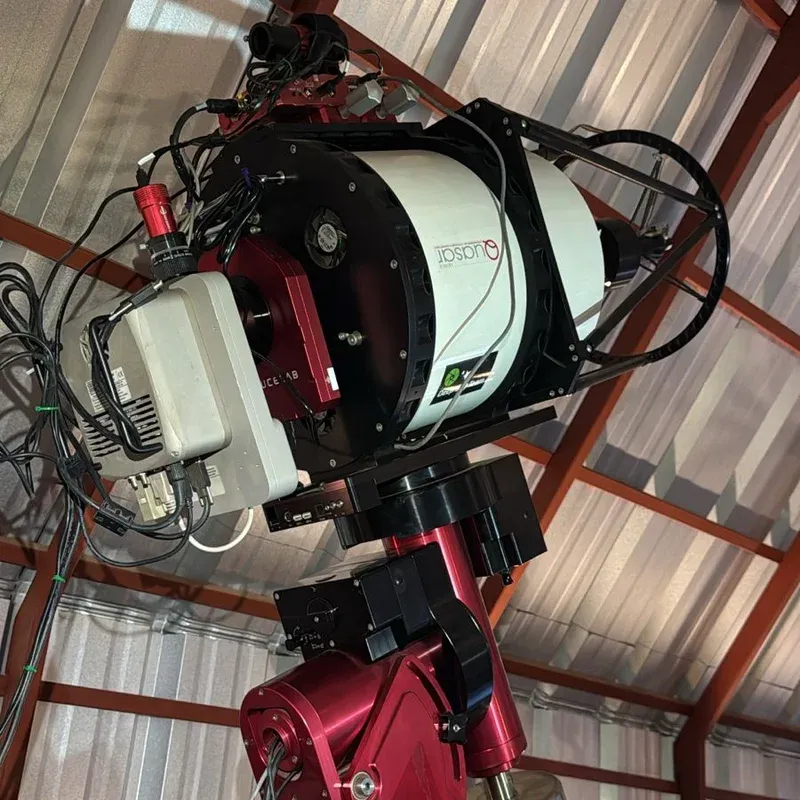
The Whirlpool Galaxy is the spiral galaxy every astrophotographer eventually points a telescope at — the first galaxy whose spiral structure was ever seen, a laboratory for how galaxies collide and grow, and a spring-sky showpiece sitting conveniently close to the Big Dipper's handle. This guide covers what Messier 51 is, how to find it, and how to capture it yourself — including the exact rig used for the image below.
What Is the Whirlpool Galaxy?
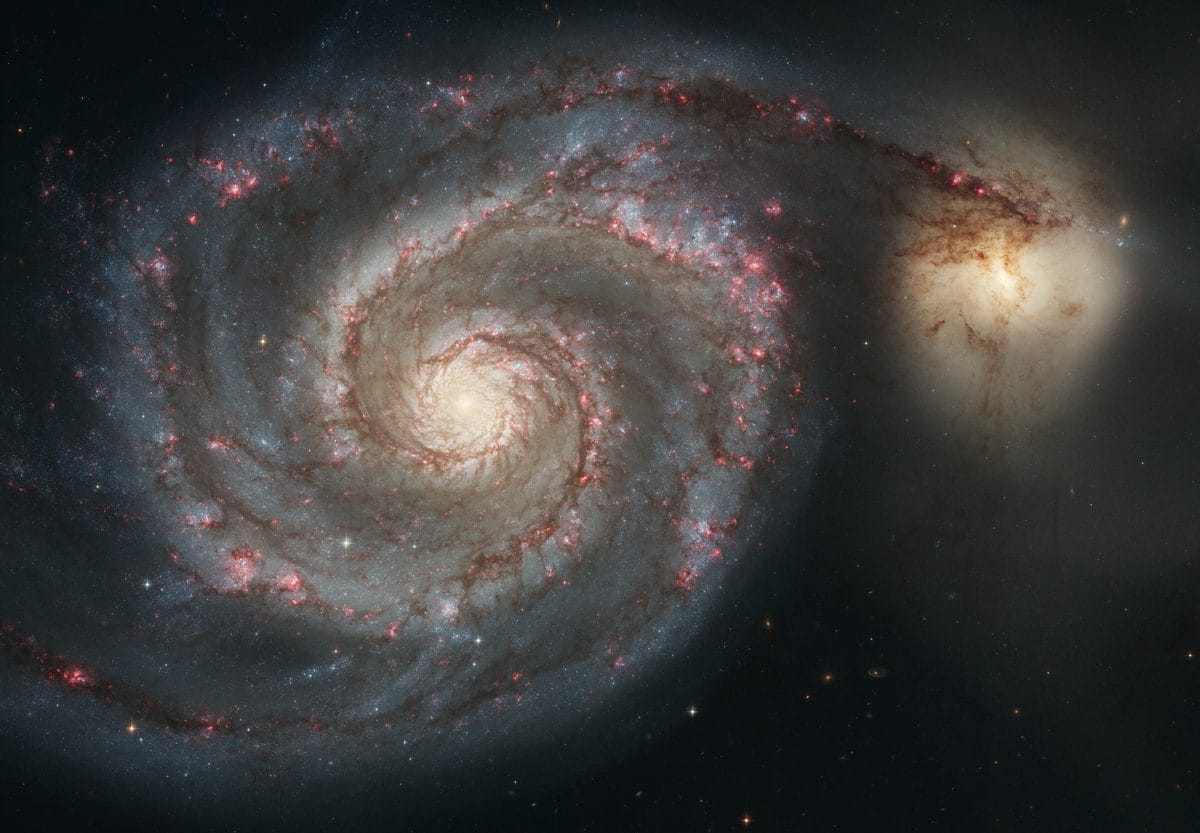
The Whirlpool Galaxy — catalogued as Messier 51 or NGC 5194 — is a classic grand-design spiral: two dominant, beautifully coherent arms wound around a bright core, traced out by lanes of dark dust and chains of pink star-forming regions. It is the archetype astronomers reach for when they want to show what a spiral galaxy is, and its face-on orientation gives us a perfect top-down view that our own edge-on vantage inside the Milky Way's Messier catalog objects can never offer.
Where Is Messier 51? How to Find It
The direct answer: M51 sits in the small constellation Canes Venatici, about 3.5 degrees southwest of Alkaid, the end star of the Big Dipper's handle. That makes it one of the easiest galaxies in the sky to locate: find the handle, hop off its last star, and you are there.
At magnitude 8.4 it is within reach of binoculars from a dark site, and it rides high overhead on spring evenings in the northern hemisphere — March through June is prime Whirlpool season, when it crosses near the zenith and you look through the least possible atmosphere.
Bonus for northern observers: above roughly 45 degrees latitude M51 is circumpolar — it never sets — though it only rewards attention when it rides high.
The classic star-hop: start at Alkaid, slide about two degrees toward 24 Canum Venaticorum (an easy 5th-magnitude star), then continue the same line another two degrees — M51 drifts into a low-power eyepiece as a pair of soft glows. From a dark site you can even land on it directly by sweeping a diagonal from Alkaid toward Cor Caroli.
Discovery: Messier, Lord Rosse and the First Spiral
Messier 51 was discovered on October 13, 1773, by Charles Messier, who logged it as one more of the fuzzy nebulae his comet-hunting catalog was built to flag. The revelation came in 1845, when William Parsons, third Earl of Rosse, turned his 72-inch Leviathan of Parsonstown — then the largest telescope on Earth — toward it and sketched something no one had ever seen: a spiral. M51 became the first object in history recognized as having spiral structure, decades before anyone knew such spirals were separate galaxies at all. When Edwin Hubble finally proved the spiral nebulae were island universes of their own, the Whirlpool had been pointing at the answer for eighty years.
A Galaxy Being Reshaped: NGC 5195
M51's defining feature is its companion. The small yellowish galaxy NGC 5195 is not passing politely by — it has been interacting with the Whirlpool for a few hundred million years, having punched through its disk and swung behind it (as radio mapping shows). That gravitational encounter is widely credited with driving the Whirlpool's unusually crisp spiral pattern: tidal forces compress gas along the arms, triggering waves of star formation that light the arms up like a neon sign.
The pair is a textbook example of how galaxy interactions shape structure and feed growth — a slow-motion preview, on a small scale, of the mergers that build giant galaxies over cosmic time.
Simulations of the pair suggest NGC 5195 has made at least two close passes — very roughly half a billion and one hundred million years ago — and each swing rang the Whirlpool like a bell, launching the density waves that keep its arms so sharply defined and its star factories running hot.
Size, Distance and Structure
The Whirlpool spans roughly 60,000 light-years — noticeably smaller than the Milky Way — and contains on the order of 100 billion stars. Its distance is surprisingly hard to pin down: published measurements range from about 23 to 31 million light-years, with several recent studies favoring the higher end. Its spiral arms are stuffed with young blue star clusters and pink HII regions, the ionized-hydrogen nurseries where new stars are switching on — the same physics described in our guide to what a nebula is.
Supernovae, a Black Hole and a Possible Exoplanet
All that star formation has consequences: massive stars live fast and die violently, and M51 has hosted three supernovae in under twenty years — SN 1994I, SN 2005cs and SN 2011dh — making it one of the most supernova-productive nearby galaxies and a favorite target for patrol imaging.
At its heart sits a supermassive black hole, mildly active and studied across X-ray and radio wavelengths. And in 2021, M51 made headlines of a different kind: astronomers using Chandra reported M51-ULS-1b, a candidate planet transiting an X-ray binary — potentially the first planet candidate ever detected in another galaxy. Confirmation may take decades (the next transit is far in the future), but the Whirlpool keeps finding ways to be first.
How to Observe the Whirlpool Galaxy
The direct answer: under dark skies, almost any telescope shows M51 — but aperture and sky darkness decide how much.
- Binoculars (dark site): a soft double glow — the two galactic cores side by side.
- 4–6 inch telescope: both cores clearly, wrapped in a shared haze; hints of mottling on the best nights.
- 8–12 inch telescope, dark skies: the payoff — the spiral arms themselves emerge with averted vision, one of the few galaxies where amateurs can genuinely see spiral structure.
Light pollution flattens M51 quickly, so this is a target worth driving for. Spring, high in the northeast after dark, moonless week — that is the recipe.
Two field techniques make a real difference: use averted vision — look slightly to the side of the galaxy and the spiral structure blooms in your peripheral vision, which is far more sensitive to faint light — and give your eyes a full twenty minutes of dark adaptation first. Magnification around 80–120x on an 8-inch scope frames the pair best; pushing higher dims the arms without adding detail.
How to Photograph Messier 51
M51 is small — about 11 by 7 arcminutes for the bright pair — so it rewards focal length. Around 1,000mm and up frames the interacting pair beautifully; check exactly how it fits your sensor with our telescope field-of-view calculator. At those focal lengths your pixel scale and autoguiding quality become the difference between crisp arms and mush — guide well, and let integration time do the rest. Aim for several hours of luminance to pull out the faint tidal debris around NGC 5195, and add RGB (plus a touch of H-alpha for the star-forming regions if you shoot mono).
A starting recipe from a dark site: three-to-five-minute guided subs at unity gain and at least four to six hours of total integration. The bright arms come quickly; the faint tidal debris is what the extra hours buy.
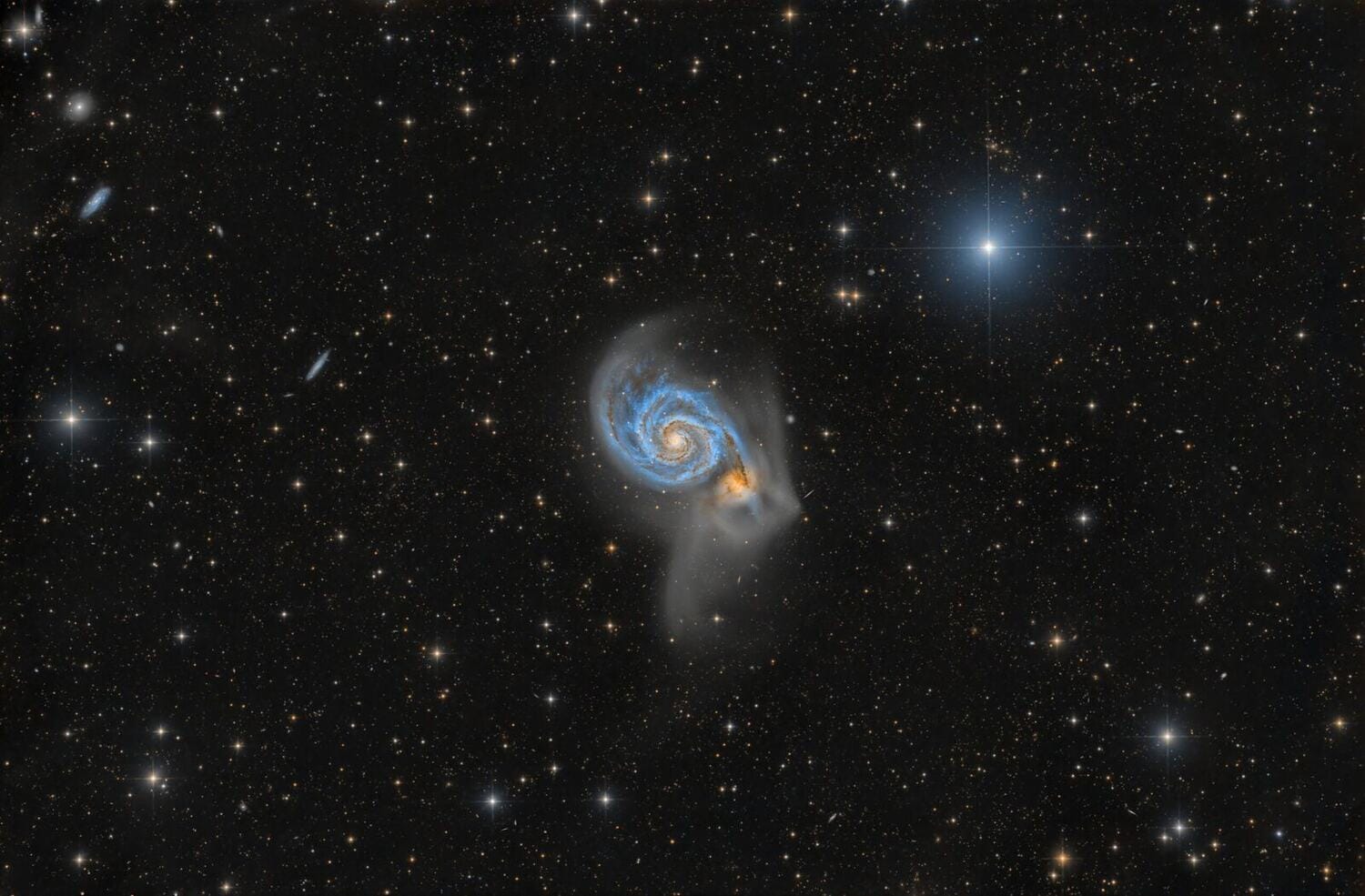
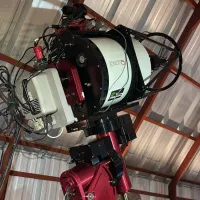
Image capture details for the photo above:
Observer: The Author
Location: Deming, NM private remote observatory
Mount: Paramount ME
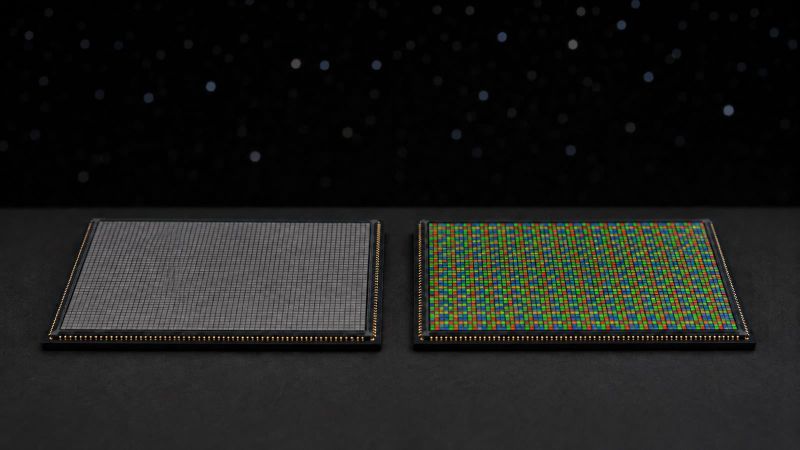
Camera: QHY600M Photo mode — Gain 26, Offset 30
Filters: 2in Astrodon I-series LRGB
Capture software: Voyager
Processing software: PixInsight
Processing notes from our own data: M51 rewards restraint. Keep the core from clipping — it is far brighter than the arms — let deconvolution sharpen only the well-sampled inner spiral, and stretch gently enough to preserve the faint tidal plume north of NGC 5195, which is the first casualty of aggressive curves. A dedicated H-alpha layer blended into red makes the star-forming knots pop without cartoon saturation.
The Whirlpool Through Different Eyes
Because it is nearby, face-on and busy, M51 is a calibration favorite for nearly every great observatory — and each wavelength tells a different story:
- Visible light (Hubble): the classic view — spiral arms, dust lanes and hundreds of young star clusters resolved one by one.
- Infrared (Spitzer, JWST): the dust itself glows, exposing the skeleton of the spiral pattern; JWST's 2023 portrait of M51 is among its most detailed galaxy images.
- X-rays (Chandra): a swarm of neutron-star and black-hole binaries — including the system hosting the candidate exoplanet — plus bubbles of supernova-heated gas.
- Radio: magnetic fields traced along the arms, and the disturbed hydrogen bridge physically connecting M51 to NGC 5195 — the smoking gun of their interaction.
Messier 51 at a Glance
| Property | Value |
|---|---|
| Designations | Messier 51, NGC 5194, the Whirlpool Galaxy |
| Type | Grand-design spiral (SA(s)bc pec) |
| Constellation | Canes Venatici, 3.5° from Alkaid |
| Distance | ~23–31 million light-years |
| Diameter | ~60,000 light-years |
| Apparent magnitude | 8.4 |
| Apparent size | ~11 × 7 arcminutes |
| Companion | NGC 5195 |
| Best season | Northern-hemisphere spring |
| Discovered | Charles Messier, October 13, 1773 |
Frequently Asked Questions
What type of galaxy is the Whirlpool Galaxy?
Messier 51 is a grand-design spiral galaxy, meaning it has two prominent, well-organized spiral arms. It is interacting with the smaller companion galaxy NGC 5195, which is helping drive and sharpen its spiral pattern.
How far away is the Whirlpool Galaxy?
Published distances range from about 23 to 31 million light-years, with several recent measurements favoring the higher end of that range. Either way, the light you see tonight left the galaxy before humans existed.
Can you see the Whirlpool Galaxy with a telescope?
Yes. From a dark site, binoculars show a faint double glow, a 4 to 6 inch telescope shows both galaxy cores, and an 8 to 12 inch telescope under dark skies can reveal the spiral arms themselves, which is rare among galaxies for amateur equipment.
Why is it called the Whirlpool Galaxy?
Because of the striking whirlpool-like spiral pattern first seen by Lord Rosse in 1845 with his 72-inch telescope. Messier 51 was the first object ever recognized to have spiral structure.
What is the small galaxy next to M51?
NGC 5195, a dwarf companion galaxy that has been gravitationally interacting with the Whirlpool for a few hundred million years. It passed through the Whirlpool's disk and now sits slightly behind it as seen from Earth.
When is the best time to see Messier 51?
Spring evenings in the northern hemisphere, roughly March through June, when Canes Venatici rides high overhead near the Big Dipper's handle. A moonless night at a dark site makes an enormous difference.
How big is the Whirlpool Galaxy?
Roughly 60,000 light-years across, a bit more than half the diameter of the Milky Way, containing on the order of 100 billion stars. On the sky the bright pair spans about 11 by 7 arcminutes, about a third of the full Moon's width.
Does the Whirlpool Galaxy have planets?
In 2021 astronomers reported M51-ULS-1b, a candidate planet seen transiting an X-ray binary star system in M51. If confirmed, it would be the first planet ever detected outside the Milky Way, but verification will take a long time.
How many supernovae has the Whirlpool Galaxy had?
Three observed in under twenty years: SN 1994I, SN 2005cs and SN 2011dh. The high rate reflects the intense star formation triggered by the interaction with NGC 5195, and it makes M51 a favorite target for amateur supernova patrols.
Was M51 the first spiral galaxy ever seen?
Yes. In 1845 Lord Rosse's 72-inch reflector revealed its spiral shape, the first spiral structure recognized in any celestial object, decades before photography. His hand-drawn sketch matches modern images remarkably well.
Keep Exploring
The Whirlpool is one stop in a much bigger sky: browse the full Messier catalog it belongs to, read how Edwin Hubble proved the spiral nebulae were galaxies, and see why galaxies like M51 spin fast enough to demand dark matter. For the deep-space view, ESA's Hubble site hosts the full-resolution 2005 Whirlpool release.


%3A%20A%20Complete%20Guide%20(2026)&body=The%20Whirlpool%20Galaxy%20(Messier%2051)%3A%20A%20Complete%20Guide%20(2026)%20%E2%80%94%20The%20Whirlpool%20Galaxy%20(Messier%2051)%20is%20the%20sky%26%2339%3Bs%20classic%20spiral.%20Where%20to%20find%20it%20near%20the%20Big%20Dipper%2C%20key%20facts%2C%20and%20how%20to%20observe%20and%20photograph%20it%20yourself.%20https%3A%2F%2Fstellarnomads.com%2Fmessier51%2F%20Image%3A%20https%3A%2F%2Fstorage.ghost.io%2Fc%2Fbf%2F0d%2Fbf0d5d59-0433-4995-b3fa-4f41b743ef1b%2Fcontent%2Fimages%2F2026%2F07%2FM51-scaled-1.jpg)