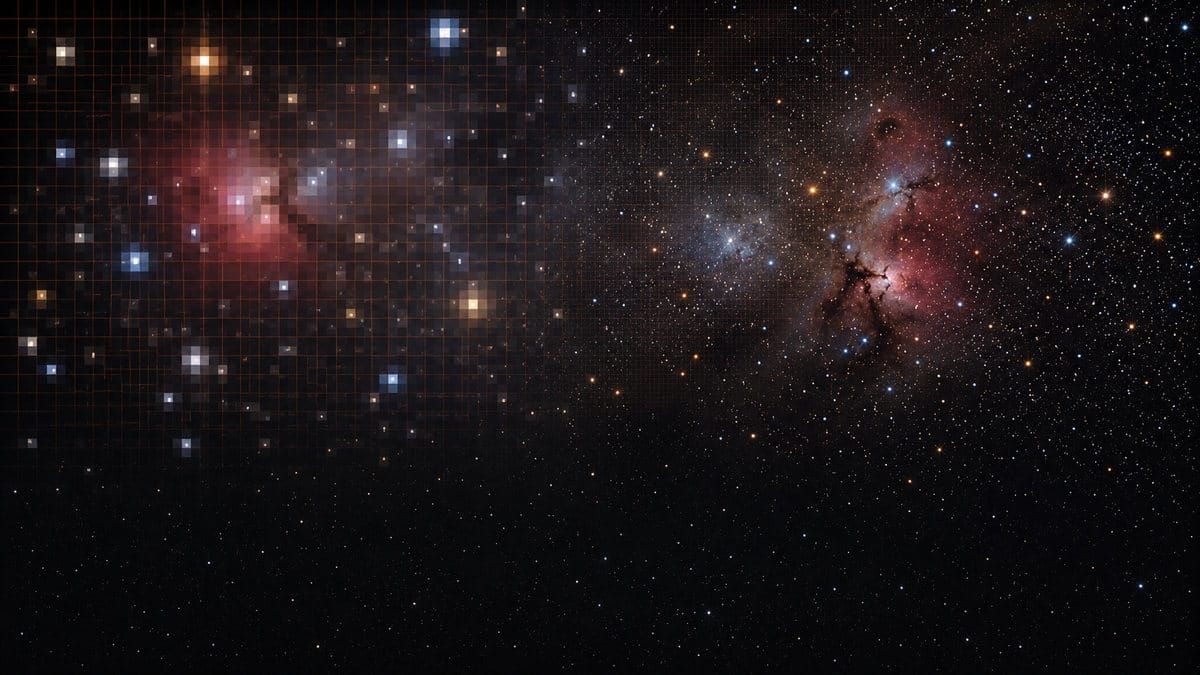
Quick answer: Pixel scale is how much sky each camera pixel covers, in arcseconds per pixel — this is what “sampling” means in astrophotography. Compute it as pixel size (µm) × 206.265 ÷ focal length (mm), and aim for roughly 1–2″/px under typical seeing. Match it well and image quality improves more than any single hardware upgrade.
Recommended Pixel Scale by Setup
The direct answer for typical suburban seeing of 2–4 arcseconds:
| Imaging style | Focal length | Target pixel scale |
|---|---|---|
| Wide-field / nightscape mosaics | 135–400 mm | 2–6″/px — sampling barely matters, framing rules |
| Standard deep-sky (nebulae, large galaxies) | 400–1,000 mm | 1–2″/px — the sweet spot for most skies |
| Small galaxies & planetary nebulae | 1,000 mm+ | 0.6–1″/px — only pays off with good seeing and tight guiding |
| Planetary / lucky imaging | Barlowed long FL | 0.1–0.25″/px — different rules: thousands of short frames beat seeing |
If in doubt, err toward slight undersampling: a well-dithered, drizzled 2″/px dataset beats a noisy 0.7″/px one on almost every night you will actually get.
How to Measure Your True Pixel Scale
You do not have to trust the math — measure it. Every time you plate-solve an image, the solver reports your real pixel scale to two decimal places, derived from the actual star positions on your sensor. Compare it against the theoretical value: a meaningful difference usually means your effective focal length is not what the sticker says (common with focal reducers and Barlows at non-standard spacing). The plate-solved number is the one to plan around.
Put Pixel Scale Into Practice: Free Tools
Pixel scale is one input in a system — these free StellarNomads calculators handle the rest of the chain:
- Telescope field-of-view calculator — see your exact pixel scale and framing for any camera + telescope combination, with targets overlaid.
- Autoguider calculator — match your guide scale to your imaging scale (and read our full autoguiding guide for the technique).
- Critical focus zone calculator — the finer you sample, the less focus slack you have; pair it with our focusing guide.
- Sub-exposure calculator and integration time calculator — because sampling finer spreads light over more pixels and changes how long you need to expose.
- The all-in-one astrophotography calculator — everything above in one place.
A Worked Example: Calculating Your Pixel Scale
Say you pair a camera with 3.76-micron pixels to a telescope of 600 mm focal length. Plug those into the formula — pixel scale = 206.265 × (3.76 ÷ 600) — and you get 1.29 arcseconds per pixel. Under typical 2–4 arcsecond seeing, that lands comfortably in the well-sampled range, so the atmosphere, not your sensor, sets the resolution limit.
Move that same camera behind a 1000 mm focal length and the scale tightens to 0.78 arcseconds per pixel — oversampled for most nights, spreading each star's light across more pixels than the seeing justifies and slowing signal build-up. The fix is rarely a new camera: 2×2 binning doubles the effective pixel size to 7.52 microns and restores a 1.55 arcsecond scale that matches the sky.
That is the whole point of running the numbers before you buy anything: the same sensor can be undersampled, perfectly matched, or oversampled depending only on the focal length in front of it — so the calculation, not the gear, is what keeps your stars tight and your nights efficient.
Frequently Asked Questions
What is pixel scale in astrophotography?
Pixel scale is the amount of sky each camera pixel covers, measured in arcseconds per pixel. It is set by your camera's pixel size and your telescope's focal length, and it determines whether your setup records real detail or just magnifies atmospheric blur.
How do I calculate pixel scale?
Multiply the pixel size in microns by 206.265, then divide by the focal length in millimeters. For example, a camera with 3.76 micron pixels on an 800 mm telescope gives 3.76 x 206.265 / 800 = 0.97 arcseconds per pixel.
What is a good pixel scale for deep-sky astrophotography?
For typical seeing of 2 to 4 arcseconds, aim for roughly 1 to 2 arcseconds per pixel. Wide-field setups work fine at 3 to 6, while scales below 1 arcsecond per pixel only pay off with excellent seeing and very accurate guiding.
What is the difference between undersampling and oversampling?
Undersampling means your pixels are too big, so fine detail lands inside a single pixel and stars look blocky. Oversampling means pixels are too small, spreading the same blur over many pixels and wasting signal-to-noise. Sampling near your seeing limit balances the two.
Does binning change pixel scale?
Yes. Binning combines groups of pixels, for example 2x2 into one, which doubles the effective pixel size and therefore the pixel scale. It trades resolution you could not use anyway for a stronger signal in every combined pixel.
Can drizzle fix undersampling?
Partly. Drizzle integration can recover real resolution from many well-dithered, undersampled frames, which is why it works so well for short focal length setups. But it cannot invent detail the optics and seeing never delivered, and it needs a large number of frames to work cleanly.
TL;DR — Pixel Scale in Plain English
Pixel scale tells you how much of the sky a single camera pixel covers, measured in arcseconds per pixel (″/px).
It determines whether your telescope-camera combo captures real astronomical detail or simply magnifies atmospheric blur.
When pixel scale is aligned with your seeing, optics, and sensor, image quality improves immediately—often more than upgrading hardware.
Why Pixel Scale Is a Strategic Lever (Not a Technical Detail)
Here’s the hard truth most people avoid:
Pixel scale is the governing constraint of astrophotography performance.
You can own:
- Premium optics
- A high-end mount
- A modern CMOS sensor
…and still produce mediocre data if pixel scale is wrong.
Pixel scale directly impacts:
- Resolution realism
- Signal-to-noise ratio (SNR)
- Star shape and FWHM
- Guiding tolerance
- Autofocus stability
- Processing headroom
Ignore it, and you’ll fight your system forever.
Design around it, and everything downstream gets easier.
1. What Pixel Scale Actually Represents
Pixel scale answers one fundamental question: How much sky does one pixel “see”?
It is expressed in arcseconds per pixel (″/px).
- Smaller value → finer sampling
- Larger value → coarser sampling
But finer does not mean better by default.
Resolution only exists if the atmosphere allows it.
Pixel scale is about sampling efficiency, not optical sharpness.
2. Understanding Arcseconds (Without the Hand-Waving)
An arcsecond is 1/3600 of a degree.
For context:
- The Moon spans ~1,800″
- Typical seeing blurs stars to 1.5–3.0″
- Your camera samples that blur into pixels
If seeing produces a 2″ star:
- At 0.5″/px, the star spans ~4 pixels
- At 2.0″/px, the star collapses into one pixel
Same sky. Radically different data quality.
3. The Pixel Scale Formula (No Guesswork)
Pixel scale depends on exactly two variables:
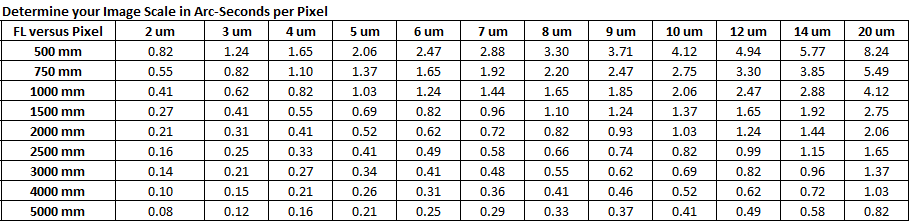
PixelScale(″/px)=206.265×Pixel Size (µm)Focal Length (mm){Pixel Scale (″/px)} = frac{206.265 times text{Pixel Size (µm)}}{text{Focal Length (mm)}}
Where:
- 206.265 is a geometric constant
- Pixel size comes from the sensor spec
- Focal length is effective focal length (reducers included)
Example A — Wide-Field Setup
- Pixel size: 3.76 µm
- Focal length: 400 mm
Result:
[1.94″/px]
Example B — Long Focal Length Setup
- Pixel size: 3.76 µm
- Focal length: 2000 mm
Result:
[0.39″/px]
Same camera. Completely different sampling regimes.
4. Seeing: The Ceiling You Cannot Break
Seeing describes how atmospheric turbulence smears incoming starlight.
It is the dominant resolution limiter for ground-based imaging.
Typical values:
- Exceptional sites: 1.0–1.5″
- Good amateur sites: ~2.0″
- Average suburban skies: 2.5–3.5″
No optical upgrade beats seeing.
If your median seeing is 2.5″, sampling at 0.3″/px adds no real detail—it only spreads blur across more pixels.
Pixel scale must be matched to seeing, not ambition.
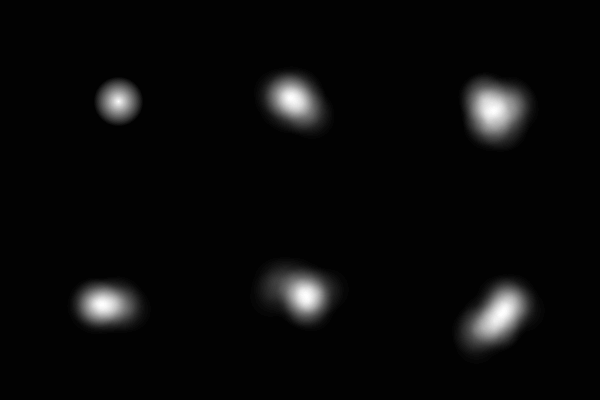
This is an example of atmospheric seeing, it is measured by the displacement of the centeroid over a period of time. You may hear someone declare that is a "2 arcseconds night"
5. Undersampling in Astrophotography (Pixels Too Big)
Undersampling occurs when pixel scale is too coarse for your seeing.
Visual Symptoms
- Square or jagged stars
- Pixelated edges
- “Crunchy” star cores
Technical Consequences
- Lost spatial information
- Poor star centroid accuracy
- Limited deconvolution effectiveness
Common Causes
- Short focal length optics
- Large-pixel sensors
- Aggressive binning
Undersampling permanently discards resolution you could have captured.
6. Oversampling in Astrophotography (Pixels Too Small)
Oversampling occurs when pixel scale is too fine for your seeing.
Visual Symptoms
- Bloated stars
- Soft images despite long integration
- Excessive noise
Technical Consequences
- Lower per-pixel SNR
- Amplified guiding errors
- Autofocus instability
Common Causes
- Long focal length telescopes
- Tiny-pixel CMOS sensors
- Unnecessary extenders
Oversampling doesn’t reveal detail—it dilutes signal.
7. Nyquist Sampling (The Practical Rule)
The Nyquist criterion states you need at least two samples across the smallest resolvable feature.
Translated to astrophotography: Ideal Pixel Scale ≈ Seeing ÷ 2
Practical Targets
| Seeing | Target Pixel Scale |
|---|---|
| 1.5″ | 0.7–0.8″/px |
| 2.0″ | ~1.0″/px |
| 2.5″ | ~1.2–1.3″/px |
| 3.0″ | ~1.5″/px |
This balance optimizes:
- Resolution realism
- SNR efficiency
- Star quality
- System tolerance
8. Pixel Scale vs Aperture (Clarifying a Common Myth)
Aperture determines:
- Light-gathering power
- Diffraction limit
Pixel scale determines:
- How efficiently that light is sampled
Large aperture + bad pixel scale = wasted potential.
Moderate aperture + correct pixel scale = excellent results.
Pixel scale governs whether aperture is used effectively.
9. Pixel Scale and Signal-to-Noise Ratio
This is where most systems quietly fail.
Smaller pixels:
- Fewer photons per pixel
- Lower SNR per pixel
Larger pixels:
- More photons per pixel
- Higher SNR per pixel
Oversampling spreads signal across many pixels, increasing noise dominance.
Correct sampling concentrates photons where they matter.
Pixel scale is an integration efficiency decision.
10. Binning: A Strategic Tool (Not a Compromise)
Binning combines adjacent pixels into one effective pixel.
What Binning Changes
- 2×2 → pixel scale doubles
- 3×3 → pixel scale triples
What Binning Improves
- SNR
- Star stability
- Guiding tolerance
Modern CMOS bin digitally, but sampling math still applies.
Binning is controlled resampling—not data destruction.
🔑 Pro Tip! (Advanced but Actionable)
If your native pixel scale is ≤0.6″/px and your median seeing is ≥2″, you are oversampling by design.
Instead of:
- Longer subs
- Aggressive sharpening
- Blaming guiding
Do this:
- Bin 2×2
- Recalculate pixel scale
- Gain cleaner stars and higher SNR instantly
This single adjustment often outperforms hardware upgrades.
11. Pixel Scale and Autofocus Reliability
Autofocus relies on:
- Star size measurement
- Metric smoothness
- Noise behavior
Oversampling:
- Produces noisy focus metrics
- Flattens or destabilizes V-curves
Correct sampling:
- Generates clean, repeatable curves
- Reduces focus hunting
- Improves automation reliability
Pixel scale affects every autofocus run.
12. Pixel Scale and Guiding Tolerance
Guiding errors are measured in arcseconds.
- At 0.4″/px, a 0.6″ error spans multiple pixels
- At 1.2″/px, the same error is barely visible
Oversampling magnifies mechanical imperfections.
Correct sampling builds forgiveness into the system.
13. Pixel Scale for Different Target Types
Large Nebulae
- Favor coarser sampling
- Prioritize SNR
- Resolution is seeing-limited
Small Galaxies & Planetary Nebulae
- Benefit from finer sampling
- Only if seeing supports it
Pixel scale defines what your rig excels at.
14. Pixel Scale vs Drizzle Integration
Drizzle integration is often misunderstood.
Drizzle does not create new resolution.
It reconstructs sampling density only when data qualifies.
Drizzle Helps When
- Data is mildly undersampled
- Dithering is consistent
- Subframe count is high
- Star shapes are good
Drizzle Hurts When
- Data is already oversampled
- Seeing dominates resolution
- Subframe count is low
Drizzle is not a substitute for correct pixel scale—it’s a refinement tool.
15. Pixel Scale: Mono vs One-Shot Color (OSC)
OSC Cameras
- Use a Bayer matrix
- Each pixel records one color
- Interpolation reduces effective resolution
Implication:
OSC benefits from slightly finer pixel scale.
Mono Cameras
- Capture full luminance per pixel
- Preserve spatial detail
- Tolerate slightly coarser sampling
Rule of Thumb
- Mono target: 1.0″/px
- OSC target: ~0.8–0.9″/px
Pixel scale is not sensor-agnostic. Neither is collecting speed — if you are still choosing between the two, our mono vs OSC simulator counts the difference photon by photon.
16. Planning Pixel Scale Before You Buy
Before purchasing:
- Telescope
- Camera
- Reducer
Ask:
- What is my median seeing?
- What pixel scale will this setup produce?
- Does it match my targets?
Pixel scale mistakes are expensive and persistent.
17. Common Pixel Scale Mistakes
- Chasing tiny ″/px numbers
- Ignoring seeing statistics
- Assuming binning is destructive
- Copying other people’s rigs
- Trying to fix sampling in processing
Pixel scale errors propagate everywhere.
18. Processing Cannot Fix Bad Sampling
No amount of:
- Deconvolution
- AI sharpening
- Star reduction
Can recover detail that was never sampled.
Pixel scale decisions are upstream system architecture.
19. Pixel Scale as a Design Philosophy
Professional observatories design around sampling first:
- Site
- Optics
- Detectors
Amateur systems should follow the same logic.
Pixel scale is the alignment metric.
Final Takeaway
Pixel scale is not optional knowledge—it is the governor of astrophotography performance.
When pixel scale matches seeing:
- Stars tighten
- Noise drops
- Automation improves
- Processing simplifies
This is how efficient, disciplined imaging systems are built.


%20%E2%80%94%202026%20Beginner%E2%80%99s%20Guide&body=Best%20Pixel%20Scale%20Explainer%20(arcsec%2Fpixel)%20%E2%80%94%202026%20Beginner%E2%80%99s%20Guide%20%E2%80%94%20Pixel%20scale%20is%20how%20you%20set%20sampling%20in%20astrophotography.%20Our%202026%20guide%20covers%20arcsec%2Fpixel%2C%20seeing%2C%20undersampling%20vs%20oversampling%2C%20binning%20and%20drizzle.%20https%3A%2F%2Fstellarnomads.com%2Fpixel-scale-astrophotography%2F%20Image%3A%20https%3A%2F%2Fstorage.ghost.io%2Fc%2Fbf%2F0d%2Fbf0d5d59-0433-4995-b3fa-4f41b743ef1b%2Fcontent%2Fimages%2F2026%2F07%2Fpixel-scale-astrophotography-hero-1.jpg)