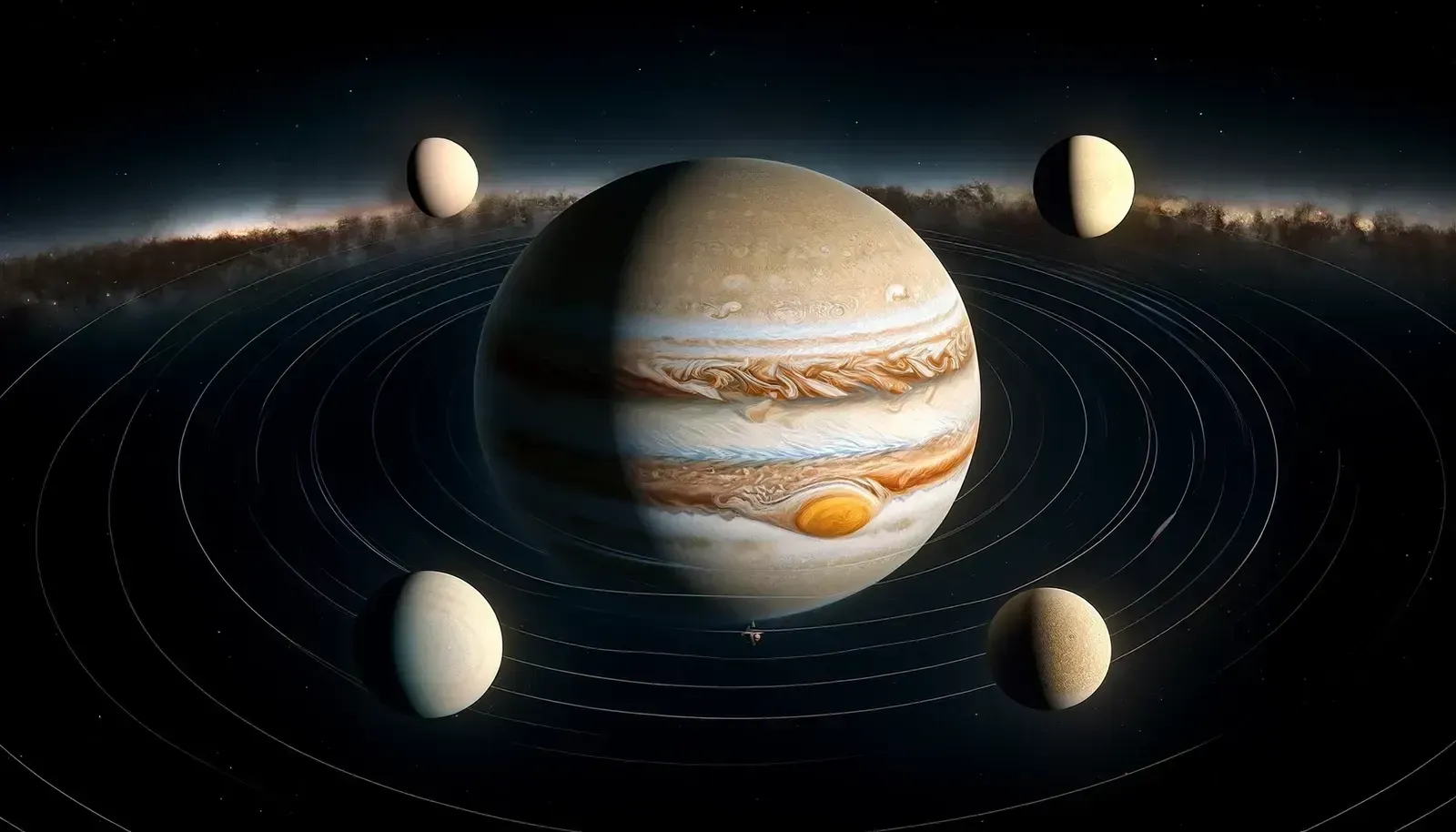
Quick answer: Jupiter is the largest planet in the solar system — so massive it outweighs every other planet combined. Its gravity acts as Earth's cosmic bodyguard, deflecting or capturing comets and asteroids that might otherwise head our way, while its Great Red Spot, nearly 100 moons and planet-sized magnetosphere make it the most dynamic world a small telescope can show you.
Jupiter stands as a colossal guardian amid the swirling dance of planets, moons and asteroids. For anyone starting out in astronomy, its sheer scale and its ever-changing cloud belts are a gateway drug to the hobby — and its role in protecting the inner solar system makes it one of the reasons we are here at all. This guide tours the planet, its extraordinary moons, the bodyguard question, and how to see Jupiter yourself in 2026.
The Gargantuan Planet
Jupiter is a gas giant, primarily composed of hydrogen and helium, with no solid surface as we know on Earth. Its most distinctive feature, visible even through small telescopes, is the Great Red Spot, a gigantic storm larger than Earth that has been raging for at least 200 years — and possibly far longer. Jupiter's rapid rotation — the fastest of all the solar system's planets, one turn every 9 hours 56 minutes — whips its atmosphere into the prominent bands and cloud belts that give the planet its striped appearance.
With a diameter of about 139,820 km (86,881 miles), Jupiter is so massive that it outweighs all other planets in the solar system combined — two and a half times over. That immense gravity shapes the orbits of countless smaller bodies, including the Trojan asteroids that share Jupiter's own orbit around the Sun.
Is Jupiter Really Earth's Bodyguard?
The direct answer: largely yes — with an asterisk. Jupiter's massive gravity has helped shape the fate of everything around it: flinging some bodies into the Sun, ejecting others from the solar system entirely, sculpting the asteroid belt, and capturing or deflecting many comets that dive in from the outer dark. The world watched the bodyguard at work in 1994, when comet Shoemaker-Levy 9 — captured and shredded by Jupiter's gravity — slammed into the planet in a chain of impacts, any one of which would have been catastrophic on Earth.
The asterisk: modern simulations suggest Jupiter also occasionally redirects objects inward, so it is less a perfect shield than a heavyweight doorman — it decides what gets through, and mostly the answer is nothing. Many scientists argue that this filtering, especially in the early solar system, helped keep Earth calm enough for life to take hold.
Amateur astronomers keep catching the bodyguard on duty. Since the Shoemaker-Levy 9 spectacle, backyard imagers have recorded repeated impact flashes on Jupiter — brief sparks from incoming objects tens of meters wide, with well-documented events in 2009, 2010, 2019 and 2021. No other planet shows us this in real time: point a video camera at Jupiter often enough and you can personally witness the solar system's cleanup crew at work.
A Miniature Solar System: The Moons of Jupiter
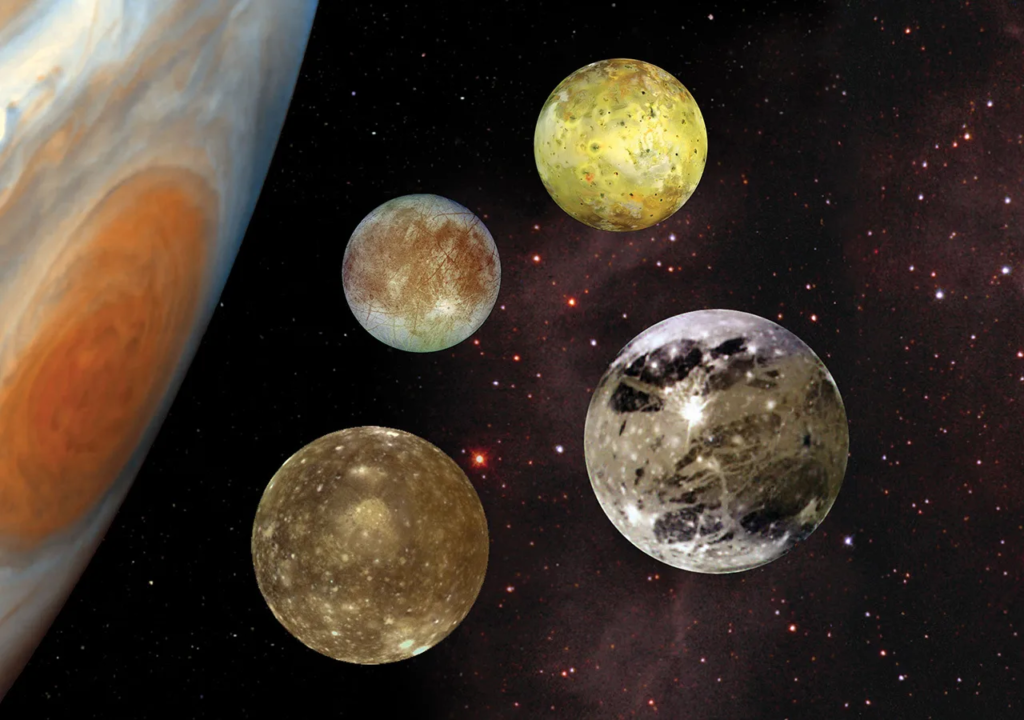
Jupiter is not just a planet; it is a miniature solar system in its own right, with nearly 100 known moons. The four largest, discovered by Galileo Galilei in 1610, are the Galilean moons — Io, Europa, Ganymede and Callisto — and each is a world worth a mission of its own:
- Io: the most volcanically active body in the solar system, resurfaced constantly by hundreds of volcanoes, some launching plumes hundreds of kilometers high — all driven by the gravitational tug-of-war with Jupiter and its sibling moons.
- Europa: beneath a shell of ice lies a global saltwater ocean holding perhaps twice the water of all Earth's oceans — one of the most promising places to look for life beyond Earth, and the destination of NASA's Europa Clipper.
- Ganymede: the largest moon in the solar system, bigger than the planet Mercury, and the only moon known to generate its own magnetic field. It too likely hides a subsurface ocean.
- Callisto: the most heavily cratered object known, an ancient face recording billions of years of solar system bombardment.
Smaller members add their own flavor: reddish Amalthea, dusted by Io's volcanic fallout; and the tiny inner moons Metis, Adrastea and Thebe, whose meteoroid-blasted debris feeds Jupiter's faint rings — rings first discovered in 1979 by the Voyager 1 spacecraft. Most inner moons, Galileans included, are tidally locked, forever showing the same face to their planet.
The Most Violent Storms in the Solar System
The Great Red Spot is a high-pressure storm wider than Earth, with winds circling its edge at about 400 km/h (250 mph). Its famous color remains an active research topic — candidate ingredients include sulfur and phosphorus compounds and organic molecules cooked by sunlight. Curiously, the Spot has been shrinking for over a century: nineteenth-century observers described a storm three Earths wide, while today it is closer to one — watching its long, slow evolution is one of amateur astronomy's great multigenerational projects.
Beyond the Spot, Jupiter hosts whole families of storms — white ovals, brown barges, and polar cyclone clusters discovered by the Juno spacecraft arranged in geometric patterns at both poles. The planet's ten-hour rotation generates powerful Coriolis forces that keep these storms spinning stably for decades or centuries.
Why Does Jupiter Have So Many Bands?
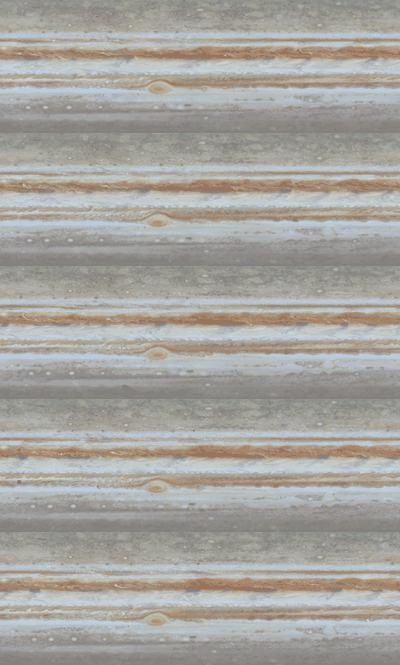
Jupiter's striped appearance comes from a combination of composition, rapid rotation and internal heat. Strong jet streams, driven by the ten-hour spin, divide the atmosphere into zones and belts: the lighter zones are regions of warm, rising gas, while the darker belts are lanes of cooler, descending gas. Jupiter radiates more heat from its interior than it receives from the Sun, and that internal furnace drives vigorous convection that keeps the pattern churning.
Chemistry paints the stripes. Ultraviolet sunlight cooks the trace gases — methane, ammonia, water vapor — into colored compounds ranging from pale cream to brick red, with phosphorus- and sulfur-bearing molecules among the suspected pigments. The result is the most photogenic weather system in the solar system.
A Very Powerful Magnetosphere
Jupiter's magnetosphere is the largest structure in the solar system after the Sun's own influence — generated by currents of metallic hydrogen deep inside the planet. It is roughly 20,000 times stronger than Earth's magnetic field, balloons up to 7 million kilometers toward the Sun, and streams a tail that reaches beyond Saturn's orbit. It traps radiation belts intense enough to be a genuine engineering hazard for visiting spacecraft, and it powers permanent auroras larger than our entire planet, fed partly by volcanic material flung off Io.
How to Observe Jupiter in 2026
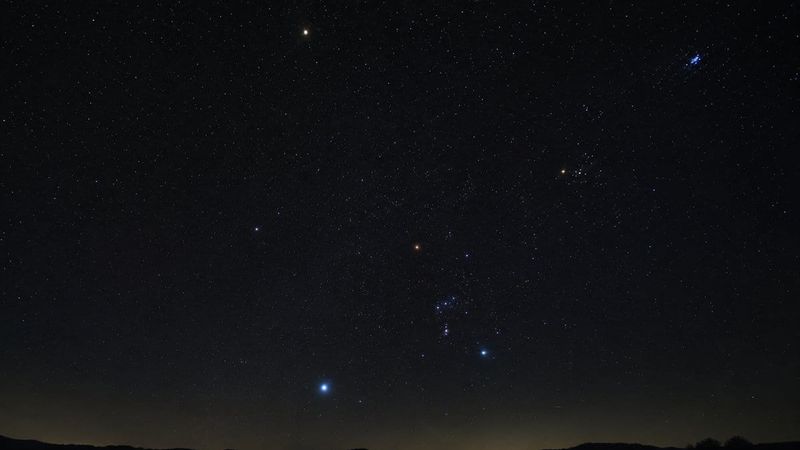
The direct answer: Jupiter reached opposition on January 10, 2026, and remains a brilliant evening beacon through the first half of the year, returning to the morning sky later; its next opposition comes in February 2027.
Jupiter is the most rewarding planet for small instruments. Steady binoculars show the four Galilean moons as pinpricks strung beside the planet — rearranging visibly night to night, exactly as Galileo saw in 1610. A 4-inch telescope shows the two dark equatorial belts; 6 inches and up begins to reveal the Great Red Spot (when it faces Earth), festoons and moon shadows crossing the disk during transits. Planetary imagers: Jupiter spins so fast that features smear within minutes — capture short, high-frame-rate video and stack the sharpest frames. Check how large Jupiter's disk (30–50 arcseconds) appears in your setup with our telescope field-of-view calculator.
Two events worth planning around: Great Red Spot transits — the Spot crosses the visible disk roughly every ten hours, and most planetarium apps include a transit timer — and Galilean moon shadow transits, when a moon's inky shadow crawls across the cloud tops. Both are within reach of a 6-inch telescope on a night of steady seeing.
The Exploration of Jupiter: Missions Past and Present
Jupiter has hosted a parade of robotic visitors: the Pioneer and Voyager flybys of the 1970s, the Galileo orbiter of the 1990s — which dropped a probe into the atmosphere itself — and NASA's Juno orbiter, which has circled the planet since 2016, mapping its gravity, deep structure and polar cyclones in unprecedented detail.
The next decade belongs to the ocean moons. NASA's Europa Clipper, launched in October 2024, arrives in 2030 to fly dozens of passes over Europa's ice shell, while ESA's JUICE (Jupiter Icy Moons Explorer), launched in 2023, reaches the system in 2031 and will ultimately settle into orbit around Ganymede — the first spacecraft ever to orbit another planet's moon. Between them, they will tell us whether Jupiter's moons hide habitable oceans.
Jupiter in Culture and Mythology
Named after the Roman king of the gods, Jupiter has anchored humanity's sky-watching for millennia — Babylonian astronomers tracked it as Marduk's star, and its slow, stately 12-year circuit of the zodiac made it a calendar-keeper for ancient cultures. In 1610 it changed history: Galileo's discovery of its four moons was the first direct evidence that not everything orbits the Earth.
The moons had one more historic job: in the 1600s, published tables of their eclipses served as a universal clock that let surveyors determine longitude on land — Jupiter, in effect, was the world's first GPS satellite.
Jupiter by the Numbers
| Property | Value |
|---|---|
| Diameter | 139,820 km — about 11 Earths |
| Mass | 318 Earths — 2.5× all other planets combined |
| Day length | 9 h 56 min — the solar system's shortest |
| Year length | 11.9 Earth years |
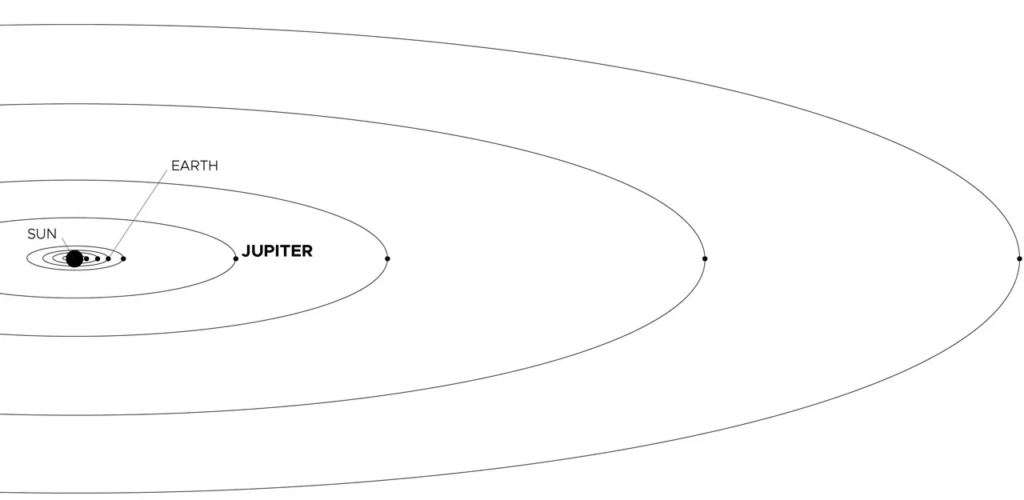
| Distance from Sun | ~778 million km (5.2 AU) |
| Known moons | Nearly 100 |
| Great Red Spot winds | ~400 km/h around a storm wider than Earth |
| Magnetic field | ~20,000× stronger than Earth's |
| Rings | Faint, discovered by Voyager 1 in 1979 |
| Spacecraft visitors | 9 missions, from Pioneer 10 to Europa Clipper's 2030 arrival |
Frequently Asked Questions
Why is Jupiter called Earth's bodyguard?
Because its enormous gravity deflects, captures or ejects many comets and asteroids that could otherwise reach the inner solar system. The 1994 impact of comet Shoemaker-Levy 9 into Jupiter showed the process in action, though modern studies note Jupiter can occasionally redirect objects inward too.
How many moons does Jupiter have?
Nearly 100 confirmed moons. The four largest, Io, Europa, Ganymede and Callisto, were discovered by Galileo in 1610 and are visible in ordinary binoculars as star-like points beside the planet.
What is the Great Red Spot?
A high-pressure storm wider than Earth that has raged for at least 200 years, with 400 km/h winds around its rim. It has been steadily shrinking for over a century, from about three Earth-widths in the 1800s to roughly one today.
Can you see Jupiter without a telescope?
Easily. Jupiter is one of the brightest objects in the night sky, outshining every star. Binoculars will even show its four Galilean moons, and their positions visibly change from night to night.
What is Jupiter made of?
About 90 percent hydrogen and 10 percent helium, similar to the Sun. There is no solid surface; pressure turns the hydrogen into a metallic liquid deep inside, which generates the planet's enormous magnetic field.
How big is Jupiter compared to Earth?
Jupiter is about 11 times wider than Earth and over 300 times more massive. It outweighs all the other planets in the solar system combined, two and a half times over, and more than 1,300 Earths would fit inside it.
How long is a day on Jupiter?
Just 9 hours and 56 minutes, the shortest day of any planet in the solar system. That rapid spin drives Jupiter's banded appearance and its powerful storm systems.
What missions are exploring Jupiter now?
NASA's Juno orbiter has studied Jupiter since 2016. NASA's Europa Clipper, launched in 2024, arrives in 2030 to survey the ocean moon Europa, and ESA's JUICE, launched in 2023, reaches the system in 2031 to explore Ganymede, Callisto and Europa.
Keep Exploring
Jupiter is the anchor of the outer solar system — continue the tour with Saturn and its rings, relive the first close look through the eyes of Voyager 1, meet the man who found its moons in Galileo Galilei, or step back for the full guided tour of the solar system.



&body=Jupiter%3A%20Earth's%20Cosmic%20Bodyguard%20%E2%80%94%20Facts%2C%20Moons%20and%20Storms%20(2026)%20%E2%80%94%20Jupiter%E2%80%99s%20immense%20gravity%20shields%20Earth%20from%20comets%20and%20asteroids.%20See%20how%20our%20cosmic%20%E2%80%98bodyguard%E2%80%99%20protects%20us%20%E2%80%94%20plus%20the%20Great%20Red%20Spot%2C%20its%20moons%2C%20and%20more.%20https%3A%2F%2Fstellarnomads.com%2Fjupiter%2F%20Image%3A%20https%3A%2F%2Fstorage.ghost.io%2Fc%2Fbf%2F0d%2Fbf0d5d59-0433-4995-b3fa-4f41b743ef1b%2Fcontent%2Fimages%2F2026%2F07%2FJupiter-1.webp)