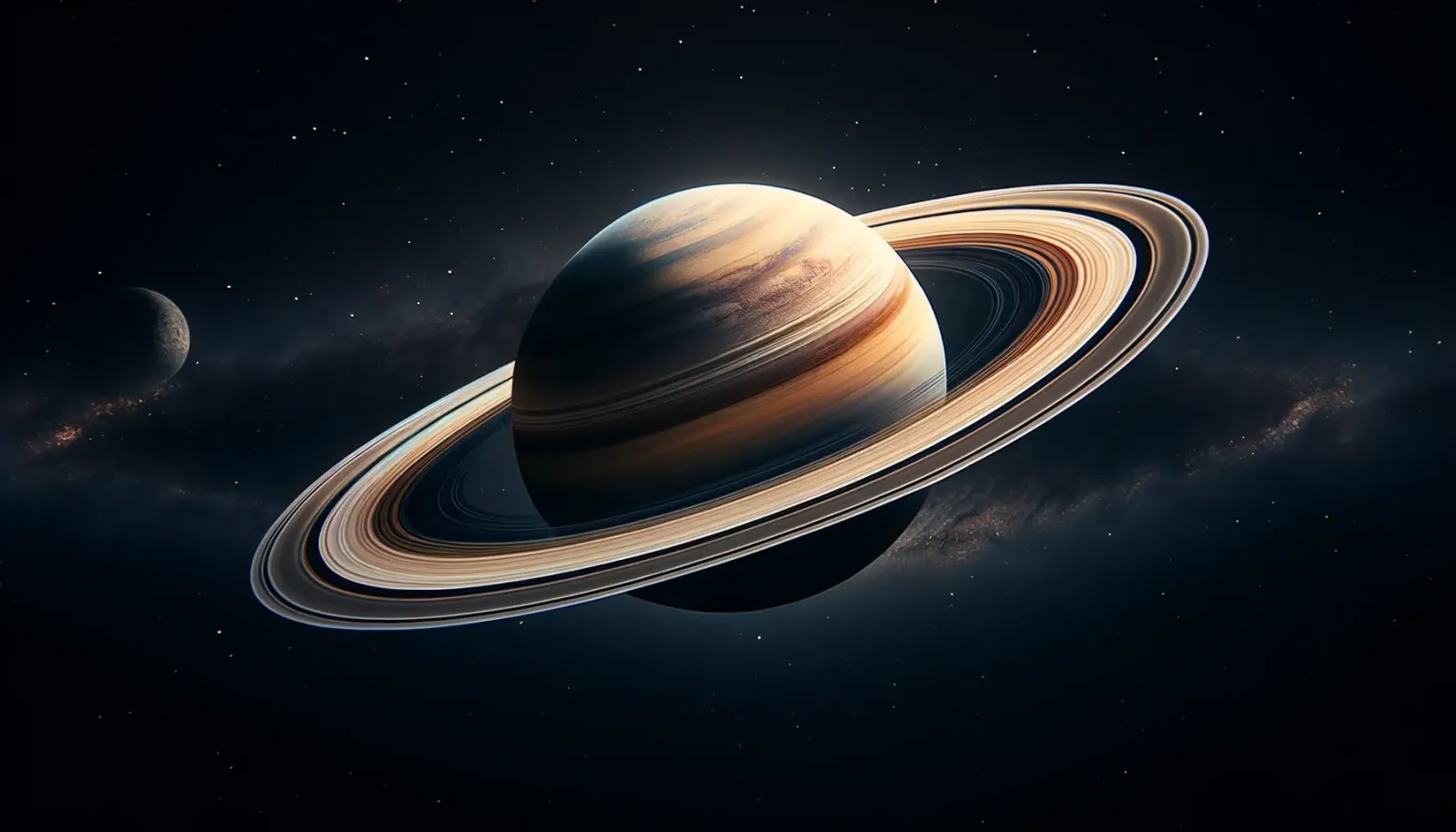
Quick answer: Saturn is the sixth planet from the Sun and the solar system's showpiece: a gas giant with the grandest ring system, a record 274 known moons, a hexagonal storm at its north pole, and a density so low it would float in water. In 2026 its rings are slowly reopening after appearing edge-on from Earth in 2025.
Saturn is the planet that turns people into astronomers. The first look at those rings through any telescope — even a small one — lands like a magic trick. But the rings are only the beginning: here are ten facts about Saturn that show why this gas giant remains the crown jewel of the solar system, plus exactly how to see it for yourself in 2026.
10 Fascinating Facts About Saturn
1. A Spectacular Ring System
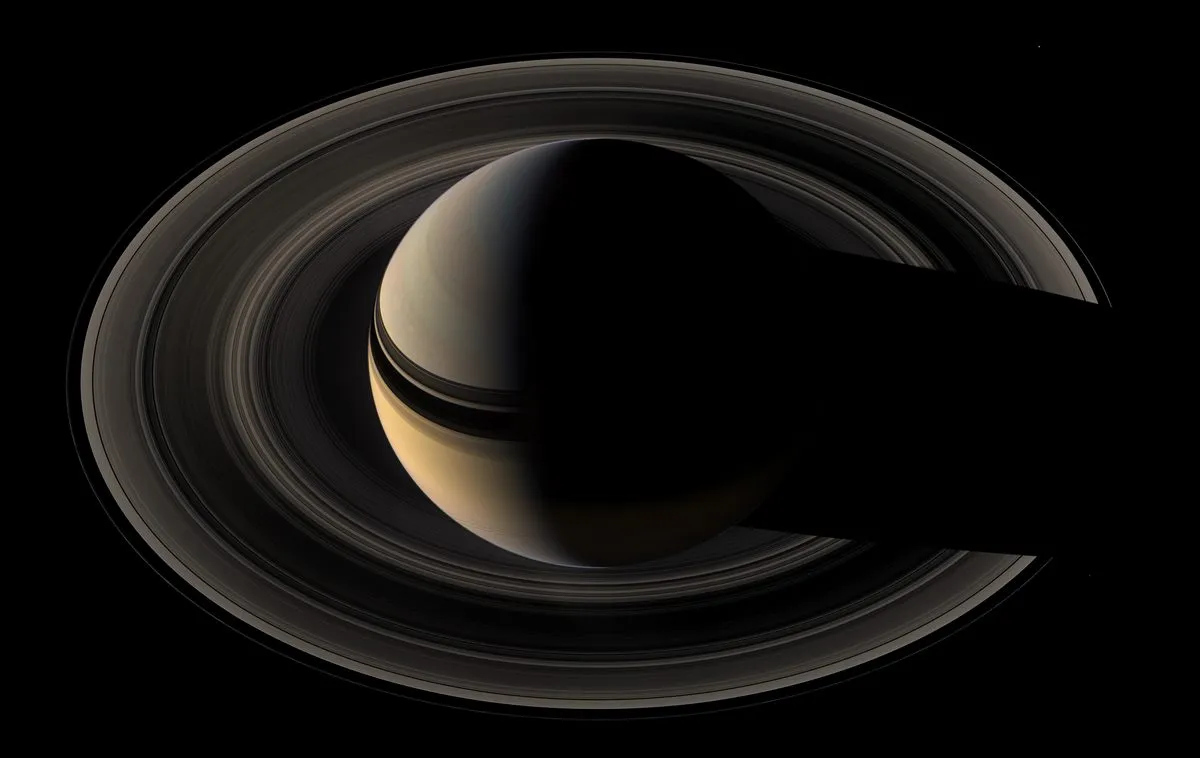
Saturn is renowned for the most extensive and conspicuous rings in the solar system. They stretch about 282,000 km (175,000 miles) across — three-quarters of the distance from Earth to the Moon — yet in most places they are only around 10 meters thick, proportionally thinner than a sheet of paper. They are not solid: countless particles of ice and rock, from dust grains to house-sized boulders, each orbit Saturn independently.
2. Composed Mostly of Gas
Saturn is a gas giant, primarily hydrogen and helium. Its atmosphere thickens gradually with depth — there is no surface to stand on — compressing into metallic hydrogen around a dense core. Despite being nine times Earth's width, it completes the picture with a golden haze of ammonia crystals in its upper clouds.
3. Home to Ferocious Winds
Saturn's atmosphere hosts some of the fastest winds ever recorded in the solar system, reaching about 1,800 kilometers per hour (1,100 mph) near the equator — several times stronger than any hurricane on Earth, driven by the planet's rapid rotation and heat rising from its interior.
4. The Hexagon Mystery
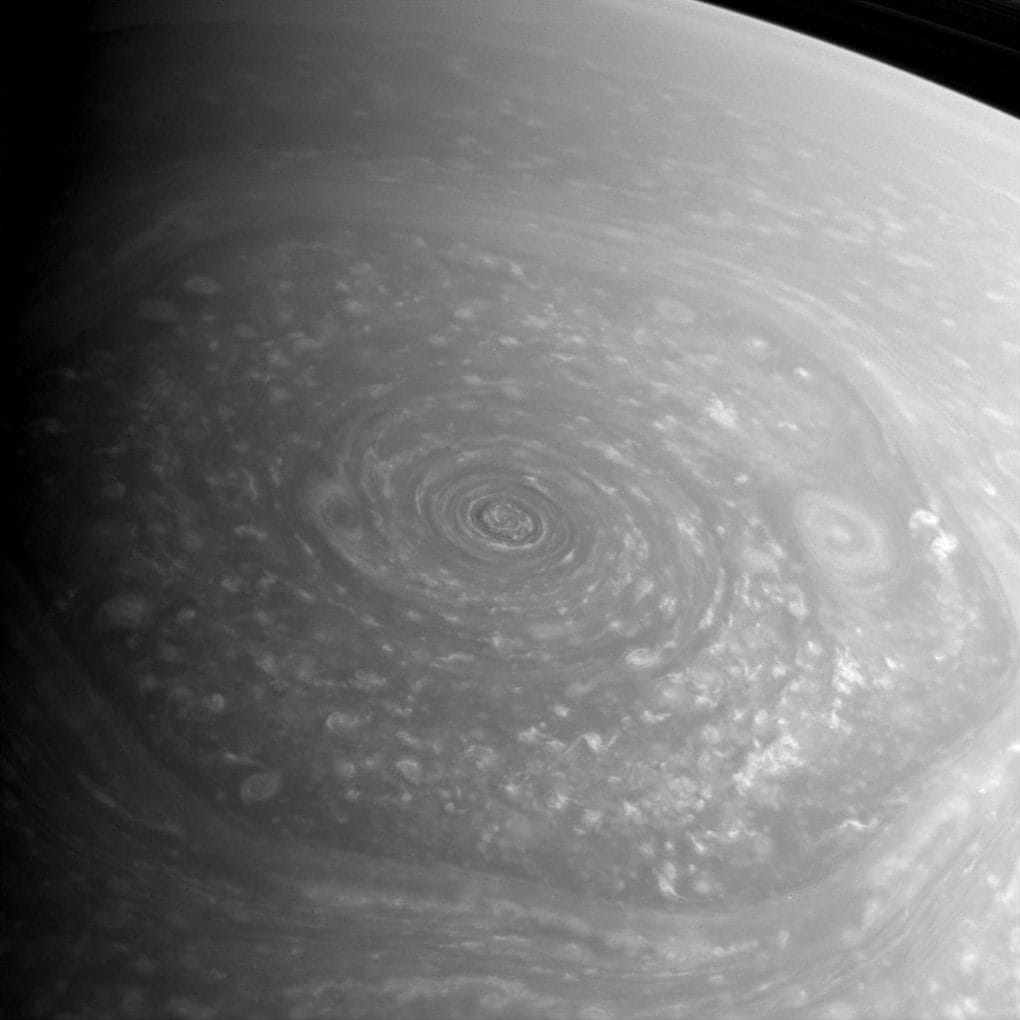
At Saturn's north pole churns a six-sided jet stream — the hexagon — roughly 29,000 km across, wide enough to swallow two Earths side by side. Each side is longer than Earth's diameter, and a hurricane-like vortex spins at its center. Lab experiments suggest the shape emerges naturally from jet streams rotating at different speeds, but the hexagon's endurance across decades remains one of planetary science's favorite puzzles.
5. A Record-Breaking Moon Collection
Saturn owns the largest known moon family in the solar system — and it keeps growing. In March 2025, astronomers announced 128 newly confirmed moons in one stroke, bringing Saturn's official count to 274 — more than all the other planets combined. The star of the collection is Titan: larger than Mercury, wrapped in a thick nitrogen atmosphere, with rivers, lakes and rain of liquid methane.
6. The Least Dense Planet
Saturn's average density is about 0.69 g/cm³ — less than water. Given a bathtub of impossible size, Saturn would float. It is the only planet in the solar system less dense than water, a direct consequence of being mostly light gas spun into a ball.
7. A Day Shorter Than 11 Hours
Pinning down Saturn's day was surprisingly hard — a gas planet has no fixed landmarks, and its magnetic field is unhelpfully symmetric. Scientists finally solved it using Cassini data on ring vibrations driven by the planet's interior: a Saturn day lasts 10 hours 33 minutes. That rapid spin also makes Saturn the most flattened planet, visibly wider at its equator than pole to pole.
8. Moons That Might Host Life
Two of Saturn's moons are on astrobiology's shortlist. Enceladus vents geysers of salty water from a subsurface ocean through cracks in its icy shell — Cassini flew through the plumes and tasted organic molecules. Titan offers a different recipe: liquid methane lakes and complex carbon chemistry, the target of NASA's upcoming Dragonfly rotorcraft mission, due to launch in 2028.
9. A Strangely Aligned Magnetic Field
Saturn's magnetic field is aligned almost perfectly with its rotation axis — a configuration standard dynamo theory says should not sustain itself. Earth's field is tilted about 11 degrees from its spin axis; Saturn's tilt is close to zero, a lingering puzzle that Cassini's final orbits sharpened rather than solved.
10. Explored by Four Spacecraft
Pioneer 11 (1979), Voyager 1 (1980), Voyager 2 (1981) and the Cassini-Huygens mission have all visited Saturn. Cassini orbited for 13 years, landed the Huygens probe on Titan — the most distant landing ever made — and ended in 2017 with a deliberate plunge into Saturn's atmosphere, sending data to the last second.
How to See Saturn in 2026
The direct answer: Saturn reaches opposition — its biggest, brightest and closest for the year — in early October 2026, rising at sunset and staying visible all night among the stars of Pisces.
2026 is also a special-interest year for ring watchers. In 2025 the rings turned edge-on to Earth — a crossing that happens only every ~15 years, briefly making them almost vanish. Through 2026 they are slowly reopening: you are watching the rings return in real time, a genuinely rare sight. Any telescope from about 50x magnification shows the rings; a 6-inch scope adds the Cassini Division on steady nights, plus Titan as an obvious nearby dot. Check how Saturn will frame in your own setup with our telescope field-of-view calculator, and if you plan to image it, remember the planet moves fast — short high-speed video capture beats long exposures for planets.
Saturn's Rings Up Close
The rings are a system, not a single object — lettered in order of discovery, not position:
- A, B and C rings: the bright main rings, with B the broadest and most opaque. The dark gap between A and B — the Cassini Division — is 4,700 km wide and visible in a 6-inch telescope on a steady night.
- D, E, F and G rings: faint, gauzy structures; the E ring is fed directly by the water-ice geysers of Enceladus.
- Shepherd moons: tiny moons such as Pan and Daphnis orbit inside the gaps, sculpting razor edges and kicking up waves that Cassini photographed casting shadows.
- Spokes: ghostly radial smudges of electrostatically levitated dust that come and go with Saturn's seasons — first seen by Voyager, and observed again by Hubble around the 2025 ring-plane crossing.
How Saturn Got Its Rings — and Why They May Be Young
Cassini's final orbits delivered a shock: the rings may be recent. Flying through the gap between the rings and the planet, the spacecraft weighed the ring system precisely — about 40 percent the mass of the moon Mimas — and measured how quickly infalling dust darkens their nearly pure water ice. Together those point to an age of perhaps 100 to 400 million years, meaning the dinosaurs may have looked up at a ringless Saturn. The leading origin story is a moon or comet that strayed inside the Roche limit and was shredded by tides — debris that spread into the disk we photograph today, even as it slowly rains back onto the planet.
The Seasons of Saturn
Saturn's 26.7-degree axial tilt gives it Earth-like seasons — each lasting about 7.4 years across its 29.5-year orbit. For observers, the tilt means our view of the rings opens and closes on a roughly 15-year rhythm: wide-open and dazzling at the extremes, vanishingly thin at the ring-plane crossings. The most recent crossing came in March 2025, when the rings briefly all but disappeared from telescopes; through 2026 and beyond they are steadily reopening toward the next maximum in the early 2030s. It is the reason Saturn genuinely looks different every year you photograph it — and why a 2026 image, rings still a narrow blade of light, will be instantly datable for decades.
Saturn at a Glance
| Property | Value |
|---|---|
| Distance from Sun | ~1.4 billion km (9.5 AU) |
| Diameter | 120,536 km — about 9 Earths wide |
| Mass | 95 Earths |
| Density | 0.69 g/cm³ — less than water |
| Day length | 10 h 33 min |
| Year length | 29.5 Earth years |
| Confirmed moons | 274 (as of 2025) |
| Ring span | ~282,000 km |
| Cloud-top temperature | about −178 °C |
| Axial tilt | 26.7° — the reason our view of the rings opens and closes on a ~15-year cycle |
Saturn's Most Remarkable Moons
Beyond the raw count of 274, a few of Saturn's moons are destinations in their own right:
- Titan — the solar system's second-largest moon, with a nitrogen atmosphere thicker than Earth's, methane seas, and a NASA rotorcraft (Dragonfly) on the way.
- Enceladus — a small ice world venting its buried ocean into space; its geysers literally feed one of Saturn's rings.
- Mimas — the “Death Star moon,” dominated by the giant Herschel crater; recent orbital analysis hints even Mimas may hide a young internal ocean.
- Iapetus — the two-faced moon, coal-dark on one hemisphere and bright ice on the other, with a bizarre equatorial mountain ridge.
- Hyperion — a sponge-looking rubble world that tumbles chaotically, with no fixed day length at all.
- Rhea — Saturn's second-largest moon, an ancient cratered ice ball nearly the size of our own Moon's little sibling worlds.
Frequently Asked Questions
How many moons does Saturn have?
Saturn has 274 confirmed moons as of the March 2025 announcement that added 128 new ones, the most of any planet in the solar system and more than all the other planets combined. Titan is the largest, bigger than the planet Mercury.
What are Saturn's rings made of?
Almost entirely water ice, with small amounts of rocky material and dust. The particles range from tiny grains to boulders the size of houses, each orbiting Saturn independently in a disk about 282,000 km wide but typically only around 10 meters thick.
Are Saturn's rings disappearing?
Yes, slowly. Ring material is steadily raining into the planet, pulled in along magnetic field lines, and studies suggest the rings could be largely gone in a few hundred million years. Separately, the rings appeared edge-on from Earth in 2025 and are reopening through 2026, but that is just our viewing angle changing.
What color is Saturn?
A pale gold or butterscotch, produced mainly by ammonia haze in its upper atmosphere. Through a telescope the color contrast between the warm-toned globe and the brighter white rings is part of what makes Saturn so striking.
How far is Saturn from the Sun?
About 1.4 billion kilometers, or 9.5 astronomical units, roughly ten times Earth's distance from the Sun. At that range Saturn takes 29.5 Earth years to complete one orbit.
What is Saturn made of?
Mostly hydrogen and helium, like the Sun. Pressure transforms the hydrogen into a metallic, electrically conducting fluid deep inside, wrapped around a dense core of rock and ice estimated at 10 to 20 Earth masses.
Why does Saturn have rings?
The rings are likely debris from comets, asteroids or moons torn apart by Saturn's gravity before they could hold together. Their surprisingly clean ice and ongoing erosion suggest the rings may be far younger than the planet itself, perhaps only a few hundred million years old.
How big is Saturn compared to Earth?
Saturn is about nine times wider than Earth, with a volume that could hold roughly 760 Earths. Yet its mass is only 95 Earths because its density is so low, lower than water.
How long is a day on Saturn?
10 hours and 33 minutes, a figure scientists finally nailed down in 2019 by reading vibrations in Saturn's rings caused by oscillations inside the planet. The fast spin visibly flattens the planet at its poles.
When can I see Saturn in 2026?
Saturn is at its best around opposition in early October 2026, when it rises at sunset and is visible all night. Any small telescope at around 50x magnification will show the rings, which are gradually reopening after appearing edge-on in 2025.
A Gateway to Cosmic Wonders
Saturn's mysteries — the youthful rings, the hexagon, the ocean moons — keep rewriting what we think we know about planets. Keep touring: meet its inner neighbor Jupiter, Earth's cosmic bodyguard, relive the flyby that started it all with Voyager 1, or step back for the full tour of the solar system.


&body=Saturn%3A%2010%20Fascinating%20Facts%20About%20the%20Ringed%20Planet%20(2026)%20%E2%80%94%20Saturn%20explained%3A%20what%20its%20rings%20are%20made%20of%2C%20the%20hexagon%20storm%20at%20its%20pole%2C%20its%20record-breaking%20moon%20count%2C%20plus%20how%20to%20observe%20and%20photograph%20Saturn%20in%202026.%20https%3A%2F%2Fstellarnomads.com%2Fsaturn%2F%20Image%3A%20https%3A%2F%2Fstorage.ghost.io%2Fc%2Fbf%2F0d%2Fbf0d5d59-0433-4995-b3fa-4f41b743ef1b%2Fcontent%2Fimages%2F2026%2F07%2FSaturn-1.webp)