Quick answer: The next total solar eclipse is on Wednesday, August 12, 2026. The Moon's shadow will sweep across the Arctic, eastern Greenland, western Iceland and northern Spain, with totality lasting up to 2 minutes 18 seconds. It is mainland Europe's first total solar eclipse since 1999 — and this guide covers exactly where, when and how to see it.
A total solar eclipse is the most dramatic sight the sky can offer: day turns to deep twilight, the temperature drops, and the Sun's ghostly outer atmosphere — the corona — blazes around a jet-black Moon. Millions of people saw it happen over North America in April 2024. On August 12, 2026, it is Europe's turn.
This guide walks through the 2026 total solar eclipse step by step: the exact path of totality, the best places to stand in Greenland, Iceland and Spain, what you will see minute by minute, how to keep your eyes safe, and — because this is StellarNomads — how to photograph it properly.
When Is the Next Total Solar Eclipse?
Wednesday, August 12, 2026. The Moon's central shadow first touches down in the high Arctic, races southwest across eastern Greenland and western Iceland during the late afternoon, crosses the North Atlantic, and finally sweeps over northern Spain in the early evening before leaving Earth just past the Balearic Islands.
The date matters for three historic reasons:
- It is the first total solar eclipse visible from mainland Europe since August 11, 1999 — a 27-year drought.
- It is Spain's first totality since 1905 and Iceland's first since 1954.
- It opens a remarkable double-header: southern Spain gets a second total eclipse just one year later, on August 2, 2027.
Because the eclipse arrives late in the day for Europe, the Sun will hang low in the west during totality over Spain — a photographer's dream, with the eclipsed Sun suspended above landscapes rather than overhead.
Where Will the 2026 Total Solar Eclipse Be Visible?
The direct answer: totality is limited to a narrow band crossing eastern Greenland, western Iceland and northern Spain, while a partial eclipse will be visible across the rest of Europe, northern Africa, and much of North America and the Atlantic.
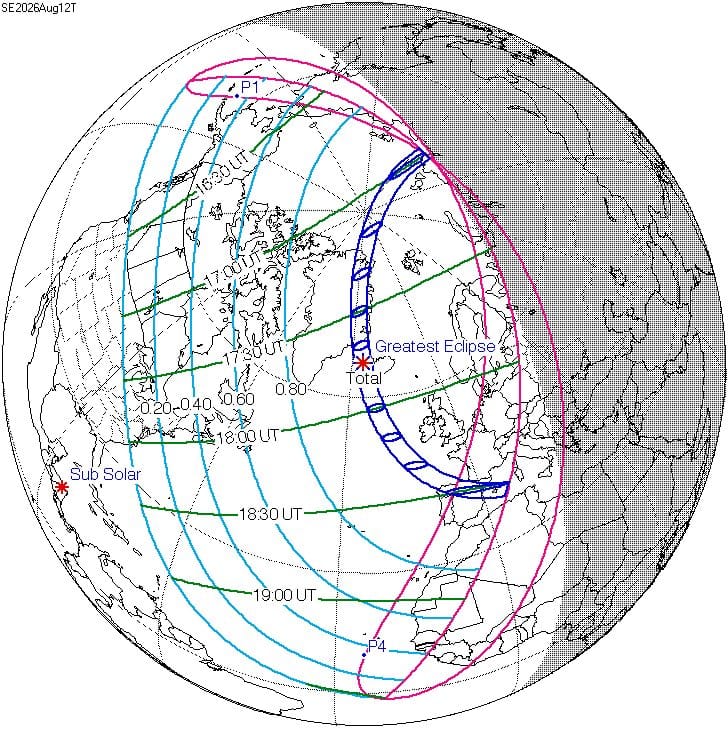
Being inside the band is everything. A 95 percent partial eclipse is interesting; a total eclipse is life-changing. The sky only goes dark, the corona only appears, and the stars only come out inside the path of totality. If you are anywhere close, travel those last kilometers.
The Path of Totality: Greenland, Iceland and Spain
Greenland: the shadow makes landfall on the remote east coast around the vast Scoresby Sund fjord system. Spectacular, but accessible only by expedition cruise.
Iceland: the western third of the country — including Reykjavík, the Snæfellsnes peninsula and the Westfjords — sees totality in the late afternoon, shortly before 17:50 local time. Reykjavík gets around a minute of darkness; locations farther northwest get closer to two. The maximum of the entire eclipse, 2 minutes 18 seconds, occurs over the Atlantic just off Iceland's coast.
Spain: the band comes ashore on the north coast in the evening and crosses the country diagonally toward the Mediterranean. Cities inside the path include Oviedo, Santander, Bilbao, Burgos, Zaragoza, Valencia and Palma de Mallorca. Totality falls roughly between 20:25 and 20:35 local time, with the Sun only 5 to 12 degrees above the western horizon — so scout a viewing spot with a completely open west-facing view.
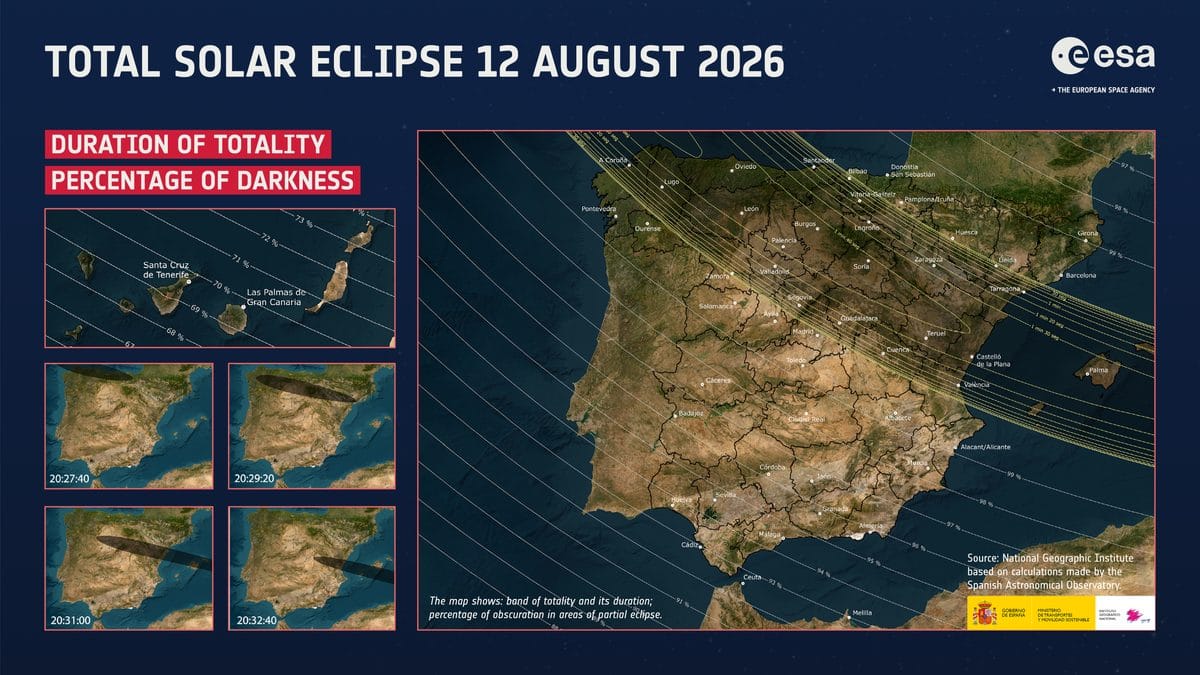
The big gotcha: Madrid and Barcelona are NOT inside the path. Both will see a deep partial eclipse above 90 percent — impressive, but a completely different experience from totality. If you are based in either city, plan the short trip into the band.
Weather odds strongly favor Spain: clear August evenings are the norm across the Ebro valley and the Mediterranean coast, while Iceland's maritime skies are a gamble. That is why most veteran eclipse chasers are booking Spain.
Plan the trip early. August 12 falls in the middle of Spain's peak holiday season, and eclipse chasers from around the world will converge on a fairly narrow band of the country. Accommodation in the well-placed cities — Zaragoza, Valencia, Bilbao, Palma — is expected to sell out far in advance, so lock in beds, rental cars and a backup viewing site months ahead. For Iceland, mobility is the strategy: hire a car, watch the forecast obsessively, and be ready to drive to whichever coast has clear sky that afternoon.
One more planning note: totality in Spain happens on a warm summer evening at prime terrace hour. Plazas, beaches and rooftops inside the band will be packed — arriving hours early to claim an open west-facing spot is not paranoia, it is the plan.
What Will You See? A Minute-by-Minute Guide
A total solar eclipse is a sequence, and every stage is worth watching:
- First contact (about 75 minutes before totality): the Moon takes its first tiny bite out of the Sun. Glasses on.
- The last 15 minutes: the light turns strange and silvery, shadows sharpen, the temperature dips, birds go quiet. Sharp-eyed observers may catch shimmering shadow bands on light-colored ground.
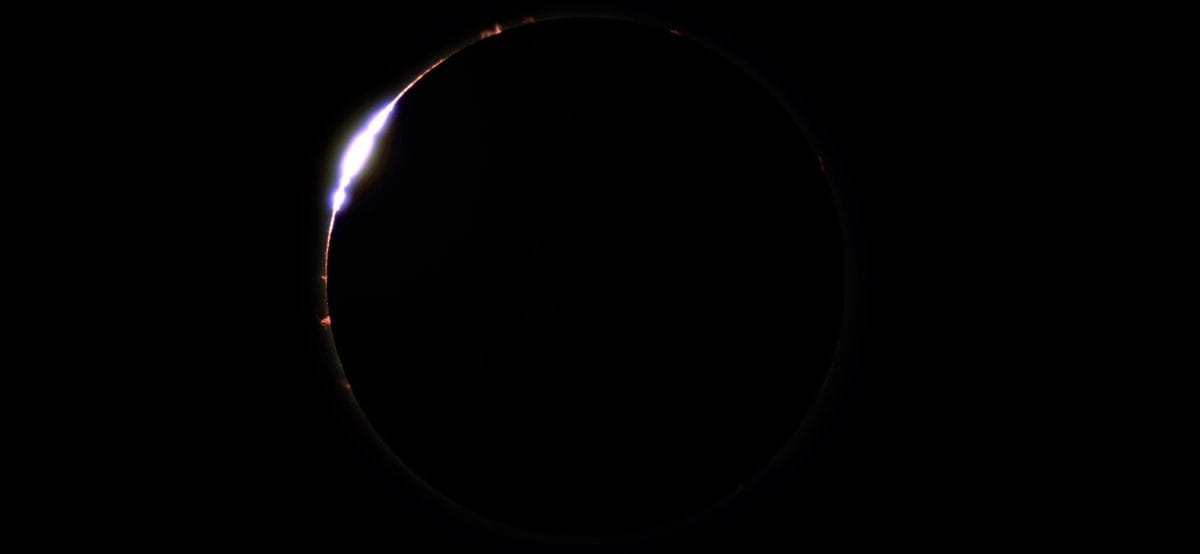
- Baily's beads and the diamond ring: the final slivers of sunlight burst through lunar valleys, ending in one brilliant flash on the Moon's edge.
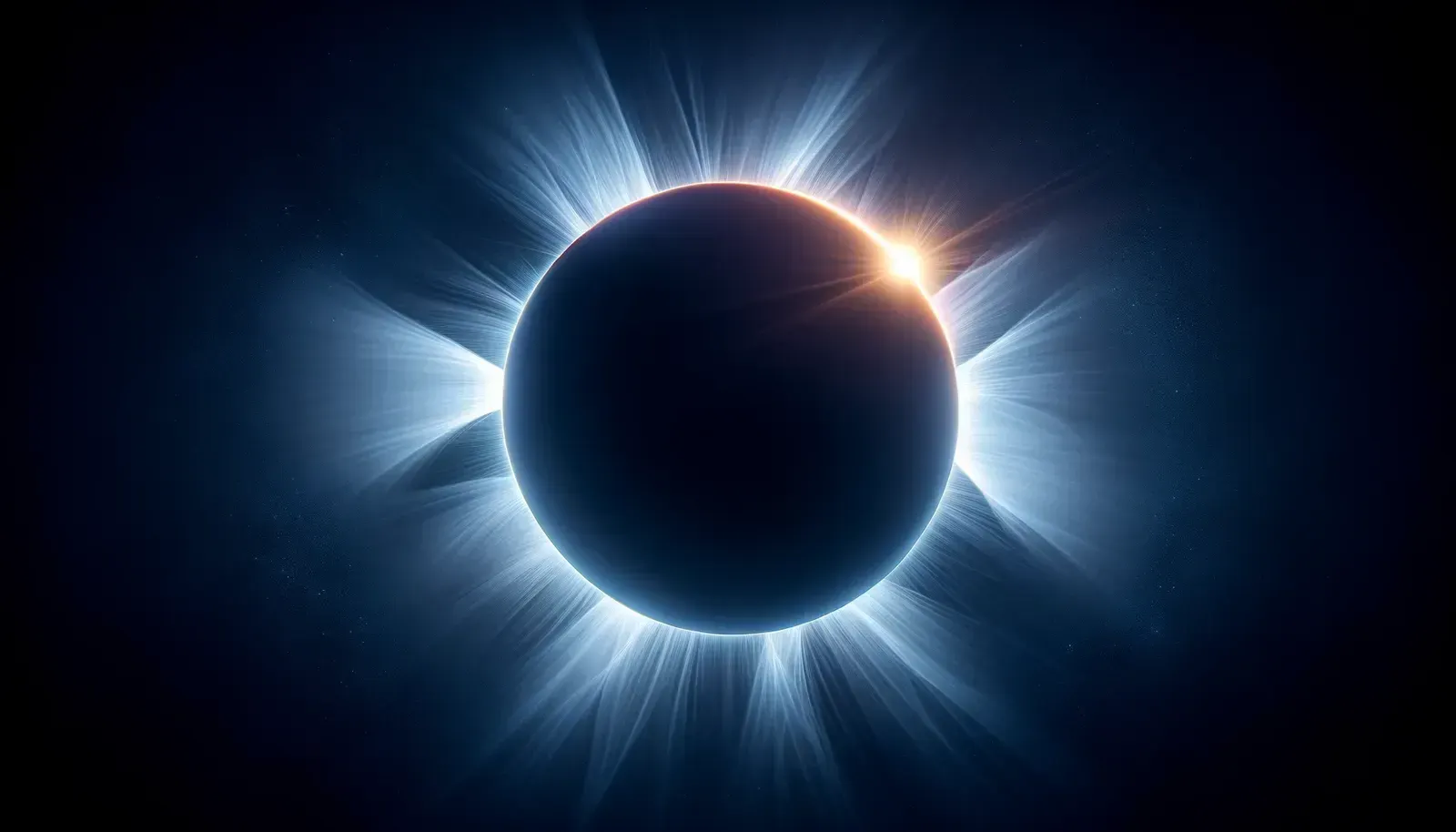
- Totality: the corona springs out around the black disk of the Moon — pearly, spiky, reaching several solar diameters into a twilight-blue sky. Look for red prominences at the rim, a 360-degree sunset around the whole horizon, and bright planets popping into view: Venus should blaze out near the Sun, with Jupiter likely visible too.
- Third contact: a second diamond ring signals the end — glasses back on as the sequence runs in reverse.
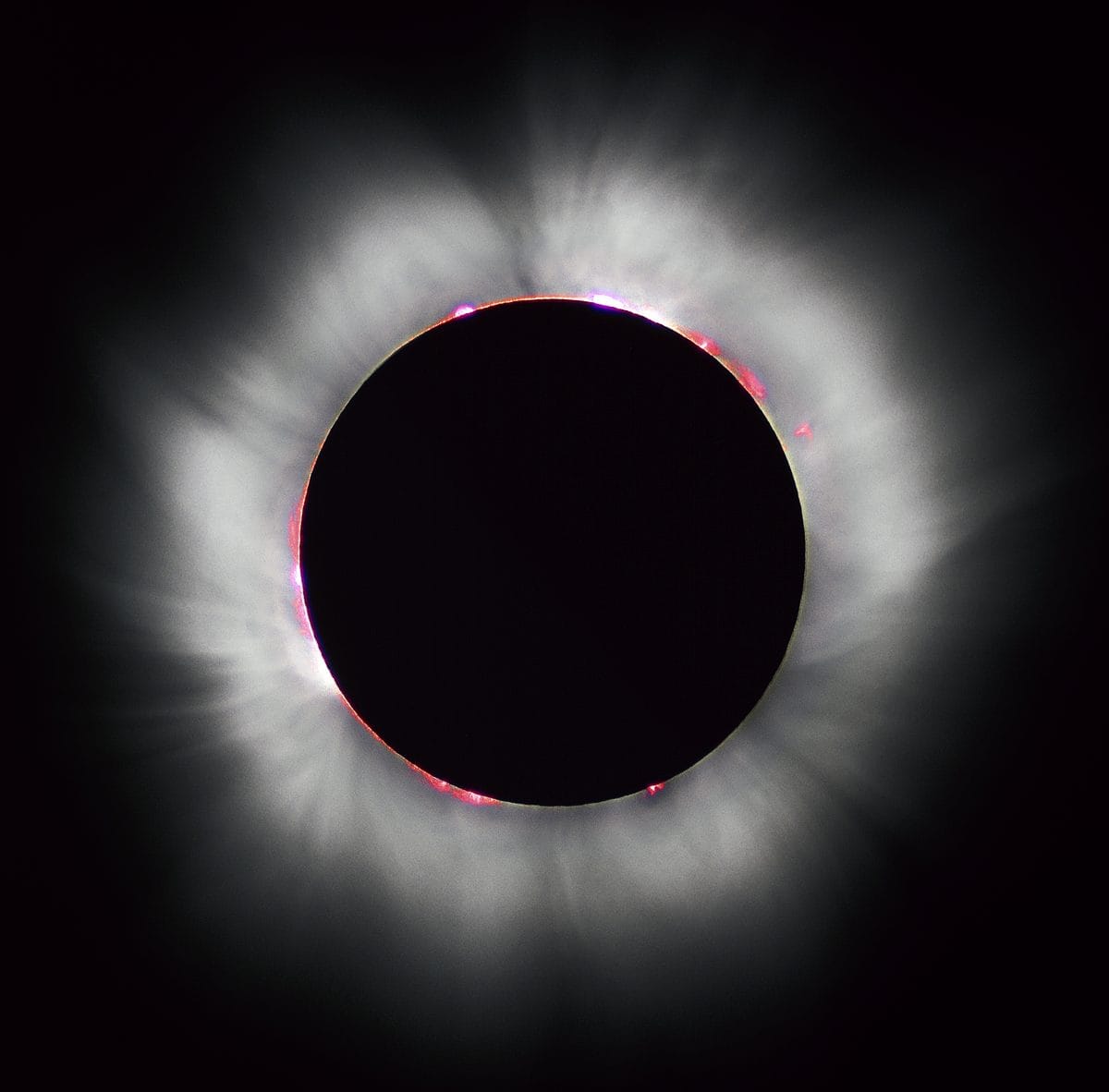
The direct answer to how long it lasts: up to 2 minutes 18 seconds at maximum, and typically one to two minutes at any given spot on land. It will feel like twenty seconds. Decide in advance what you want to do with them.
How to Watch the 2026 Eclipse Safely
The rule is simple: any time any part of the Sun's bright surface is visible, you need certified protection.
- Use eclipse glasses certified to ISO 12312-2 for all partial phases — the American Astronomical Society keeps a list of safe suppliers. Sunglasses, smoked glass and camera filters stacked together are all dangerous substitutes.
- Telescopes, binoculars and camera lenses need a proper solar filter mounted on the front of the optics — never an eyepiece filter, and never optics pointed at the Sun through eclipse glasses.
- Only during totality — when the Moon completely covers the Sun's disk — is it safe to look with the naked eye. The moment the diamond ring reappears, protection goes back on.
Supervise children closely during the partial phases, and check glasses for scratches or pinholes before eclipse day.
How to Photograph a Total Solar Eclipse
Totality is short, so the golden rule of eclipse photography is: rehearse everything, automate what you can, and budget half of totality for just looking up.
- Smartphone: skip the zoomed shot — go wide. Film the landscape, the racing shadow, the 360-degree sunset and the people around you. It is the one photo the big rigs cannot take.
- Camera + telephoto (300–600mm): on a solid tripod with a certified solar film filter for the partial phases. Typical filtered settings: ISO 100, f/8, around 1/500 to 1/2000 second. Focus on the crisp lunar edge in live view and then tape the focus ring.
- Practice on the full Moon: it is almost exactly the same apparent size as the Sun and demands the same telephoto technique. A dress rehearsal of framing, focusing and bracketing on the Moon a month before eclipse day is the best preparation there is.
- During totality: the filter comes OFF. Bracket hard — from about 1/1000 second for prominences and the inner corona out to 1 second for the long streamers. The corona's brightness range is enormous; no single exposure captures it.
- The 2026 bonus: in Spain the eclipsed Sun sits low over the horizon, so mid-range focal lengths can frame totality with the landscape — a composition the overhead eclipses of 2017 and 2024 never allowed.
Work out your framing and exposure plan before you travel — our free astrophotography calculator will tell you how large the Sun's half-degree disk appears with your exact camera and lens or telescope combination.
Why Total Solar Eclipses Happen
Total solar eclipses are a cosmic coincidence. The Sun's diameter is about 400 times the Moon's, and the Sun happens to sit about 400 times farther away — so the two disks appear almost exactly the same size in our sky. When a new Moon crosses the Sun–Earth line precisely at one of the points where its tilted orbit intersects the ecliptic, its shadow touches Earth and races along the ground at over 2,000 km/h.
That such a spectacle happens at all is pure luck: the Moon is slowly drifting away from Earth, and in the distant future all central eclipses will be annular rings, not totalities. We live in the window of time when our nearest neighbor can perfectly blot out our home star.
Eclipses After 2026: Mark These Dates
| Date | Where totality goes | Highlight |
|---|---|---|
| August 2, 2027 | Southern Spain, North Africa, Egypt, Arabian Peninsula | 6 min 23 s near Luxor — the longest land totality of the century |
| July 22, 2028 | Australia (incl. Sydney) and New Zealand | Totality over a major world city |
| March 30, 2033 | Alaska | Next US totality |
| August 23, 2044 | Montana, the Dakotas, western Canada | Next totality for the contiguous US |
| August 12, 2045 | USA coast to coast, California to Florida | The next Great American Eclipse |
The takeaway for Europeans: 2026 and 2027 form a once-in-a-lifetime pair. Catch the first over northern Spain, then come back a year later for the second over Andalusia — two totalities, one country, twelve months apart.
Frequently Asked Questions
When is the next total solar eclipse?
The next total solar eclipse takes place on Wednesday, August 12, 2026, crossing the Arctic, eastern Greenland, western Iceland and northern Spain. After that, the next one is on August 2, 2027, across southern Spain, North Africa and the Middle East.
Where will the 2026 total solar eclipse be visible?
Totality will be visible from parts of eastern Greenland, western Iceland including Reykjavik, and a band across northern Spain reaching the Balearic Islands. A partial eclipse will be visible across the rest of Europe, northern Africa and much of North America.
What time is the 2026 eclipse in Spain?
Totality sweeps across Spain in the evening of August 12, 2026, roughly between 20:25 and 20:35 local time, with the Sun hanging low in the west. Plan a viewing spot with a completely clear, unobstructed western horizon.
Is Madrid or Barcelona inside the path of totality?
No. Both cities will see a deep partial eclipse of more than 90 percent, but that is nothing like totality. To experience the full spectacle you must travel into the band, for example to Zaragoza, Valencia, Oviedo or Palma de Mallorca.
How long will totality last in 2026?
The maximum is about 2 minutes 18 seconds, reached over the North Atlantic west of Iceland. On land, most locations in Iceland and Spain will get roughly one to two minutes of totality.
Do I need eclipse glasses for the 2026 eclipse?
Yes. You need ISO 12312-2 certified eclipse glasses for every partial phase, and certified solar filters for any camera, binoculars or telescope. Only during the brief window of totality is it safe to look at the eclipsed Sun with the naked eye.
When is the next total solar eclipse after 2026?
August 2, 2027. Its path crosses southern Spain, North Africa and the Arabian Peninsula, and near Luxor in Egypt totality lasts an extraordinary 6 minutes 23 seconds, the longest of any land-based total eclipse this century.
When is the next total solar eclipse in the United States?
Alaska sees totality on March 30, 2033. For the contiguous United States, the next total solar eclipses come on August 23, 2044 and August 12, 2045, with the 2045 event sweeping coast to coast from California to Florida.
Keep Exploring
Eclipses are the solar system's greatest show — start with our tour of the solar system to see the machinery behind them, meet Jupiter, the planet that will share the darkened sky during totality, and read what a star actually is to appreciate what the corona reveals about our own.
For official circumstances and interactive maps, see NASA's eclipse portal and the detailed local timings on timeanddate.