
6 Women Who Changed Astronomy Forever (2026)
Five remarkable women who transformed astronomy — from Caroline Herschel to Vera Rubin. Their groundbreaking discoveries and hard-won place in the science.
Astronomy was, for most of its history, a field that actively excluded women — barring them from degrees, observatories and telescopes. Yet again and again, women found ways in, and their discoveries reshaped our understanding of the universe. This guide profiles six of the most influential women in astronomy, from an 18th-century comet-hunter to the scientist who revealed that most of the cosmos is invisible. Their work stands on its own; that they achieved it against the odds makes it all the more remarkable.
Cecilia Payne-Gaposchkin
Born in 1900 in England, Cecilia Payne displayed a keen interest in science from a young age. Overcoming gender barriers in academia, she attended the University of Cambridge but was not awarded a degree due to her gender. Undeterred, she moved to the United States and enrolled at Harvard College Observatory, where she would make her groundbreaking discovery.
In 1925, Payne-Gaposchkin's doctoral thesis, "Stellar Atmospheres," presented a revolutionary idea: stars are primarily composed of hydrogen and helium, challenging the then-prevailing belief that stars had a similar composition to Earth. Her thesis, initially met with skepticism, particularly from astronomer Henry Norris Russell, was later proven to be correct, fundamentally altering the field of astrophysics. This discovery was pivotal in understanding stellar evolution and the composition of the universe.
Beyond her major discovery, Payne-Gaposchkin's career was marked by numerous achievements. She became the first woman to earn a doctorate in astronomy from Radcliffe College, and later, she was appointed as the first female department chair at Harvard. Her extensive research on variable stars and the Milky Way galaxy contributed significantly to the field.
Cecilia Payne-Gaposchkin's contributions to astronomy were monumental. Her determination in the face of adversity, her groundbreaking thesis, and her role as a trailblazer for women in science have left an indelible mark on the field. Her legacy continues to inspire astronomers and scientists worldwide.
Caroline Herschel
Born in Hanover in 1750, Caroline Herschel's early life gave little hint of the astronomer she would become — a childhood bout of typhus stunted her growth, and her family assumed she would never marry or amount to much. When her brother William moved to England and turned from music to astronomy, she joined him, first as his assistant and then as an observer in her own right, grinding mirrors and recording sweeps of the sky through long, cold English nights.
Working with a small telescope William built for her, Caroline discovered eight comets between 1786 and 1797, including the periodic comet now catalogued as 35P/Herschel-Rigollet, and she independently found several nebulae and star clusters. Her painstaking work correcting and extending John Flamsteed's star catalogue was so valued that in 1787 she became the first woman known to be paid a salary for scientific work. In 1828 the Royal Astronomical Society awarded her its Gold Medal — an honour it would not give another woman for well over a century. The precision she brought to observational astronomy set a standard that long outlived her.
Maria Mitchell
Maria Mitchell was born on Nantucket in 1818 into a Quaker community that, unusually for the era, valued education for girls and boys alike. Her father, an amateur astronomer, taught her to use a telescope and to make the exacting observations that sailors depended on, and by her teens she was already rating chronometers for the island's whaling fleet.
On the evening of 1 October 1847, sweeping the sky from the roof of the Pacific National Bank, Mitchell spotted a comet not yet catalogued. The discovery — soon known as “Miss Mitchell's Comet” — won her a gold medal from the King of Denmark and international fame. She became the first American woman to work as a professional astronomer, the first woman elected to the American Academy of Arts and Sciences, and later the first female professor of astronomy in the United States, at Vassar College. There she was a fierce advocate for women's education, insisting her students learn by observing the real sky rather than memorising from textbooks.
Henrietta Swan Leavitt
Henrietta Swan Leavitt was born in Massachusetts in 1868 and joined the Harvard College Observatory as one of its “computers” — the women hired to measure and catalogue stars from glass photographic plates, often for a fraction of a man's wage and with little say over the research. Deaf for much of her adult life, she worked with extraordinary care through tens of thousands of stellar images.
Studying variable stars in the Magellanic Clouds, Leavitt noticed a striking regularity: the brighter a Cepheid variable, the longer it took to pulse. This period-luminosity relationship — now called Leavitt's Law — gave astronomers their first reliable “standard candle” for measuring cosmic distances. It was the ruler Edwin Hubble later used to prove that other galaxies lie far beyond the Milky Way and that the universe is expanding. Leavitt received little recognition in her lifetime and died in 1921; a Swedish mathematician tried to nominate her for the Nobel Prize, only to learn she had already passed away. Modern astronomy's entire distance scale still rests on her insight.
Vera Rubin
Vera Rubin was born in Philadelphia in 1928 and fell in love with the night sky as a child, watching the stars wheel past her bedroom window. She met resistance at nearly every step — turned away from one graduate programme because of her gender, and often the only woman in the room — yet she pressed on, deliberately choosing research questions others thought unfashionable precisely because they left her free to work in peace.
In the 1970s, working with instrument-maker Kent Ford, Rubin measured how fast stars orbit within spiral galaxies. Gravity predicted that stars far from the bright centre should move slowly; instead, Rubin found they moved just as fast as those near the core, galaxy after galaxy. The only explanation was a vast halo of unseen mass — dark matter — outweighing the visible stars several times over. Her meticulous, irrefutable measurements turned dark matter from a fringe idea into one of the central problems of modern cosmology. She never received the Nobel Prize many felt she had earned, but the Vera C. Rubin Observatory now carries her name. You can read her full story in our profile of Vera Rubin.
Jocelyn Bell Burnell
Jocelyn Bell Burnell was born in Northern Ireland in 1943 and had to fight simply to study science — at her school, girls were initially steered toward cooking and needlework rather than the laboratory. She persevered, and as a PhD student at Cambridge in 1967 she found herself analysing miles of chart-recorder paper from a radio telescope she had helped build.
Amid the noise she noticed a faint, absurdly regular signal — a pulse every 1.3 seconds, so precise her team half-jokingly labelled it “LGM-1” for “Little Green Men.” It turned out to be the first known pulsar: a rapidly spinning neutron star sweeping a beam of radio waves across Earth like a lighthouse. The discovery reshaped astrophysics — but when the 1974 Nobel Prize in Physics was awarded for it, the honour went to her supervisor, not to her. Bell Burnell has borne the omission with remarkable grace, becoming one of science's most respected voices and, in 2018, donating her £2.3 million Breakthrough Prize to fund physics scholarships for women, refugees and other under-represented students.
More Women Who Shaped Astronomy
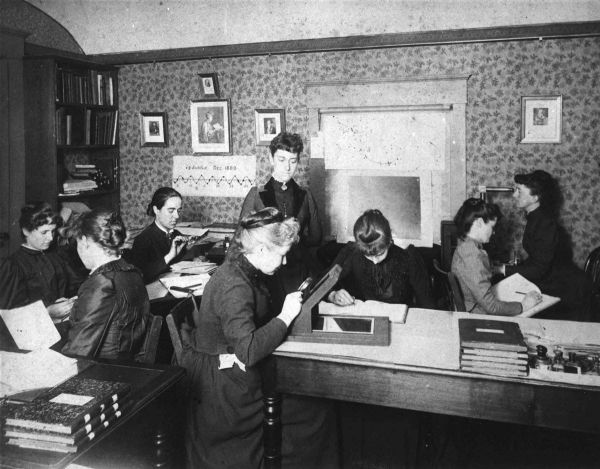
Any list of six leaves out dozens who deserve a place — and several of them worked shoulder to shoulder with Henrietta Leavitt as part of the Harvard College Observatory's “computers,” the group of women pictured at the top of this article. Poorly paid and often uncredited, they collectively built the foundations of modern stellar astronomy.
Williamina Fleming rose from William Pickering's housekeeper to one of Harvard's most productive astronomers, cataloguing more than 10,000 stars and identifying the Horsehead Nebula on a photographic plate in 1888.
Annie Jump Cannon devised the stellar classification system — the O, B, A, F, G, K, M temperature sequence still taught today — and personally classified around 350,000 stars, faster and more consistently than anyone before her.
Nancy Grace Roman became NASA's first Chief of Astronomy and fought for the orbiting observatory that became the Hubble Space Telescope, earning her the nickname the “Mother of Hubble.”
Margaret Burbidge helped explain how the chemical elements are forged inside stars, co-authoring the landmark 1957 paper on stellar nucleosynthesis known to physicists simply as B²FH.
And in our own era, Andrea Ghez shared the 2020 Nobel Prize in Physics for proving that a supermassive black hole sits at the centre of the Milky Way — only the fourth woman ever to win the physics prize.
Ruby Payne-Scott, an Australian physicist, was one of the founders of radio astronomy, making pioneering observations of solar radio bursts during the 1940s — often having to conceal that she was married in order to keep her job.
Beatrice Tinsley transformed extragalactic astronomy by modelling how galaxies form, brighten and evolve across cosmic time — work that still underpins how we read the light of the distant universe.
The pattern repeats across every century and continent: women advancing astronomy while being written out of the credit for it. Naming them, and teaching their science, is part of putting that right.
The Legacy They Left Behind
These six women did more than add entries to the record books — they widened the field itself. Between them they gave us the composition of the stars, the ruler that measures the cosmos, the evidence for dark matter and the first pulsar, all while dismantling the assumption that astronomy was no place for a woman. Their persistence opened doors for the astronomers who followed, and their names now mark prizes, observatories and laws that working scientists use every night. Celebrating them is both a debt to the past and an invitation to a more inclusive future for science. The next generation of astronomers deserves to grow up knowing their names.
Frequently Asked Questions
Who was the first woman paid to be a scientist?
Caroline Herschel, who from 1787 received a royal salary for cataloguing the sky and assisting her brother William Herschel — making her the first woman known to be paid for scientific work.
Who discovered that stars are made mostly of hydrogen?
Cecilia Payne-Gaposchkin, whose 1925 doctoral thesis showed that stars are composed primarily of hydrogen and helium, overturning the prevailing view that they resembled Earth in composition.
Who found the first evidence for dark matter?
Vera Rubin. Her 1970s measurements of galaxy rotation showed stars orbiting far too fast to be held by visible matter alone, implying a large halo of unseen dark matter.
What is Leavitt's Law?
Henrietta Swan Leavitt's discovery that a Cepheid variable star's pulse period is tied to its true brightness. It gave astronomers a standard candle for measuring distances and underpins the entire cosmic distance scale.
Why didn't Jocelyn Bell Burnell win the Nobel Prize for pulsars?
The 1974 Nobel Prize in Physics for pulsars went to her PhD supervisor and a colleague, not to Bell Burnell, despite her being the one who first spotted the signal — a decision still widely regarded as a serious oversight.
Who was the first American woman to become a professional astronomer?
Maria Mitchell, who discovered a comet in 1847, became the first American woman to work as a professional astronomer and later the first female astronomy professor in the United States.
Who were the Harvard Computers?
A group of women hired by the Harvard College Observatory from the 1880s onward to measure and classify stars from photographic plates. Though poorly paid and often uncredited, they included Henrietta Leavitt, Annie Jump Cannon and Williamina Fleming, and their work underpins modern stellar astronomy.
Have women won the Nobel Prize in Physics for astronomy?
Yes, though rarely. Andrea Ghez shared the 2020 Nobel Prize in Physics for revealing the supermassive black hole at the centre of our galaxy — only the fourth woman ever to win it, a reminder that the barriers these pioneers faced are still being dismantled.
Written by