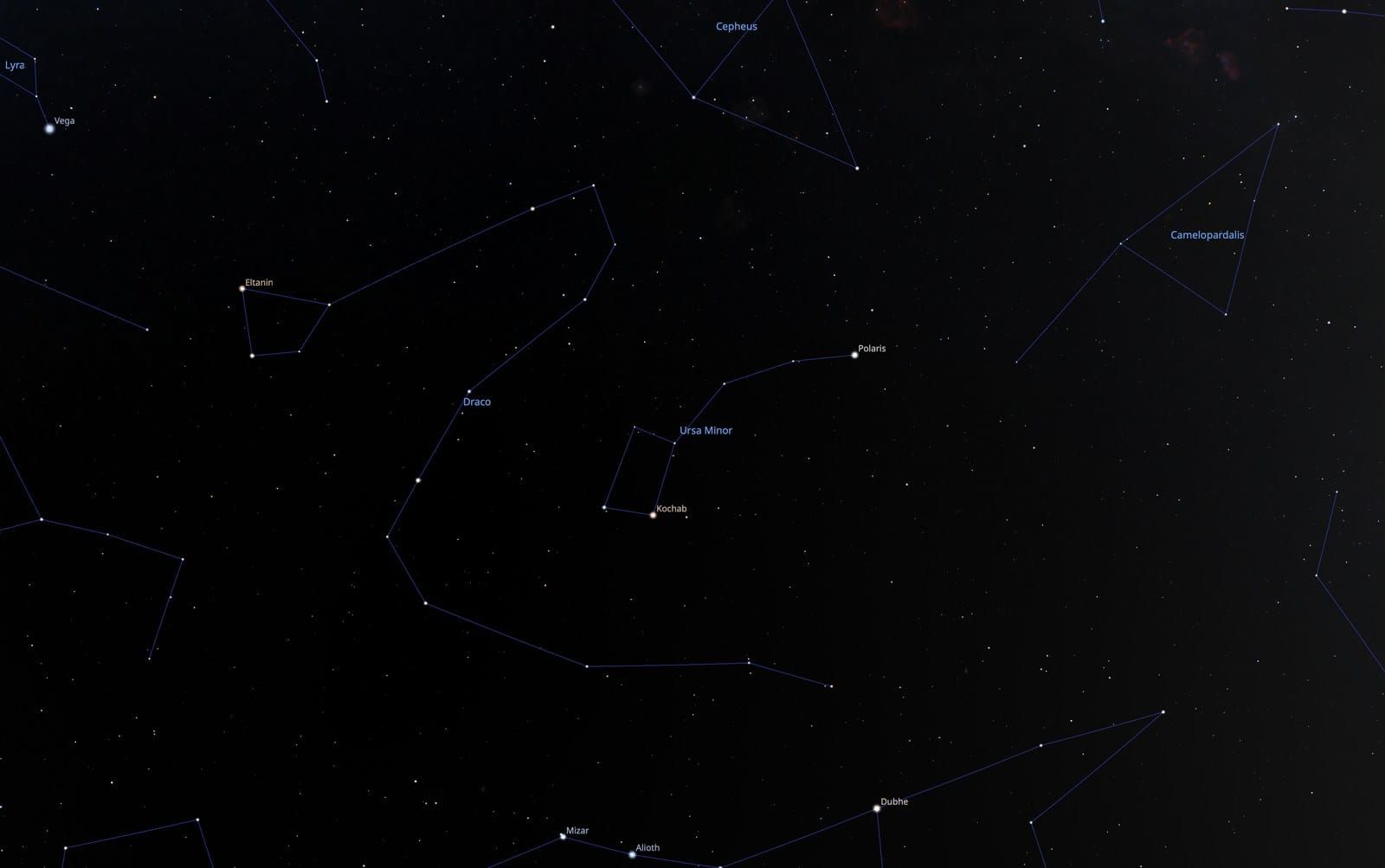
Quick answer: The Ursa Minor constellation is a small northern star pattern best known for Polaris, the North Star, at the tip of its tail. Also called the Little Bear, it holds the Little Dipper asterism and never sets for most Northern Hemisphere observers.
Trace the sky north from the Big Dipper to a single steady star, and you have met the Ursa Minor constellation. Latin for the "Lesser Bear," it carries the abbreviation UMi and the genitive form Ursae Minoris (used when naming its stars). The Greeks also called it Cynosura, "the dog's tail" — the origin of our word "cynosure," something all eyes turn toward. That is a fitting name for a constellation anchored by the one star that barely moves: Polaris.
| Ursa Minor at a glance | Data |
|---|---|
| Abbreviation | UMi |
| Genitive | Ursae Minoris |
| Meaning | The Lesser Bear (Little Bear) |
| Right ascension | about 15h |
| Declination | about +77.7° |
| Area | 256 square degrees (56th of 88) |
| Main stars | 7 (the Little Dipper) |
| Brightest star | Polaris (Alpha UMi), magnitude 1.98 |
| Neighboring constellations | Camelopardalis, Cepheus, Draco |
| Visible at latitudes | +90° to −10° |
| Best season | Circumpolar year-round; highest on June evenings |
| Meteor shower | Ursids (peak around December 22) |
Values above are drawn from the standard IAU constellation boundaries and stellar catalogs; magnitudes follow Hipparcos-era measurements.
What is the Ursa Minor constellation?
Ursa Minor is one of the 48 constellations catalogued by the astronomer Ptolemy in the second century, and it remains one of the 88 constellations recognized today. It is small — 56th out of 88 in area — but it punches far above its size because of what sits at its tail: Polaris, the current North Star. For roughly two thousand years, sailors, caravans, and travelers have used this faint little pattern to find true north.
The seven brightest stars of Ursa Minor form the Little Dipper, a ladle shape that echoes its larger neighbor, the Big Dipper. Polaris sits at the end of the Little Dipper's handle, and the bowl hangs below it. The whole figure is faint: apart from Polaris and two bowl stars, most of Ursa Minor's stars are dim enough that you need a reasonably dark sky to trace the full shape. That faintness is why so many first-time stargazers can find Polaris but struggle to see the rest of the Little Bear.
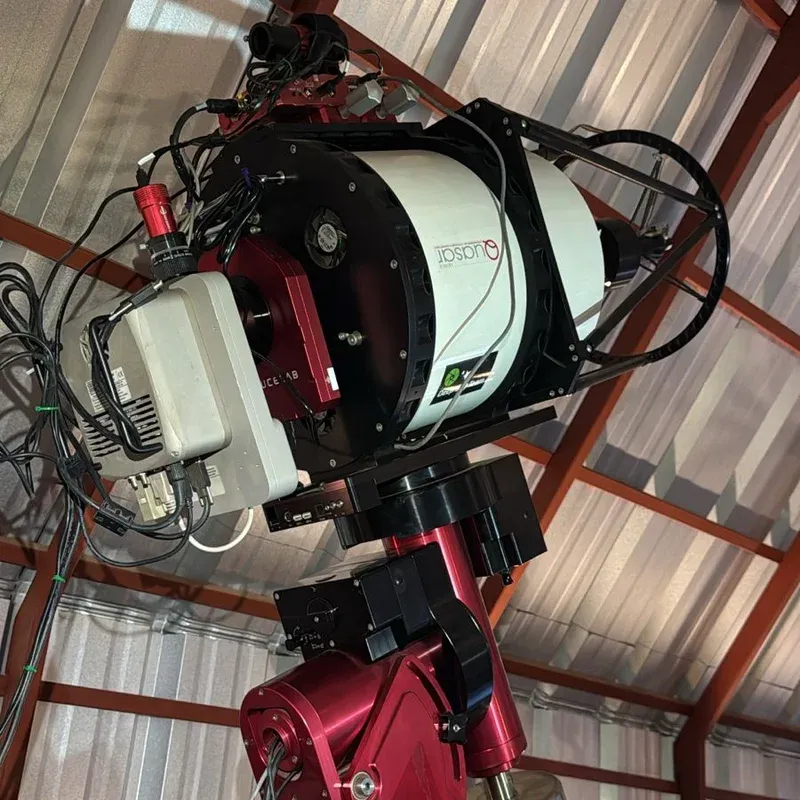
Because Ursa Minor sits so close to the north celestial pole, it never sets for observers across most of the Northern Hemisphere. Instead it turns slowly around Polaris through the night and across the seasons, like a hand sweeping around a clock face. We come back to this pattern constantly from our remote imaging sites, because Polaris is where you begin any careful polar alignment.
How to find Ursa Minor and Polaris
Finding Ursa Minor starts with finding Polaris, and finding Polaris starts with the Big Dipper. The two outer stars of the Big Dipper's bowl — Dubhe and Merak — are known as the "Pointer Stars." Draw an imaginary line from Merak through Dubhe, extend it about five times the gap between them, and you arrive at a lone moderately bright star sitting more or less by itself. That is Polaris. From there, the Little Dipper curls away, with the bowl's two guardian stars, Kochab and Pherkad, off to one side.
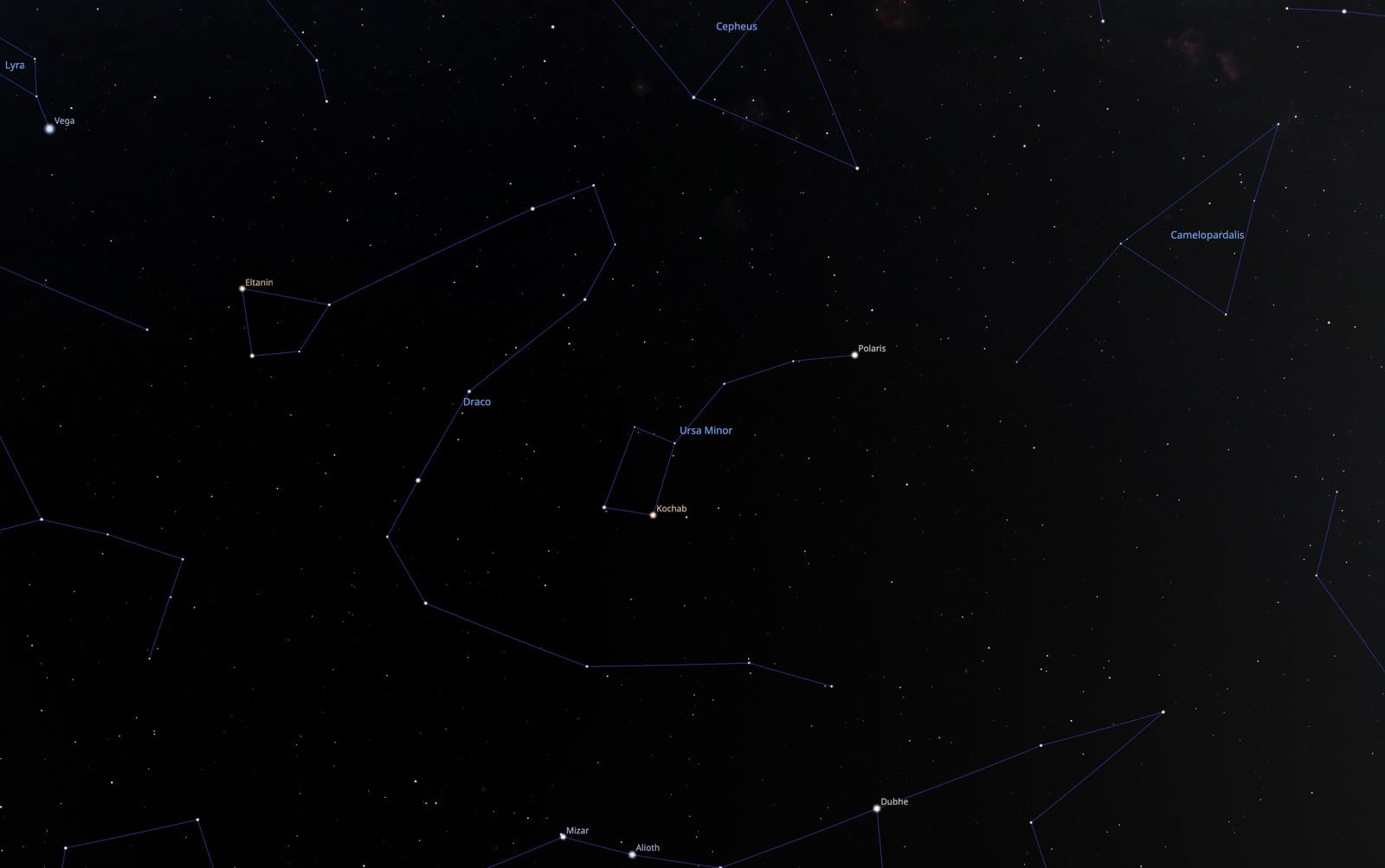
Here is the same route as a step-by-step star hop you can follow with the naked eye from a reasonably dark backyard:
- Find the Big Dipper. High in the northern sky, look for the seven-star ladle of the Big Dipper (part of Ursa Major). In spring and summer evenings it rides high; in autumn it sits low near the horizon.
- Identify the Pointer Stars. Dubhe (magnitude 1.8) and Merak (magnitude 2.4) form the front edge of the Dipper's bowl, the side away from the handle.
- Extend the line about five times. Run a straight line from Merak up through Dubhe and keep going roughly five times that same distance. You will not pass any brighter star along the way.
- Land on Polaris. The first moderately bright star you reach — magnitude 1.98, sitting fairly alone — is Polaris, the tip of the Little Dipper's handle.
- Trace the Little Dipper. From Polaris, follow the faint handle down and around to the bowl. The two brightest bowl stars, Kochab (magnitude 2.1) and Pherkad (magnitude 3.0), are the "Guardians of the Pole" and are the easiest bowl stars to catch under light pollution.
Whatever the season, Polaris always sits at the same spot above your northern horizon — its altitude in degrees equals your latitude. From New York (about 41° N) Polaris stands 41 degrees up; from Quito on the equator it hugs the horizon; from below the equator it drops out of sight entirely.
The stars of the Little Dipper
The Little Dipper's seven stars range from genuinely bright to distinctly faint. Knowing which is which turns a vague smudge of sky into a recognizable shape. Here are the headline stars of the Ursa Minor constellation and the Little Dipper.
| Star | Designation | Magnitude | Notes |
|---|---|---|---|
| Polaris | Alpha (α) UMi | 1.98 | The North Star; a Cepheid variable and a multiple star system |
| Kochab | Beta (β) UMi | 2.08 | Orange giant; brightest of the bowl "Guardians" |
| Pherkad | Gamma (γ) UMi | 3.00 | The second "Guardian of the Pole" |
| Yildun | Delta (δ) UMi | 4.36 | Sits between Polaris and the bowl on the handle |
| Epsilon UMi | Epsilon (ε) UMi | 4.19 | A spectroscopic binary in the bowl |
| Zeta UMi | Zeta (ζ) UMi | 4.28 | A white main-sequence star |
| Eta UMi | Eta (η) UMi | 4.95 | The faintest of the seven — needs a dark sky |
Polaris: the North Star
Polaris is not the brightest star in the night sky — it ranks around 50th — but its position makes it the most useful. It sits within about one degree of the north celestial pole, the point in the sky directly above Earth's north rotational axis. As the planet turns, every other star appears to circle Polaris while Polaris itself barely budges. Point a long-exposure camera north and you get the classic image of concentric star trails wheeling around a single still point.
Polaris is also more than one star. It is a Cepheid variable — a type of star that pulses in brightness on a regular cycle — and it anchors a small system that includes at least two fainter companions. It lies roughly 430 light-years away, so the light you see tonight left Polaris around the time Galileo first turned a telescope to the sky.
Kochab and Pherkad, the Guardians
Before Polaris drifted into its current role, the honor of "pole star" belonged elsewhere. Around 1500 BC, Kochab and Pherkad — the two bright stars of the Little Dipper's bowl — flanked the pole closely enough that ancient observers called them the Guardians of the Pole. Kochab is an orange giant a little brighter than Polaris in raw luminosity; together the pair are your best fallback for locating the bowl when city lights wash out the fainter stars.
Constellation or asterism? Ursa Minor vs the Little Dipper
People often use "Ursa Minor" and "Little Dipper" interchangeably, but they are not quite the same thing. Ursa Minor is a constellation — an official region of the sky with fixed boundaries set by the International Astronomical Union, containing everything within those borders. The Little Dipper is an asterism — an informal, memorable pattern made of the constellation's seven brightest stars, with no official standing.
Put simply: the Little Dipper is the recognizable shape; Ursa Minor is the whole neighborhood that shape sits in. It is the same relationship the Big Dipper has with its parent constellation, Ursa Major — a distinction we unpack further in our guide to the Little Dipper asterism. If you can picture the ladle, you have the asterism; if you can name the boundary and everything inside it, you have the constellation.
Best time to see Ursa Minor
The short answer: any clear night, if you live in the Northern Hemisphere. Because Ursa Minor wraps around the north celestial pole, it is circumpolar for most northern observers — it never dips below the horizon, so it is technically visible every night of the year. That is a rare luxury among constellations, most of which come and go with the seasons.
The full Little Dipper spans roughly 15° of sky — far too wide for a telescope, but a fine binocular target. To see how much of the bowl or Polaris's neighborhood fits in your own eyepiece or camera frame, run your setup through our telescope field of view calculator.
That said, the pattern rides highest and is easiest to trace on June and July evenings, when the bowl swings up above Polaris. In autumn and winter evenings the Little Dipper hangs below the pole star instead, and the fainter stars can be harder to pick out. Your latitude matters too: the farther north you are, the higher Polaris and the whole Little Bear sit in your sky. From roughly 10 degrees south of the equator and beyond, Ursa Minor disappears from view entirely.
Dark skies make the difference
Light pollution is the real obstacle here. Polaris, Kochab, and Pherkad punch through suburban skies, but the three faint handle-and-bowl stars — Yildun, Epsilon, and Eta Ursae Minoris — need a genuinely dark site to appear. Under a Bortle 4 sky or better, the full Little Dipper snaps into shape; under bright city glow, you may only ever see the three brightest stars. If you are learning the pattern, start on a moonless night away from streetlights.
The Ursids meteor shower
Ursa Minor also lends its name to the Ursids, a modest meteor shower that radiates from near Kochab and Pherkad each December, peaking around the 22nd. It is a quiet shower — typically 5 to 10 meteors per hour — but because the radiant is circumpolar, you can watch it all night from a dark northern site.
Deep-sky objects in Ursa Minor
Ursa Minor is a small, star-poor patch of sky, so it holds few showpiece deep-sky targets — but a couple are worth knowing. The Ursa Minor Dwarf is a dwarf spheroidal galaxy, one of the Milky Way's small satellite companions, lying about 200,000 light-years away. It is extremely faint and dominated by ancient stars, a favorite of researchers studying dark matter rather than a backyard target.
The best telescopic object here is NGC 6217, a barred spiral galaxy of around 11th magnitude. It is compact but shows structure in mid-sized amateur scopes and rewards astrophotographers with a tidy face-on spiral. There is also the Polaris Flare, a wispy field of high-latitude molecular cloud near Polaris that turns up in deep, wide-field images as faint "integrated flux" nebulosity.
Wondering whether NGC 6217 will fit your camera and scope? Its apparent size is only about 3 arcminutes across, so it suits longer focal lengths. Before you plan a session, drop the target and your gear into our telescope field-of-view simulator to see exactly how the galaxy will frame in your setup — the same tool we use to plan our own runs.
A note on our own imagery: unlike our deep-sky target guides, this post uses charts rather than our own captures — a constellation-wide field spanning hundreds of square degrees is a job for a star chart, not a telescope. NGC 6217 is on our capture list for the remote rig, and we will add our own image of it here once the data is in.
The mythology of the Little Bear
Why a bear, and why a little one? The most familiar story comes from Greek myth and pairs Ursa Minor with its larger neighbor. In one telling, the nymph Callisto is transformed into a bear and set into the sky as Ursa Major, while her son Arcas becomes the smaller bear beside her, Ursa Minor. In another tradition, the constellation represents Cynosura, one of the nymphs who nursed the infant Zeus and was rewarded with a place among the stars.
The bear's oddly long tail — no real bear has one — is often explained in the myth by Zeus swinging the animals into the heavens by their tails, stretching them in the process. Whatever the story, the practical value outshone the poetry: the Greek navigator-astronomer Thales is credited with encouraging sailors to steer by Ursa Minor rather than Ursa Major, because the Little Bear sits closer to true north. Phoenician sailors relied on it so heavily that some ancient writers called the constellation "the Phoenician." For a wider tour of the sky's storied patterns, our complete guide to the constellations maps how figures like this one fit together, and the winter showpiece Orion makes a striking companion once you have found north.
Frequently asked questions
Is Ursa Minor the same as the Little Dipper?
Not exactly. Ursa Minor is the official constellation — a bounded region of sky. The Little Dipper is the asterism formed by its seven brightest stars. The Little Dipper is the shape; Ursa Minor is the whole area it lives in.
Is Polaris in Ursa Minor, and is it the North Star?
Yes. Polaris (Alpha Ursae Minoris) is the brightest star in Ursa Minor and marks the tip of the Little Dipper's handle. It sits within about one degree of the north celestial pole, which is why it serves as the North Star and appears to stay fixed while the sky turns around it.
How do you find Ursa Minor in the sky?
Find the Big Dipper, then use its two Pointer Stars, Dubhe and Merak. Extend a line from Merak through Dubhe about five times the gap between them to reach Polaris. From Polaris, trace the faint Little Dipper down to its bowl.
Why is Ursa Minor called the Little Bear?
"Ursa Minor" is Latin for "Lesser Bear." In Greek mythology it represents a small bear — often the son of Callisto (the Great Bear, Ursa Major) or the nymph Cynosura — placed in the sky beside its larger companion.
Can you see Ursa Minor all year?
From most of the Northern Hemisphere, yes. Ursa Minor is circumpolar, meaning it never sets and is visible on any clear night. It rides highest on June and July evenings and vanishes only for observers south of about 10 degrees south latitude.
Will Polaris always be the North Star?
No. Earth's axis slowly wobbles in a 26,000-year cycle called precession, so the pole gradually points at different stars. Polaris is near its closest alignment now; thousands of years from now, stars like Vega and Thuban will take a turn as the pole star.


&body=Ursa%20Minor%20Constellation%3A%20How%20to%20Find%20the%20Little%20Bear%20%26%20Polaris%20(2026)%20%E2%80%94%20The%20Ursa%20Minor%20constellation%20is%20home%20to%20Polaris%2C%20the%20North%20Star.%20Here%20is%20how%20to%20find%20the%20Little%20Bear%2C%20spot%20its%20Little%20Dipper%20stars%2C%20and%20know%20when%20to%20look.%20https%3A%2F%2Fstellarnomads.com%2Fursa-minor%2F%20Image%3A%20https%3A%2F%2Fstorage.ghost.io%2Fc%2Fbf%2F0d%2Fbf0d5d59-0433-4995-b3fa-4f41b743ef1b%2Fcontent%2Fimages%2F2026%2F07%2Flittle-dipper-finder.jpg)