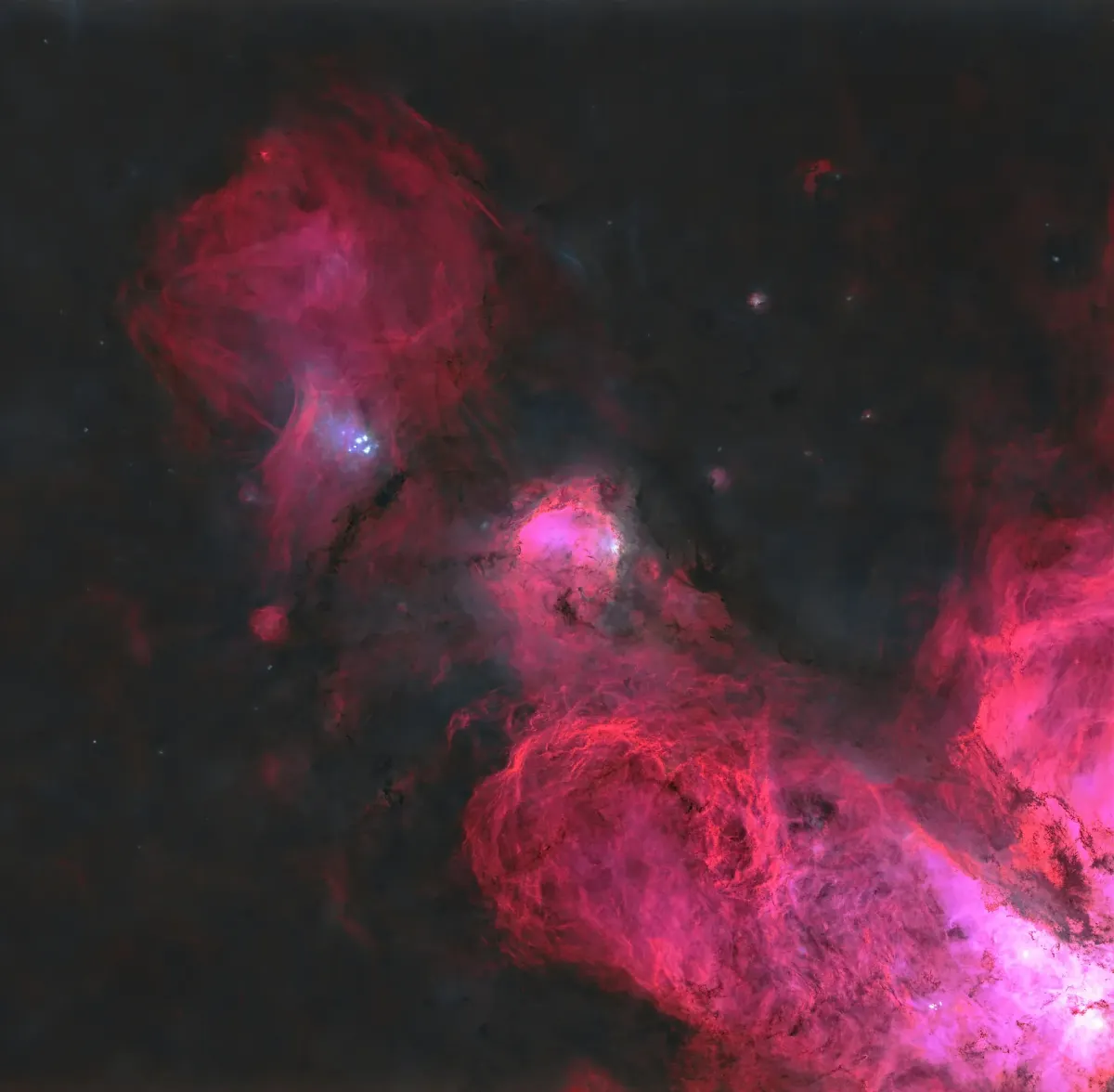
The Orion constellation is a bright, hourglass-shaped group of stars named after a hunter in Greek myth. You find it on winter evenings by spotting Orion's Belt — three stars in a near-perfect row — flanked by red Betelgeuse and blue-white Rigel. It sits on the celestial equator, so almost everyone on Earth can see it.
Few star patterns are as easy to learn as the Orion constellation. Once you have met the Hunter, you will spot him again every winter for the rest of your life — and he becomes the signpost that leads you to half the bright stars in the sky. This guide is written for curious beginners: no telescope, no jargon, just your eyes and a dark-ish evening. We will show you how to find Orion, name its main stars, tour its glowing nebula, and unpack the myth behind the figure.
Orion is one of the 88 official constellations that map the whole sky. If you want the bigger picture once you are done here, start with our complete guide to the 88 constellations.
What is the Orion constellation?
The Orion constellation is a pattern of stars representing Orion the Hunter, a giant from Greek mythology. It is one of the 88 constellations recognised by the International Astronomical Union, and it is among the most recognisable of them all — a broad-shouldered figure with a slim three-star belt at his waist and a sword hanging beneath it.
What makes Orion special is its position. It straddles the celestial equator — the imaginary line that divides the sky into northern and southern halves — so it rises due east and sets due west and is visible from almost every inhabited place on Earth. Orion ranks 26th in size among the constellations, covering 594 square degrees, but it punches far above its area: it holds two of the ten brightest stars in the night sky and one of the closest large star-forming regions to us. Its official IAU boundary and star chart are among the best documented in the sky.
How to find Orion in the night sky
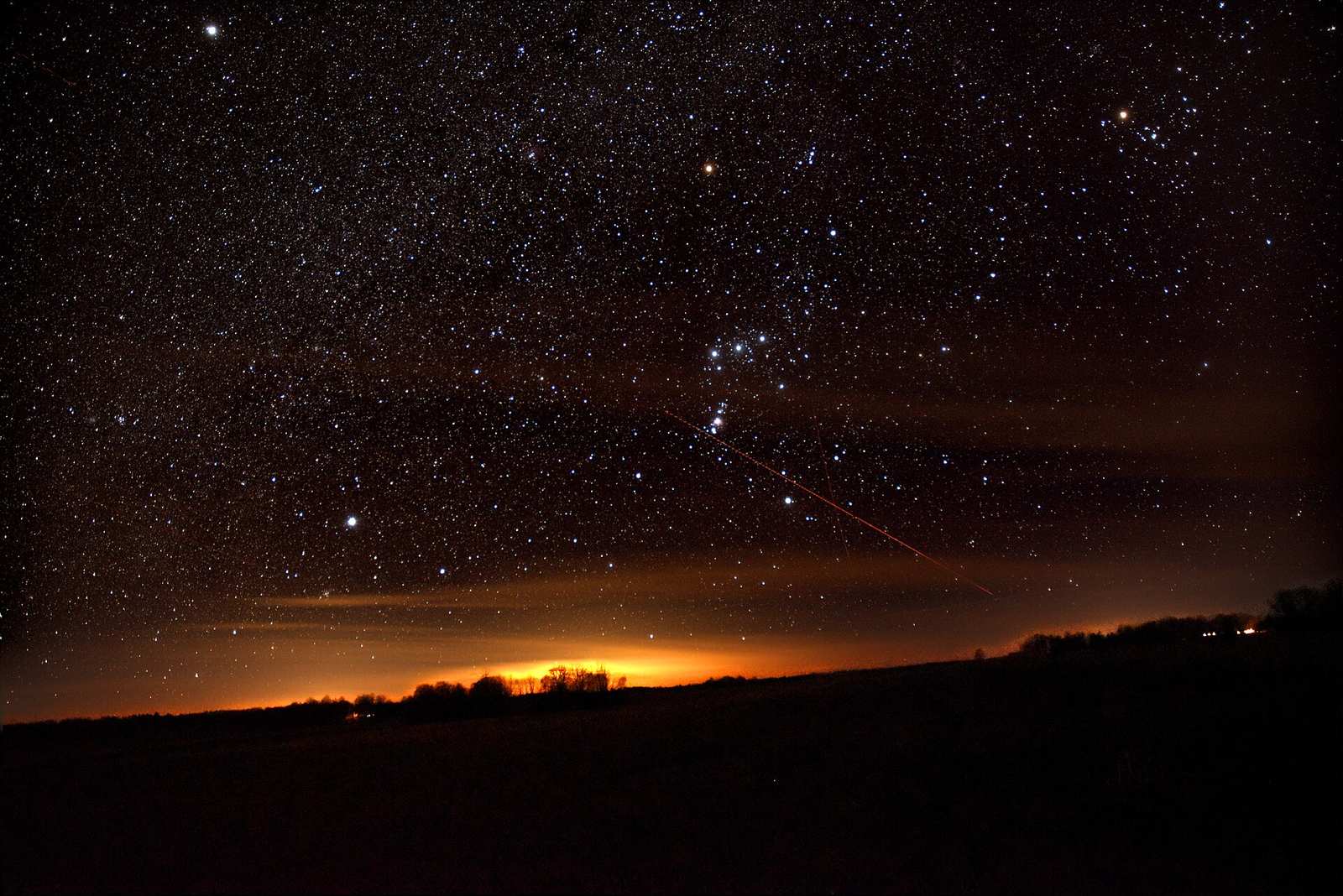
The fastest way to find Orion is to look for the Belt: three bright stars of similar brightness, evenly spaced in a short, straight line. Nothing else in the sky looks quite like it, so once you learn the Belt, you have learned Orion.
Start with Orion's Belt
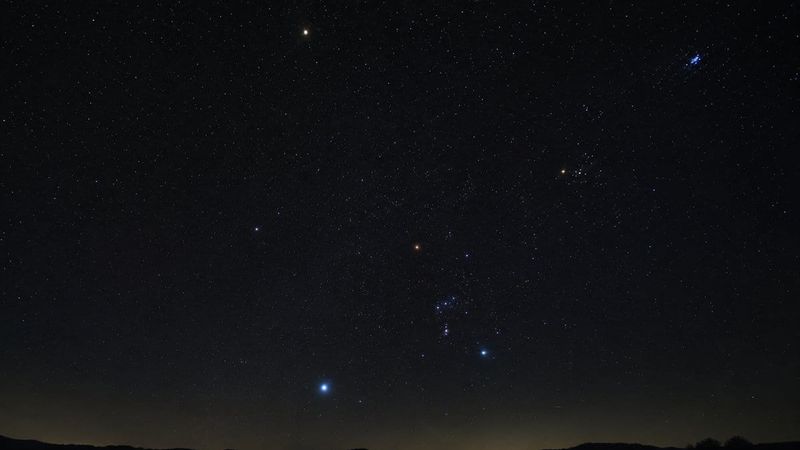
On a clear winter evening, face the southern part of the sky (if you are in the Northern Hemisphere) and look for three medium-bright stars in a tidy row. That is Orion's Belt. Above and to either side you will notice two brighter stars — the shoulders — and below, two more bright stars mark the feet or knees. Together they frame the tall hourglass shape of the Hunter.
Just below the Belt, look for a fainter vertical smudge of stars: that is Orion's Sword, and the middle "star" is really the Orion Nebula, which we visit further down.
When and where to look
Orion is a winter constellation for the Northern Hemisphere. From roughly December to March it stands high in the evening sky; by late winter it is already sinking in the west after sunset. Through 2026 the best naked-eye evenings run from January into March, and again from late October before dawn as Orion climbs back into the morning sky.
South of the equator the seasons flip: Orion appears on summer evenings, and it stands "upside down" compared with the northern view, with Rigel up top and Betelgeuse below. The pattern is identical — only the orientation changes.
| Where you are | Best evening months | Look toward |
|---|---|---|
| Northern Hemisphere | December – March | South, mid-to-high in the sky |
| Equator / tropics | December – March | Passes near overhead |
| Southern Hemisphere | December – February | North, appears inverted |
Use the Belt as a signpost
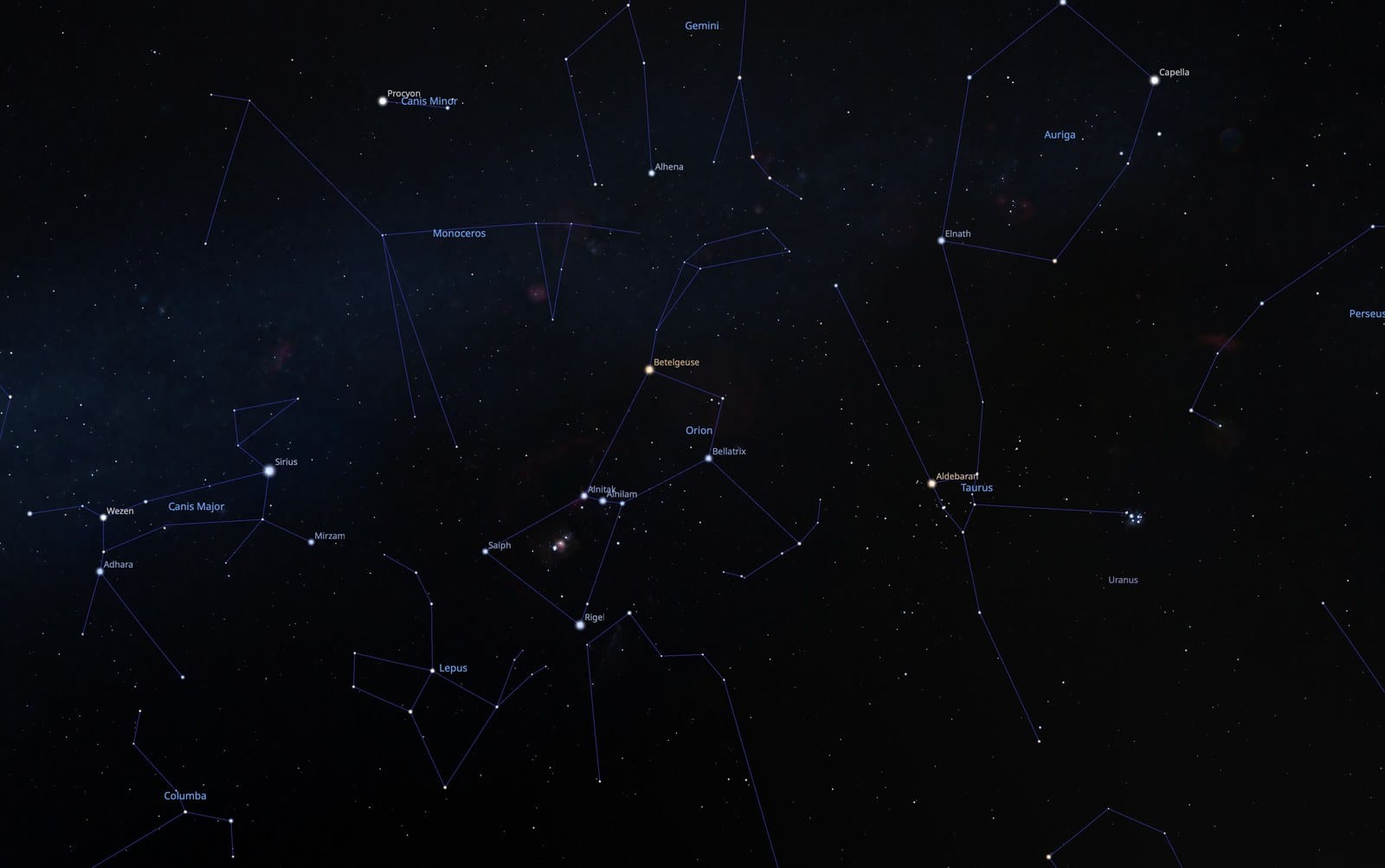
Orion's real superpower is that it points to other stars. Follow the line of the Belt down and to the left and you run straight into Sirius, the brightest star in the night sky. Follow it up and to the right and you reach orange Aldebaran in Taurus, and beyond it the tiny dipper-shaped Pleiades star cluster. Drop a line down from the shoulders and you find Sirius again with Procyon, forming the Winter Triangle.
This is exactly how experienced observers navigate — one known pattern leads to the next. The Big Dipper does the same job in the northern spring sky, and the Little Dipper holds Polaris, the North Star. Learn a few signpost patterns and the whole sky opens up.
The main stars of Orion
Orion is crowded with luminous, massive stars — the kind that live fast and die young. Several of the dots you are looking at are supergiants hundreds of times wider than the Sun, so bright that we see them clearly from hundreds or thousands of light-years away. Before we name them one by one, this Kurzgesagt explainer puts their scale in perspective — the difference between our Sun and a star like Betelgeuse is genuinely hard to believe:
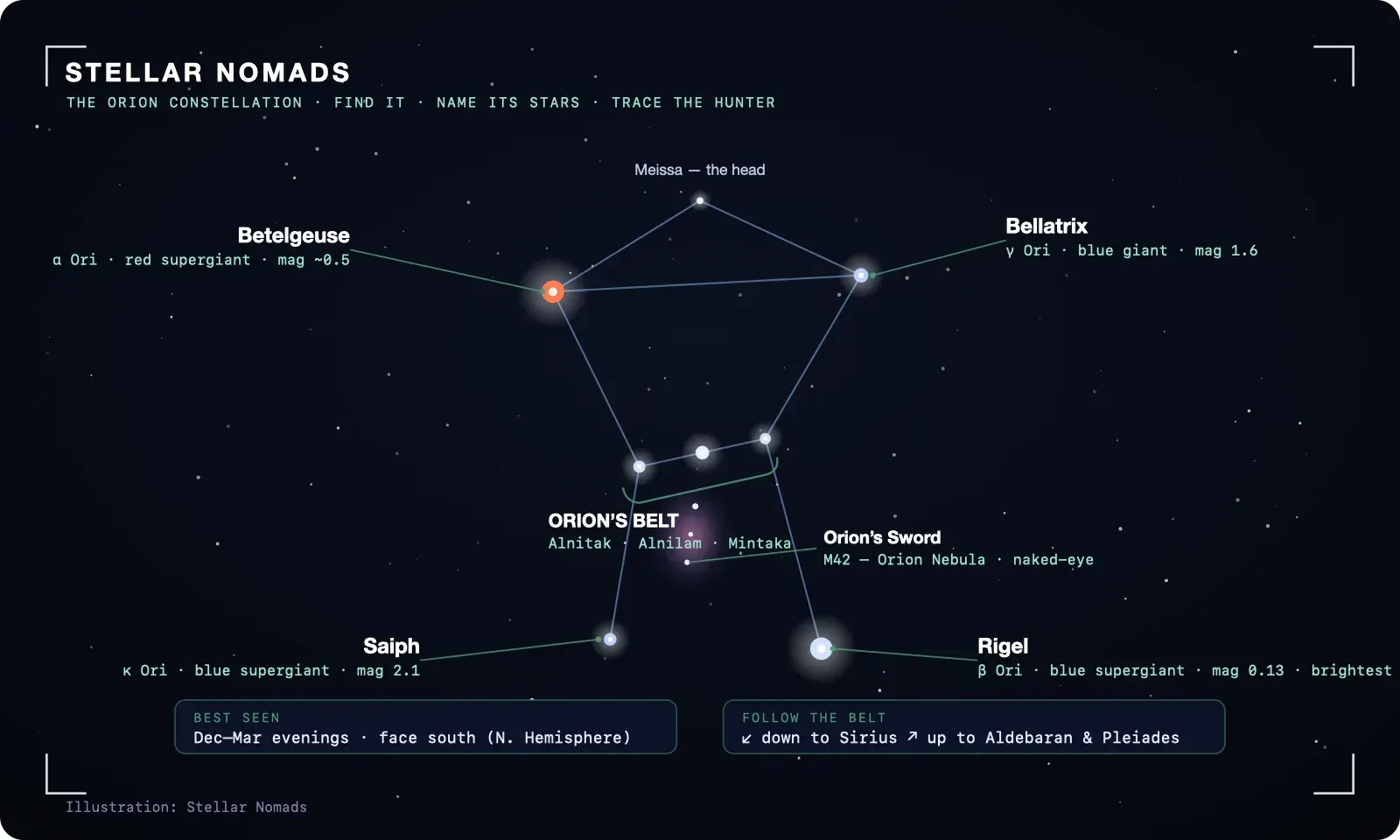
Here is the whole figure at a glance — the two bright shoulders, the three-star Belt, the feet, and the Sword with its nebula:
Betelgeuse — the red supergiant
Betelgeuse (Alpha Orionis) marks Orion's left shoulder and is the easiest star in the sky to identify by colour: it glows a distinct orange-red, unlike the icy blue-white of Orion's other bright stars. It is a red supergiant so vast that, if it replaced the Sun, its surface would reach out past the orbit of Jupiter.
Betelgeuse is a variable star — its brightness wobbles around magnitude 0.5. In late 2019 and early 2020 it dimmed dramatically in the "Great Dimming," fading by more than half. Astronomers later traced this to a giant cloud of dust the star had belched out, temporarily veiling it. Betelgeuse is near the end of its life and will one day explode as a supernova; when it does, it will briefly shine as bright as a crescent Moon before fading forever. That is likely tens of thousands of years away, so there is no rush — but it is a reminder that these stars are living things. To understand what is happening inside a star like this, see our guide to what a star actually is.
Rigel — the blue supergiant
Rigel (Beta Orionis) marks Orion's foot and is, despite its "Beta" label, the brightest star in the constellation at magnitude 0.13 — the seventh-brightest star in the entire night sky. It is a blue supergiant roughly 860 light-years away, pouring out around 120,000 times the light of the Sun. Where Betelgeuse is a cooling giant nearing death, Rigel is a searing-hot heavyweight in its prime. The colour contrast between the two — warm Betelgeuse at one corner, cold-blue Rigel at the opposite — is one of the best naked-eye demonstrations of stellar temperature you can see.
Bellatrix, Saiph and Meissa
The other corners of the figure are bright in their own right. Bellatrix (Gamma Orionis), the right shoulder, is a hot blue giant at magnitude 1.6. Saiph (Kappa Orionis) marks the right foot and is a blue supergiant much like Rigel, only farther away and so appearing dimmer at magnitude 2.1. Above the shoulders, the faint star Meissa (Lambda Orionis) forms the Hunter's small head, sitting inside its own little cloud of gas.
Orion's Belt — Alnitak, Alnilam and Mintaka
Orion's Belt is the three-star line at the Hunter's waist, and it is one of the most famous sights in the sky. From east to west (left to right, seen from the north) the stars are Alnitak, Alnilam and Mintaka — all hot, blue, massive stars, and all far more distant than they look. Alnilam, the middle star, is the standout: a blue supergiant so luminous that we see it clearly from well over a thousand light-years away.
The names carry their history. "Alnitak," "Alnilam" and "Mintaka" all come from Arabic, a legacy of the medieval astronomers who catalogued and named so many stars — the same tradition that gave us names like those charted by Al-Battani. Here is how the seven headline stars compare:
| Star | Designation | Type | Magnitude | Distance (approx.) |
|---|---|---|---|---|
| Rigel | β Ori | Blue supergiant | 0.13 | ~860 ly |
| Betelgeuse | α Ori | Red supergiant | ~0.5 (variable) | ~550–650 ly |
| Bellatrix | γ Ori | Blue giant | 1.64 | ~250 ly |
| Alnilam | ε Ori | Blue supergiant | 1.69 | ~1,300+ ly |
| Alnitak | ζ Ori | Blue supergiant | 1.77 | ~1,260 ly |
| Saiph | κ Ori | Blue supergiant | 2.09 | ~650 ly |
| Mintaka | δ Ori | Blue giant | 2.23 | ~1,200 ly |
Orion's Sword and the Orion Nebula (M42)
Hanging below the Belt is a fainter line of stars — Orion's Sword. Look closely (or through binoculars) and the middle of the Sword is not a star at all but a soft glowing patch. That is the Orion Nebula, catalogued as Messier 42 (M42): the brightest nebula in the sky and the closest large stellar nursery to Earth, about 1,340 light-years away.
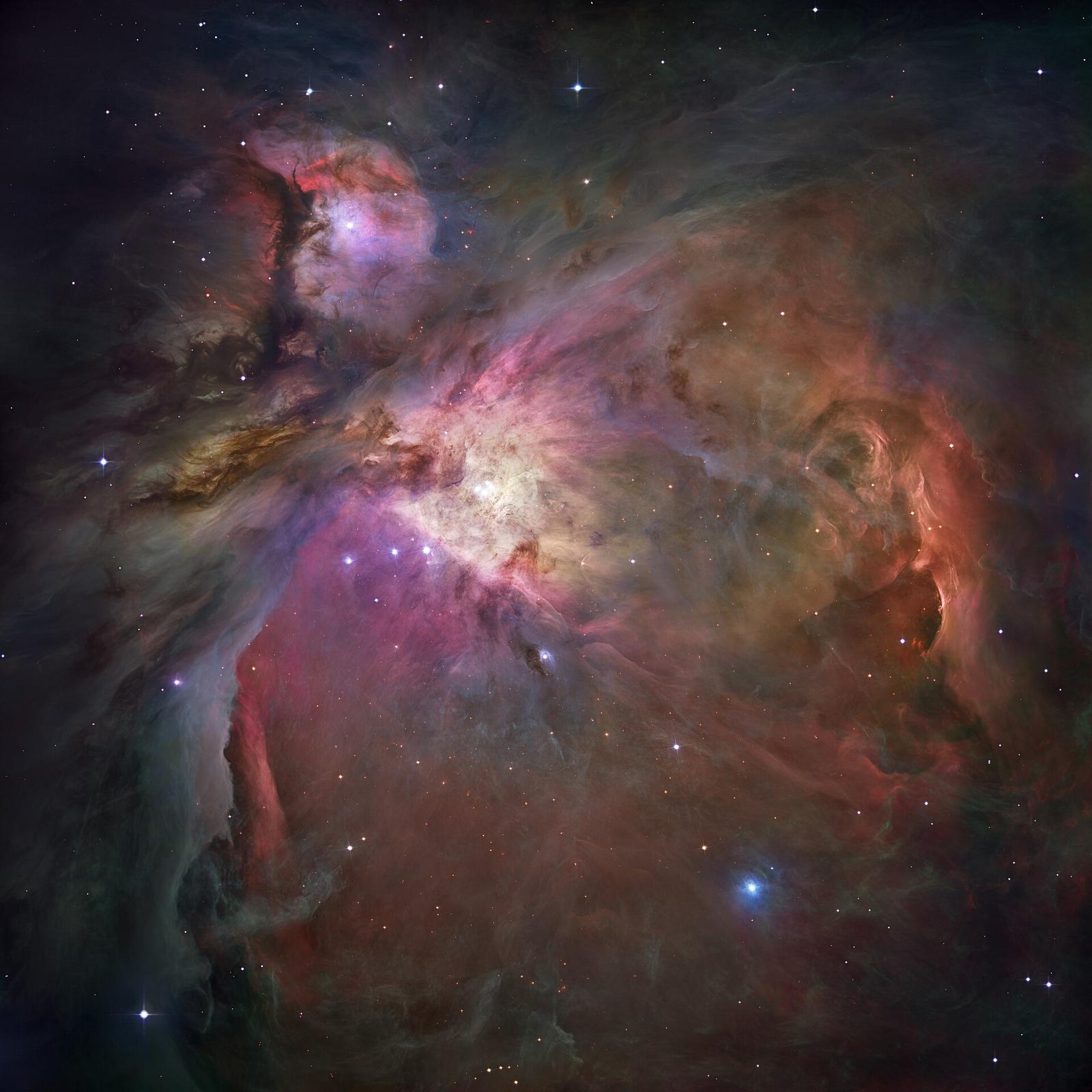
Inside this cloud, gravity is pulling gas together into thousands of new stars right now. At its heart sits the Trapezium, a tight knot of hot young stars whose radiation lights the whole nebula from within. The famous Hubble Space Telescope mosaic of the Orion Nebula reveals this detail in extraordinary depth. You can glimpse M42 with your unaided eye from a dark site and see real structure in it through a small telescope — it is the perfect first deep-sky target. To understand what these clouds are and how they build stars, read our explainer on what a nebula is.
Orion holds more than M42. Near the Belt star Alnitak lie the dark Horsehead Nebula and the glowing Flame Nebula — famous astrophotography targets that need long exposures rather than a casual glance. If you want to try capturing them, our guide to the Wizard Nebula walks through the same find-see-photograph approach, and you can plan how a target fits your gear with our telescope field-of-view calculator.
The mythology of Orion
Orion is named for a giant huntsman in Greek mythology, often called a son of the sea god Poseidon. Stories about him vary — the ancients told several versions — but the most common thread is that Orion was a boastful hunter who claimed he could kill every animal on Earth.
That boast was his undoing. In one telling, the Earth goddess Gaia sent a scorpion to kill him; in another, the goddess Artemis was involved. Either way, Orion and the scorpion were both placed in the sky — and, crucially, on opposite sides of it. That is why the constellation Scorpius rises in the east only as Orion sets in the west: the Hunter still flees the scorpion, forever, across the turning sky. It is a myth written into the mechanics of the heavens, and a lovely thing to point out to someone the first time they meet both constellations.
Orion appears in cultures far beyond Greece. The three Belt stars, so striking and so evenly spaced, show up in the sky-lore of ancient Egypt, of many Indigenous peoples, and of civilisations across every continent — a reminder that this is one of humanity's shared landmarks.
When is Orion visible in 2026?
For most readers in the Northern Hemisphere, Orion is an evening sight from about December 2025 through March 2026, highest around midnight in early winter and lower in the west as spring approaches. Through spring and summer it is lost in the Sun's glare, then returns to the pre-dawn sky in late October — which is also when the Orionid meteor shower peaks, its meteors streaking out of the region near Orion's raised club.
Those "shooting stars" are debris from Halley's Comet burning up in our atmosphere, and they are a great excuse to get out under a dark sky in autumn. NASA's guide to the Orionid meteor shower has the exact peak dates each year. If you want to plan for them and other displays, see our full guide to meteor showers.
Orion constellation FAQ
Is Orion a zodiac constellation?
No. Orion sits just below the zodiac and is not one of the twelve zodiac signs. The Sun never passes through Orion; it passes through neighbouring Taurus and Gemini instead. Orion is simply a bright, non-zodiac constellation that happens to lie near the ecliptic.
What are the three stars in a row in Orion?
They are Orion's Belt — Alnitak, Alnilam and Mintaka, listed from east to west. All three are hot blue supergiant or giant stars, more than a thousand light-years away, and their near-perfect alignment is the quickest way to identify the whole constellation.
Why is Orion so easy to find?
Because it packs bright stars into a distinctive shape and sits on the celestial equator, so it is visible worldwide. The three evenly spaced Belt stars are unlike anything else in the sky, and the surrounding shoulders and feet are bright enough to see from a city.
Is Betelgeuse going to explode?
Yes, eventually. Betelgeuse is a red supergiant near the end of its life and will end as a supernova — but that is likely tens of thousands of years away, and possibly much sooner or later. When it happens it will be a spectacular but harmless show, briefly as bright as the Moon.
Can you see Orion from the Southern Hemisphere?
Yes. Because Orion lies on the celestial equator, it is visible from both hemispheres. Southern observers see it on summer evenings and "upside down" relative to the northern view, with Rigel above and Betelgeuse below, but it is the same familiar pattern.
What are the brightest stars in Orion?
Rigel (magnitude 0.13) is the brightest, followed by the red supergiant Betelgeuse (around magnitude 0.5). Both rank among the ten brightest stars in the entire night sky. After them come Bellatrix, the three Belt stars, and Saiph.
Orion rewards you every winter: the more you look, the more you notice — the colour split between Rigel and Betelgeuse, the fuzzy glow in the Sword, the way the Belt guides your eye across the sky. Meet him once and you will never be lost under the stars again. When you are ready for the next pattern, head back to our guide to all 88 constellations and pick your next target.