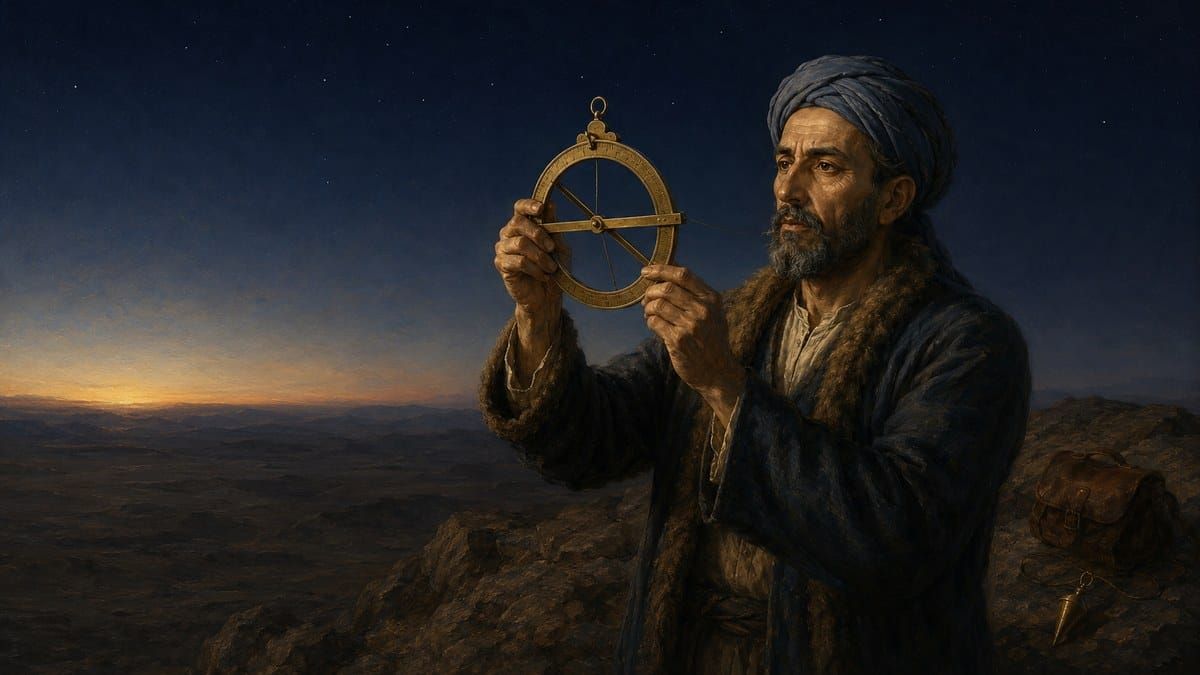
Al-Biruni (973–1048 CE) was a Persian polymath who measured the Earth’s radius to within about 1%, argued that our planet turns on its axis, and described the Milky Way as a cloud of countless stars — roughly 500 years before Copernicus. Across a long life he wrote some 150 works spanning astronomy, mathematics, geography, and history.
Why Al-Biruni Still Matters in 2026
Ask most people to name a great early astronomer and you will hear Ptolemy, then a long silence until Copernicus and Galileo. Yet a thousand years ago, in the oasis towns of Central Asia, Al-Biruni was already practising something we would recognise today as modern science: measuring carefully, questioning authority, and admitting when the evidence ran out.
He is the scholar who worked out the size of the Earth from a single hillside, weighed gemstones to a precision that would not be matched for centuries, and treated Indian astronomy as a subject to study rather than dismiss. If you enjoy our guide to the most famous astronomers in history, Al-Biruni belongs near the very top — and this is why.
Who Was Al-Biruni?
His full name was Abu Rayhan Muhammad ibn Ahmad al-Biruni. He was born in September 973 CE in Kath, the capital of Khwarezm (in modern Uzbekistan), and the name “Biruni” roughly means “from the outer district” — an outsider from the start. He grew up in a region that prized learning, and by his twenties he was already exchanging sharp letters with other scholars about the shape of the cosmos.
His curiosity refused to stay in one lane. Alongside astronomy and mathematics he wrote on mineralogy, pharmacology, cartography, and the measurement of time, and he insisted on checking claims against observation rather than accepting them on authority. That habit of testing ideas — and of saying plainly when he could not be sure — is what makes reading him feel oddly contemporary a thousand years later.
Al-Biruni lived through war and exile. When Sultan Mahmud of Ghazni conquered his homeland, Al-Biruni was carried east to the Ghaznavid court and, from there, into India during Mahmud’s campaigns. Rather than resent the upheaval, he learned Sanskrit and used the journey to study a civilisation few in his world understood. He wrote in Arabic — the scholarly language of the age — but read Persian, Greek, and Sanskrit too. He died in December 1048 in Ghazni, in what is now Afghanistan, at around 75 years of age. For a concise overview of his life, the Encyclopaedia Britannica entry on al-Biruni is a reliable starting point.
What Did Al-Biruni Discover? 8 Contributions That Changed Science
Al-Biruni was not a one-idea genius. His reach was extraordinary, but eight achievements stand out for how far ahead of their time they were.
1. He Measured the Size of the Earth from a Single Mountain
Earlier scholars had sized the Earth by walking a long north–south baseline between two cities and comparing the Sun’s angle — the method of Eratosthenes and, later, the astronomers of Caliph al-Ma’mun. Around 1023, while staying at the fort of Nandana in the Salt Range of present-day Pakistan, Al-Biruni found a way to do it from one spot.
He climbed a hill of known height, waited for a clear day, and measured the tiny angle by which the horizon appears to “dip” below true horizontal when you look out to sea or across a plain. That single angle, plus the mountain’s height, is enough to solve for the planet’s radius using the geometry of a right triangle. His answer — about 6,339 kilometres — lands within roughly 1% of the modern value of 6,371 kilometres.
We should be honest about the accuracy: Al-Biruni did not know that the atmosphere bends light near the horizon, and that refraction quietly nudged his answer. Part of his close result was good fortune. But the idea — reducing a planetary measurement to one clever observation — was centuries ahead of its time.
2. He Argued the Earth Turns on Its Axis
Long before it was safe or fashionable, Al-Biruni took seriously the possibility that the Earth spins. He had read the Indian astronomers Aryabhata and Brahmagupta, some of whom assigned the daily east-to-west motion of the sky to a turning Earth rather than a turning heaven.
Al-Biruni weighed the idea with real rigour and concluded that, mathematically, a rotating Earth and a rotating sky produce the same predictions for an astronomer’s tables — so the observations of his day could not settle it. He left the question open rather than pretend to an answer. That restraint is one of the most modern things about him.
3. He Saw the Milky Way as Countless Stars
With no telescope, Al-Biruni described the Milky Way as “a collection of countless fragments of the nature of nebulous stars.” It would take Galileo’s telescope in 1610 to confirm that the pale band is made of individual suns. You can trace that thread forward through Galileo Galilei and his contributions to astronomy.
4. He Wrote the Mas’udic Canon, a Complete Astronomy
In 1031 Al-Biruni finished his masterwork, Al-Qanun al-Mas’udi (the Mas’udic Canon), dedicated to Sultan Mas’ud of Ghazni. It is an encyclopedia of astronomy: trigonometry, planetary motions, star positions, and geographic coordinates, gathered and corrected in one place. In the tradition of handbooks like those of Al-Battani, who corrected Ptolemy’s tables, it became a reference for generations of astronomers.
5. He Mapped the World with Eclipses and Coordinates
Al-Biruni was a geographer as much as an astronomer. He timed lunar eclipses from different cities to work out differences in longitude, calculated the latitudes and longitudes of hundreds of places, and devised methods to find the direction of Mecca from anywhere. Determining position on a round Earth is the same problem astronomers solve today when they map the sky — a challenge we explore in how astronomers measure sizes and distances in space.
6. He Founded the Serious Study of India
His book Tarikh al-Hind (“The History of India”) is a landmark. Instead of caricaturing a foreign culture, Al-Biruni learned Sanskrit, read Indian astronomy and philosophy at the source, and reported what he found with unusual fairness. Historians often call him one of the first anthropologists for exactly this reason.
7. He Weighed Metals and Gems to Astonishing Precision
Using a simple conical vessel and the principle of displacement, Al-Biruni measured the specific gravities (relative densities) of eighteen metals and gemstones. His figures for gold, silver, and other materials come remarkably close to modern values — often within a fraction of a percent, an accuracy that would not be routinely bettered for centuries.
8. He Refined the Astrolabe and Built a Geared Calendar
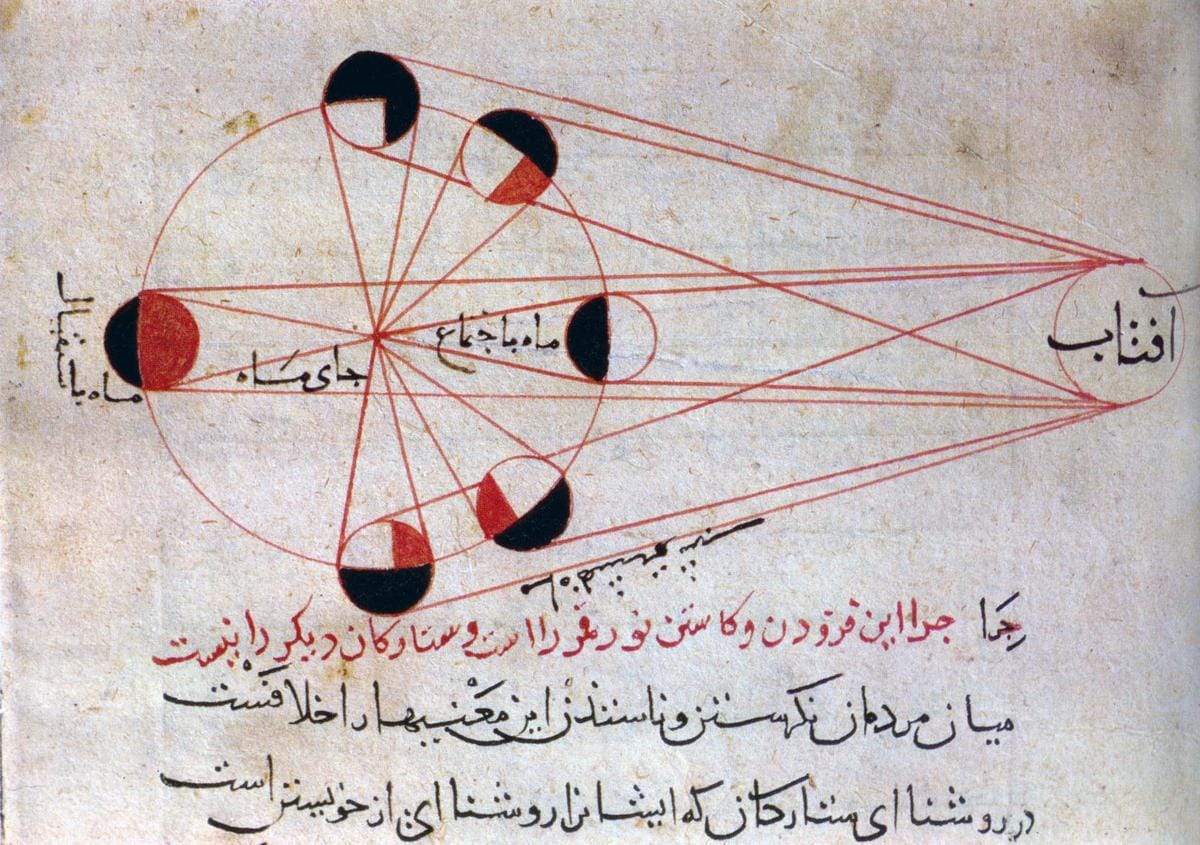
Al-Biruni wrote extensively on the astrolabe, the elegant hand-held computer of medieval astronomy, building on the work of scholars such as Al-Farghani, whose primer taught medieval Europe the shape of the sky. He also described a mechanical lunisolar calendar driven by gear wheels — a device that points, in miniature, toward the geared instruments of later centuries.
Did Al-Biruni Discover Heliocentrism?
Not quite — and it is worth being precise. Al-Biruni never proposed that the planets orbit the Sun. What he did do was take the Earth’s rotation seriously and engage honestly with Indian ideas that leaned toward a moving Earth. He concluded that the astronomy of his time could not decide the matter and refused to overstate the case.
That is a different achievement from the one credited to Copernicus, who placed the Sun at the centre five centuries later — but it shows a mind willing to question the fixed Earth long before Europe did.
Al-Biruni and Ibn Sina: A Clash of Two Giants
As a young man, Al-Biruni exchanged a famous series of letters with Ibn Sina (Avicenna), the towering philosopher-physician of the age. Preserved as al-As’ila wal-Ajwiba (“Questions and Answers”), the debate saw Al-Biruni challenge Aristotle’s physics head-on — asking, for instance, whether other worlds could exist and pressing on points where observation seemed to contradict the old philosophy. It is a rare window onto two brilliant minds disagreeing in real time.
How Accurate Was Al-Biruni’s Earth Measurement?
Judged by the standards of his era, Al-Biruni’s numbers are striking. Here is how his figures for the Earth compare with today’s accepted values.
| Quantity | Al-Biruni (c. 1023) | Modern value | Difference |
|---|---|---|---|
| Earth’s radius | ~6,339.6 km | 6,371 km (mean) | ~0.5% |
| Earth’s circumference | ~39,965 km | 40,075 km (equatorial) | ~0.3% |
The caveat from earlier still stands: because Al-Biruni could not correct for atmospheric refraction, some of this precision was luck rather than method. The honest verdict is that his technique was brilliant and his result was excellent — and that both facts can be true at once.
There is a second, quieter uncertainty worth knowing about. Al-Biruni recorded his answer in the units of his day — cubits and Arabic miles — and historians still debate exactly how long those units were. Convert them one way and his figure is almost perfect; convert them another and the error grows. So when you read that he was “accurate to within 1%,” remember that the last decimal depends on a ruler we can no longer hold. What is not in doubt is the elegance of the method itself.
Al-Biruni’s Books: How Many Did He Write?
By his own account, Al-Biruni produced around 150 works, of which roughly 35 dealt with pure astronomy. Fewer than two dozen survive today. The University of St Andrews’ MacTutor history of mathematics catalogues his surviving mathematical work in detail. The most important include:
- The Chronology of Ancient Nations (al-Athar al-Baqiya) — a comparative study of calendars and eras across cultures.
- Tarikh al-Hind — his groundbreaking account of Indian science, religion, and society.
- The Mas’udic Canon (al-Qanun al-Mas’udi) — his encyclopedic astronomy handbook.
- The Book of Instruction in the Elements of the Art of Astrology — which quietly teaches real mathematics and astronomy along the way.
- Kitab al-Jamahir — his treatise on gems and their densities.
Death, the Moon Crater, and a 1,000-Year Legacy
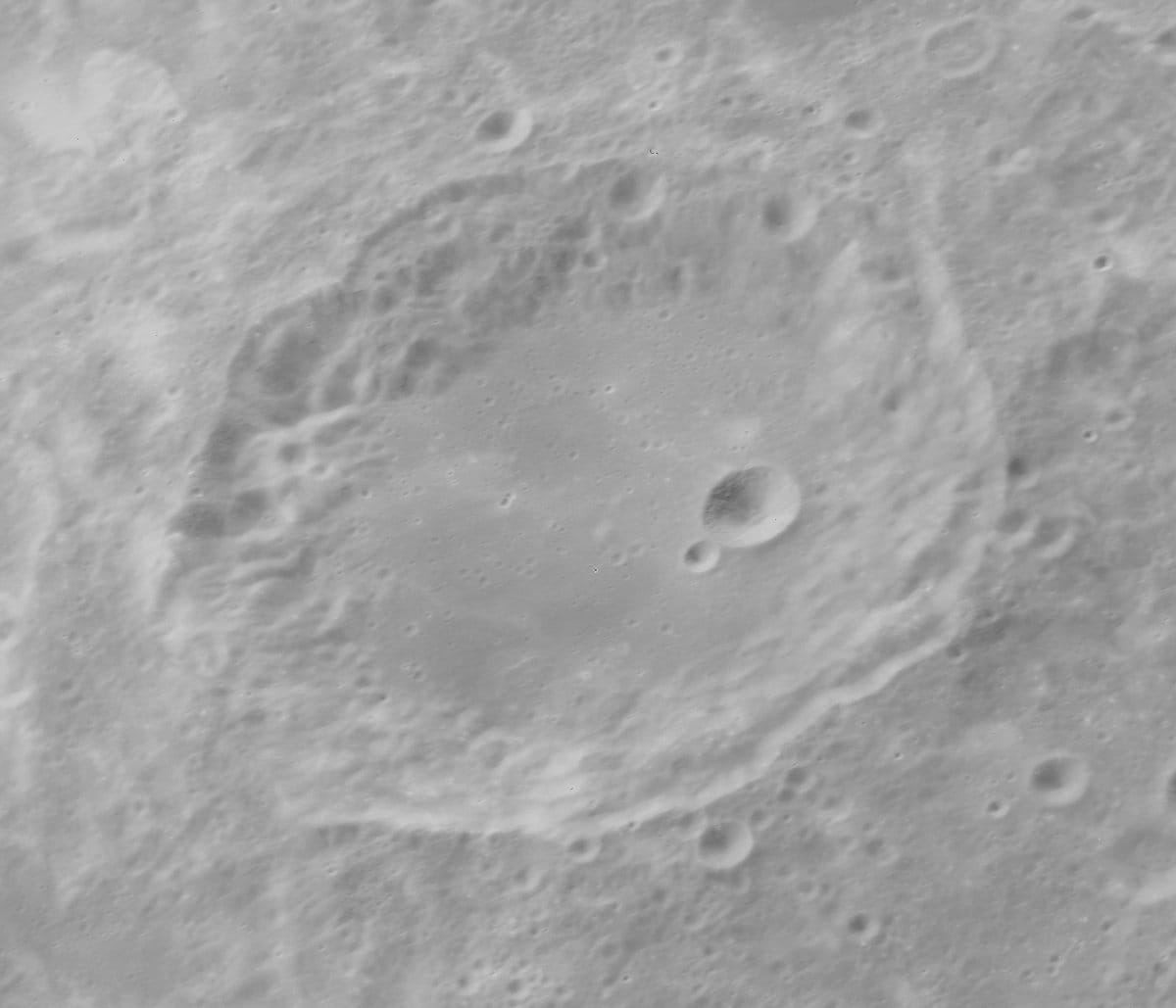
Al-Biruni died in Ghazni in December 1048, still working almost to the end. His influence outlived him by a millennium. The lunar crater Al-Biruni, on the far side of the Moon, carries his name, as does the asteroid 9936 Al-Biruni. A statue of him stands among the great scholars honoured at the United Nations Office in Vienna, and 1973 — the thousandth anniversary of his birth — was marked by celebrations across Central Asia.
Common Misconceptions About Al-Biruni
- “He proved the Earth is round.” Educated scholars already accepted a spherical Earth in his day. Al-Biruni’s achievement was to measure its size, not its shape.
- “He was an Arab.” He was a Persian speaker from Khwarezm who wrote in Arabic because it was the scholarly language of the Islamic world — much as scientists later wrote in Latin.
- “He invented the astrolabe.” He refined and wrote about it in depth, but the instrument long predated him.
- “He discovered the Americas.” He reasoned that unknown land might lie across the ocean, given the Earth’s size and the water he could account for. That is clever speculation — not a voyage of discovery.
Frequently Asked Questions
When and where was Al-Biruni born?
Al-Biruni was born in September 973 CE in Kath, the capital of Khwarezm, in what is now Uzbekistan.
What is Al-Biruni most famous for?
He is best known for measuring the Earth’s radius from a single mountain to within about 1%, and for being one of history’s greatest polymaths — an astronomer, mathematician, geographer, and historian in one.
What was Al-Biruni’s biggest contribution to astronomy?
His most celebrated astronomical work is the Mas’udic Canon, an encyclopedic handbook of trigonometry, planetary tables, and coordinates. His method for sizing the Earth is his single most famous individual result.
Did Al-Biruni believe the Earth was flat?
No. Al-Biruni knew the Earth was a sphere and actually measured its radius. He also seriously discussed whether it rotates on its axis.
What is Al-Biruni’s most famous book?
Two works compete for the title: the Mas’udic Canon in astronomy, and Tarikh al-Hind, his pioneering study of India. His Chronology of Ancient Nations is also widely read.
Is there a crater named after Al-Biruni?
Yes. The lunar crater Al-Biruni lies on the far side of the Moon, and the asteroid 9936 Al-Biruni is also named in his honour.
Explore more of the people who built astronomy in our roundup of the most famous astronomers in history, including his fellow pioneers Ibn al-Haytham, father of optics, and Hypatia of Alexandria.



%2C%20the%20Persian%20polymath%20who%20measured%20the%20Earth%26%2339%3Bs%20size%2C%20argued%20it%20spins%20on%20its%20axis%2C%20and%20wrote%20roughly%20150%20works%20%E2%80%94%20centuries%20ahead%20of%20Europe.%20https%3A%2F%2Fstellarnomads.com%2Fal-biruni%2F%20Image%3A%20https%3A%2F%2Fstorage.ghost.io%2Fc%2Fbf%2F0d%2Fbf0d5d59-0433-4995-b3fa-4f41b743ef1b%2Fcontent%2Fimages%2F2026%2F07%2Fal-biruni-hero-1.jpg)