Quick answer: Redshift is the stretching of light to longer, redder wavelengths as an object moves away from us or as space itself expands. Astronomers measure it as z, the fractional shift in a spectral line’s wavelength. It is the single most important clue that the universe is expanding — and the main way we gauge the distance to far-off galaxies.
Redshift is how we know the universe is expanding, and how we measure the distance to almost everything beyond our own galaxy. When light from a distant galaxy reaches us, its waves arrive stretched out and shifted toward the red end of the spectrum. Read that shift correctly and it tells you how fast the galaxy is receding, how far away it lies, and how long its light has been travelling to reach your eye.
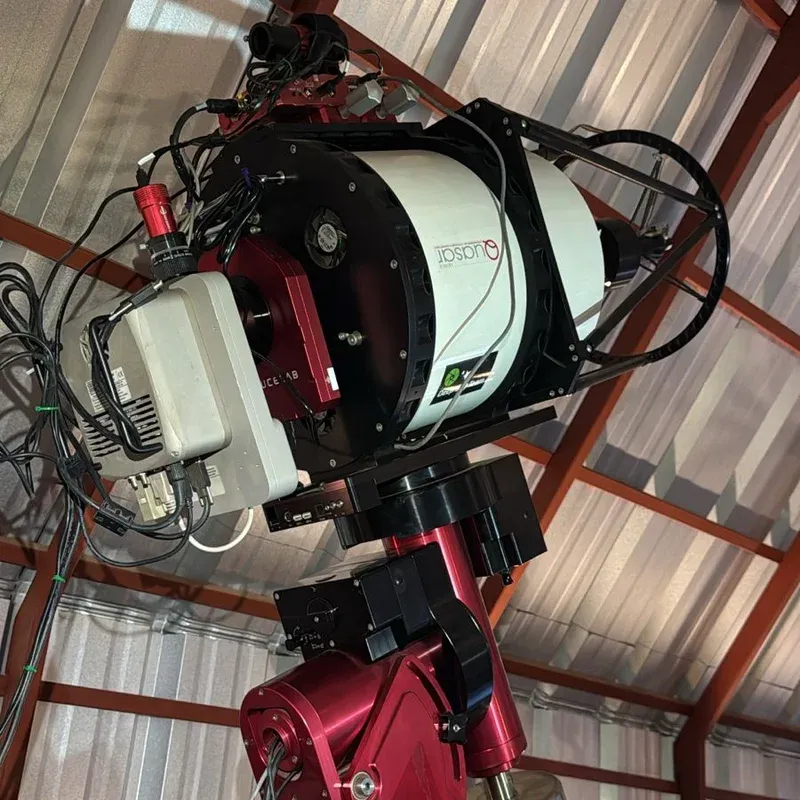
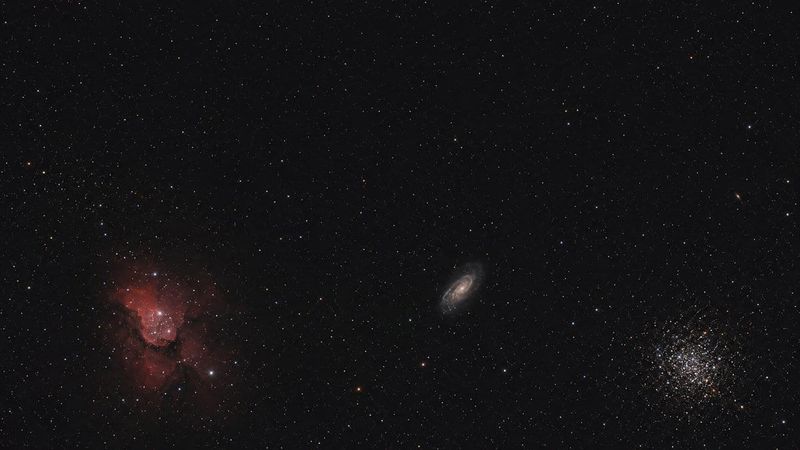
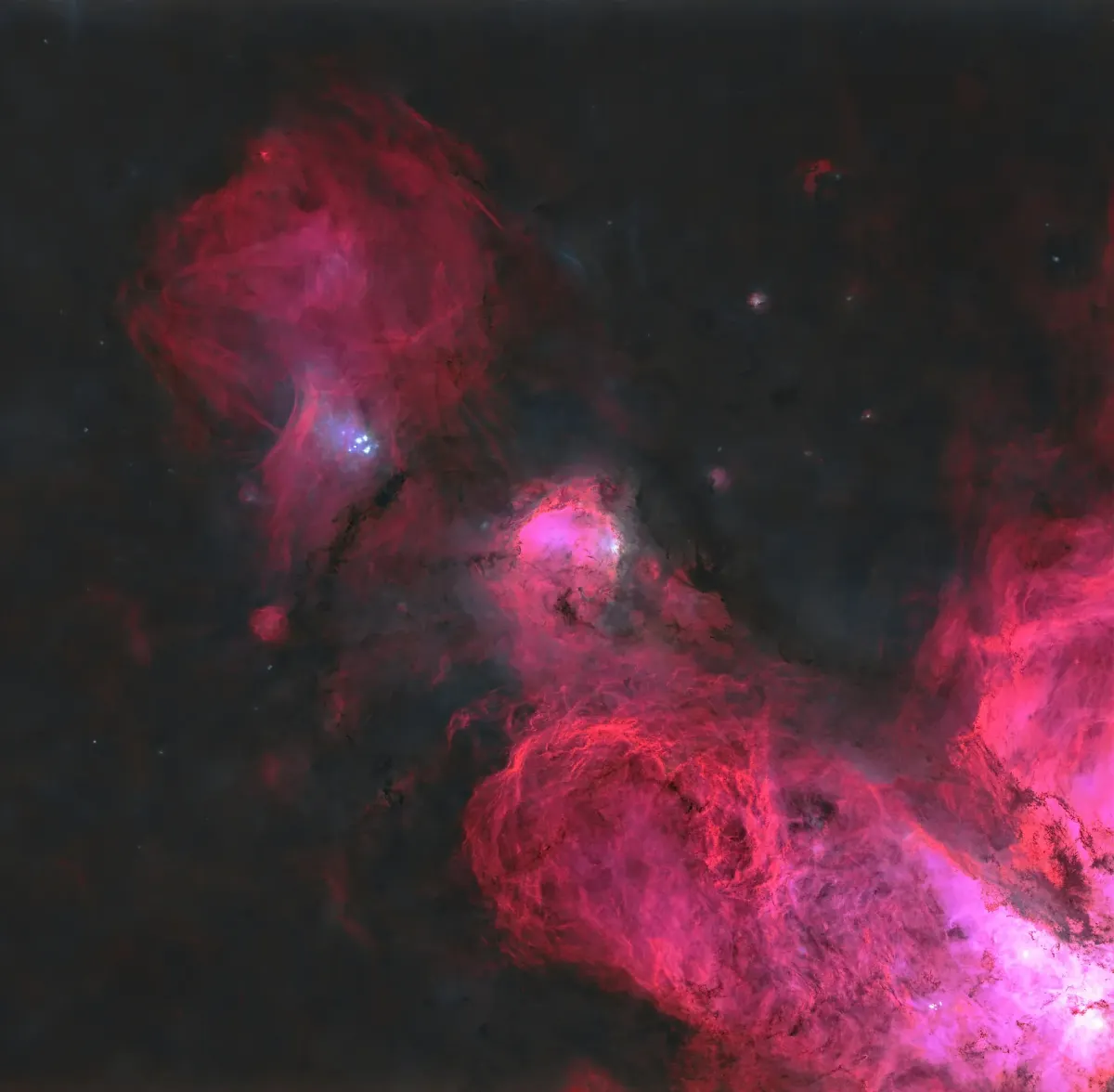
From our remote observatory under the dark skies of the Atacama Desert in Chile, we work with this every clear night. The faint smudge of a galaxy in the frame is light that left before there were dinosaurs on Earth, stretched by the expansion of space on its way here. This guide explains what redshift is, the three different ways it happens, how astronomers actually measure it, and what the numbers — from a modest z = 0.2 to the record-breaking z = 14.44 — really mean. It is written for the curious, so we define the jargon as we go.
What is redshift?
Redshift is what happens to light when its wavelengths are stretched to longer, redder values. Light is a wave, and the wavelength of visible light is what your eye reads as colour: short waves look blue and violet, long waves look orange and red. Stretch the waves, and the whole spectrum slides toward the red — and, for very distant objects, right past red into the infrared.
The name is a little misleading. A redshifted galaxy does not literally look like a red lightbulb. “Redshift” describes a measured shift in the position of features in the light, not a colour you would notice by eye. To see it, astronomers spread the light out into a spectrum, the way a prism makes a rainbow.
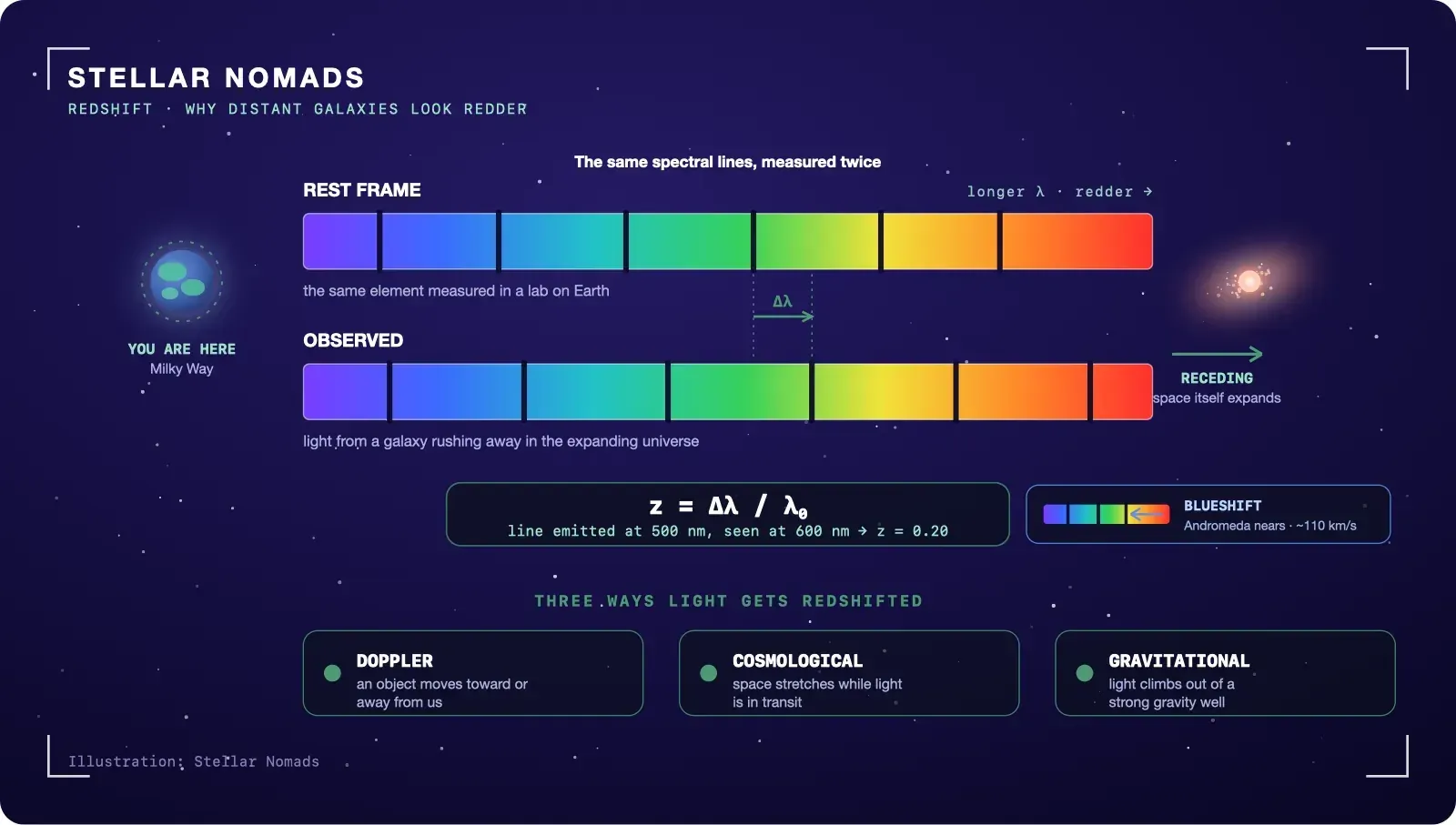
That spectrum is covered in sharp dark lines called absorption lines. Each chemical element — hydrogen, calcium, sodium — absorbs light at a fixed set of wavelengths, leaving a barcode-like pattern that is identical everywhere in the universe. Because we know exactly where those lines fall when measured in a lab on Earth (this is the same physics that gives stars their colours and spectral types), we can spot the same pattern in a galaxy’s light and measure how far it has moved. That displacement is the redshift.
Redshift vs blueshift: what is the difference?
Redshift and blueshift are opposites: redshift stretches light to longer wavelengths as an object recedes, while blueshift squeezes it to shorter wavelengths as an object approaches. You already know the everyday version of this effect. When an ambulance races toward you its siren sounds higher-pitched, then drops to a lower pitch as it passes and speeds away. Sound waves bunch up ahead of the ambulance and stretch out behind it. Light does the same thing.
| Redshift | Blueshift | |
|---|---|---|
| Object is | moving away (receding) | moving closer (approaching) |
| Wavelength | stretched, longer | squeezed, shorter |
| Spectral lines move | toward the red end | toward the blue end |
| Value of z | positive | negative |
| Example | almost every distant galaxy | the Andromeda galaxy |
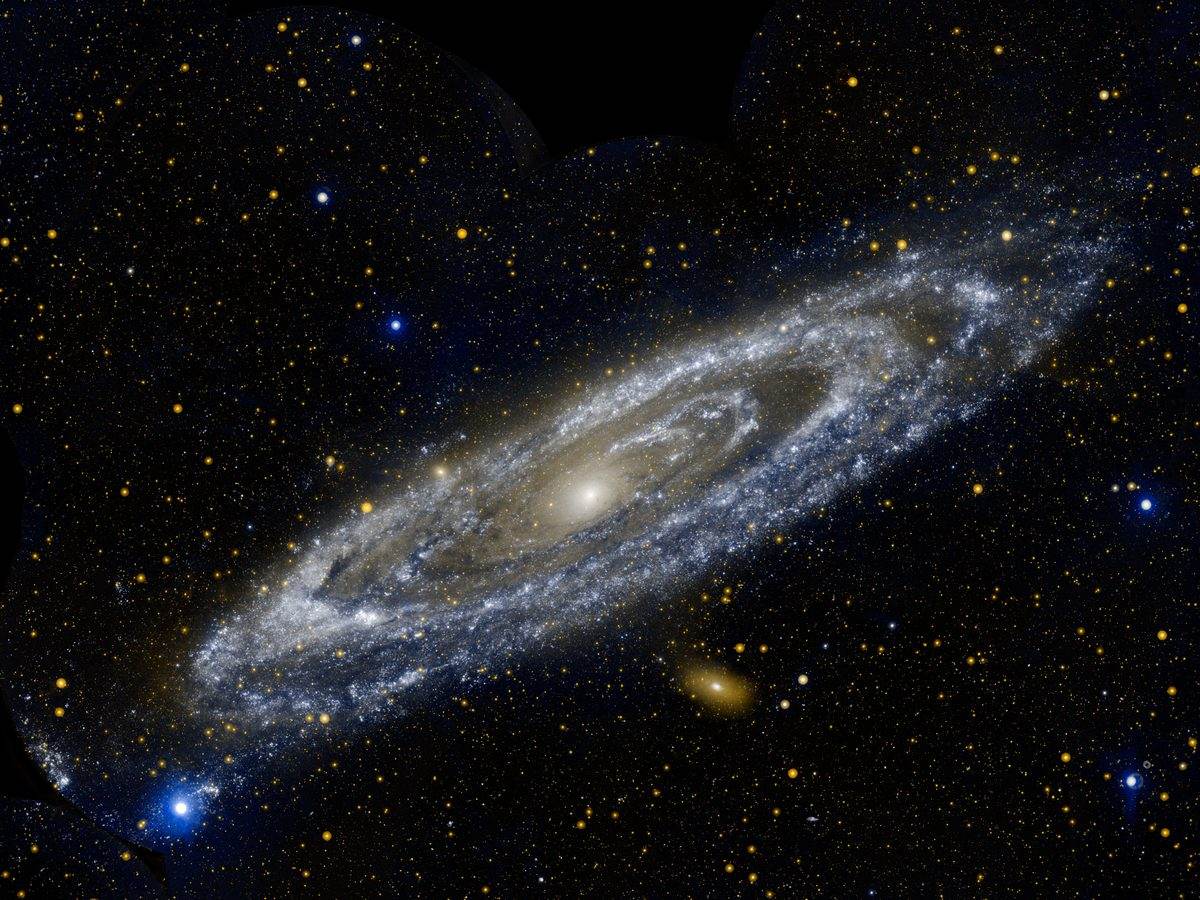
Almost every galaxy we look at is redshifted, because the universe is expanding and carrying them away from us. Blueshifted galaxies are rare. The most famous is our large neighbour, the Andromeda galaxy, which is bound to us by gravity and is actually falling toward the Milky Way. It will collide and merge with our galaxy in roughly four billion years.
The three types of redshift
Not all redshifts have the same cause. Physicists sort them into three kinds, and telling them apart matters, because they mean very different things about the universe.
1. Doppler redshift (motion through space)
This is the ambulance-siren version. An object physically moves away from us through space, so its light waves are stretched by that motion. Doppler shifts are how we clock the speeds of stars in our own galaxy, spot planets tugging on their host stars, and watch the two stars in a binary system swing toward and away from us. For speeds well below the speed of light, the maths is simple: the recession speed is roughly the speed of light multiplied by the redshift, or v ≈ cz.
2. Cosmological redshift (the expansion of space)
This is the big one, and it is subtly different. A distant galaxy is not really flying away through space like a bullet. Instead, the space between us and the galaxy is expanding, and light travelling across that space gets stretched along with it. The longer the light has been in transit, the more the wavelength grows. This is why the most distant galaxies show the largest redshifts — their light has been riding an expanding cosmos for billions of years. Cosmological redshift is the cornerstone of modern cosmology, and the effect that the physicist Georges Lemaître predicted from Einstein’s equations before it was even measured.
A neat way to read the number: a redshift of z = 1 means the universe has doubled in size since that light set out, so it was half its present size when the light left. At z = 9, the cosmos was one-tenth its current scale.
3. Gravitational redshift (escaping gravity)
The third type has nothing to do with motion. When light climbs out of a strong gravitational field — leaving the surface of a dense star, for example — it loses energy, and losing energy means its wavelength stretches toward the red. This falls straight out of Einstein’s general relativity. It was confirmed in a famous 1959 experiment by Pound and Rebka, who measured the tiny redshift of light climbing just 22.5 metres up a tower at Harvard. The same effect shifts the spectra of white dwarfs and neutron stars, and your phone’s GPS quietly corrects for it every day.
How do you measure redshift?
Astronomers measure redshift by comparing where a spectral line appears in an object’s light with where that same line sits in a laboratory. The redshift z is simply the change in wavelength divided by the original, rest wavelength:
z = (observed wavelength − rest wavelength) ÷ rest wavelength
Suppose a hydrogen line that should sit at 500 nanometres is instead found at 600 nanometres. The shift is 100 nm, so z = 100 ÷ 500 = 0.20. Equivalently, the observed wavelength is always the rest wavelength multiplied by (1 + z) — here, 1.2 times longer.
To capture that shift, light is passed through a spectrograph that spreads it into its component colours. The astronomer then finds a recognisable pattern — often the hydrogen Balmer lines or the calcium H and K lines — and measures how far the whole pattern has slid. Because the pattern is fixed by physics, even a faint, distant galaxy gives up its redshift once its lines are found. The technique reaches beyond visible light, too: in radio astronomy, the 21-centimetre line of hydrogen is tracked in exactly the same way to map galaxies we cannot see optically.
One important caution about very large redshifts. A galaxy at z = 7 is not moving away faster than light, and the simple v ≈ cz rule breaks down for big values. Those enormous redshifts are cosmological — they come from the stretching of space over billions of years, not from breakneck motion through it.
How redshift proved the universe is expanding
Redshift proved cosmic expansion because distant galaxies are not just redshifted — the farther away they are, the faster they appear to recede. That single pattern is the fingerprint of an expanding universe.
The story began around 1912, when Vesto Slipher measured the spectra of spiral “nebulae” and found that most were strongly redshifted, racing away at hundreds of kilometres per second. In 1929, working at Mount Wilson with Milton Humason, Edwin Hubble added distances to those velocities and uncovered a clean relationship: recession speed rises in proportion to distance. We now call it Hubble’s law, v = H₀ × d.
Crucially, this does not mean we sit at the centre of the universe. In a uniformly expanding cosmos, every observer sees the same thing — everyone else rushing away, faster with distance. It was exactly the behaviour Georges Lemaître had derived from theory two years earlier, and it became the observational bedrock of the Big Bang model that George Gamow and others went on to build.
For a visual companion, this excellent Kurzgesagt explainer shows how that same expansion — the stretching of space that reddens distant starlight — sets a hard limit on how much of the universe we can ever reach:
Redshift and the Hubble constant — and its famous tension
The Hubble constant, H₀, is the number that turns a galaxy’s redshift into a distance and a recession speed. It is roughly 70 kilometres per second for every megaparsec of distance — but pinning down the exact value has opened one of the deepest cracks in modern physics.
Two careful methods disagree. Measurements of the early universe, anchored in the cosmic microwave background by the Planck satellite, give H₀ = 67.4 ± 0.5. Measurements of the nearby, present-day universe, built up from Cepheid stars and supernovae by the SH0ES team, give 73.2 ± 0.9. The gap between them is now about five standard deviations — far too large to be a fluke. Astronomers call it the Hubble tension.
Many hoped the James Webb Space Telescope would settle it. Instead, in 2024 and 2025 Webb re-observed the same Cepheid stars at higher resolution and confirmed that the local measurements were right, ruling out simple errors and deepening the puzzle. Something in our standard picture of the cosmos — perhaps involving dark matter or dark energy — may be incomplete. Redshift, the humble stretch in a spectral line, has led us to the edge of what we understand.
How far back can redshift see? The most distant galaxies
Because light takes time to travel, a high redshift is also a look into the deep past: the bigger the z, the older and more distant the light. Redshift is, in effect, a time machine.
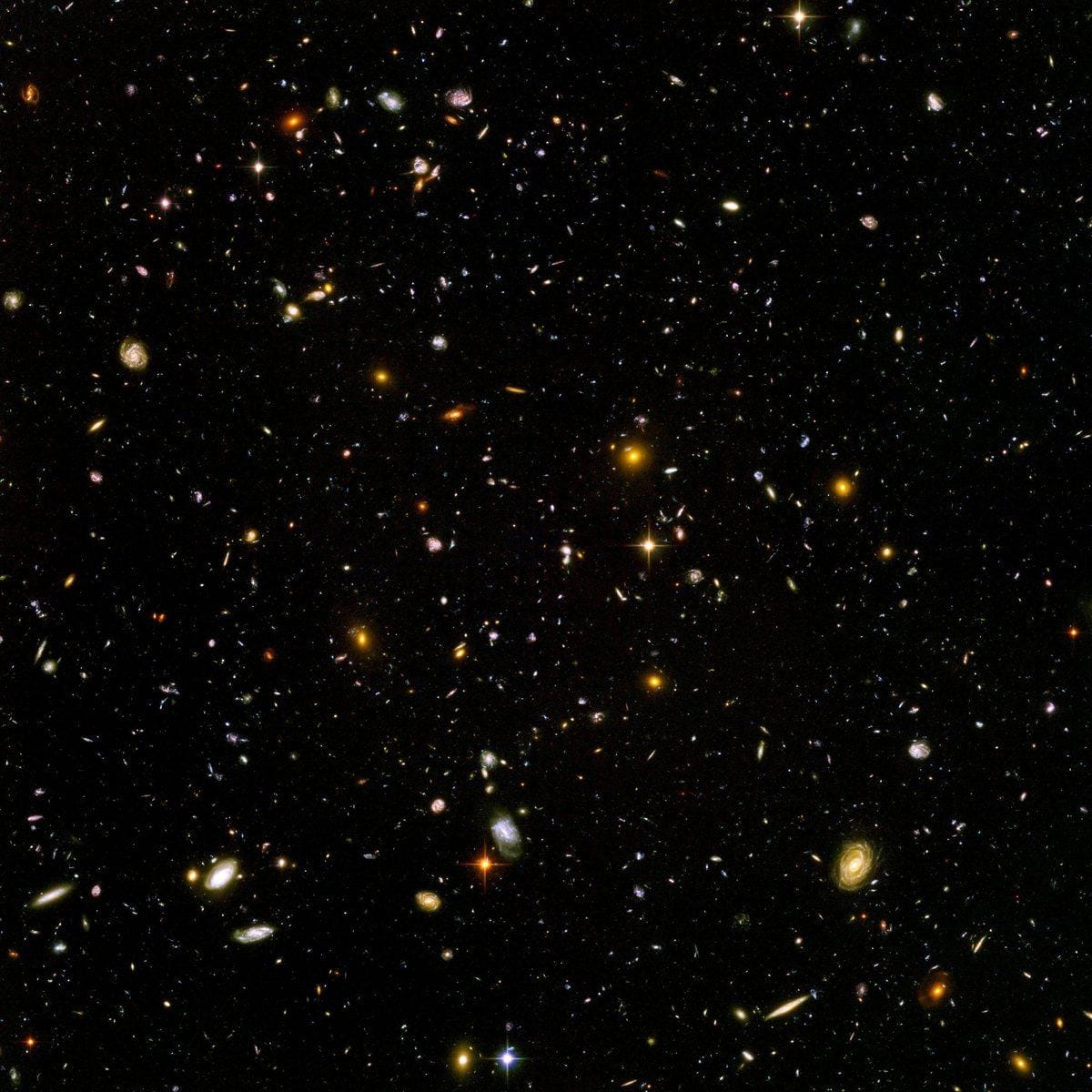
The current record holder is a galaxy called MoM-z14, confirmed by the James Webb Space Telescope in 2025 at a staggering z = 14.44. We see it as it was just 280 million years after the Big Bang, when the universe was only about two percent of its present age. It narrowly beat the previous champion, JADES-GS-z14-0, at z = 14.18. Each of these distant galaxies is a snapshot of the cosmic dawn.
One source of light is redshifted even further. The cosmic microwave background — the leftover glow of the hot young universe — sits at about z = 1100. It set out roughly 380,000 years after the Big Bang as visible and infrared light, and 13.8 billion years of cosmic expansion have stretched it all the way down into microwaves. It is the oldest, most redshifted light we can detect anywhere, and reading its subtle patterns is how we measure the universe’s size, age and geometry.
Can you see redshift through a telescope?
Not with your eye. A galaxy is far too faint to reveal any colour shift when you look at it directly, and in any case redshift is a change in the position of spectral lines, not a tint you could notice at the eyepiece. To see redshift you have to measure a spectrum.
The good news is that you can — even from a backyard. This part is aimed at imagers who are already comfortable capturing and calibrating deep-sky data. A modest diffraction grating such as a Star Analyser, screwed into the imaging train ahead of a camera, turns a telescope into a spectrograph. The classic amateur target is the quasar 3C 273, the brightest quasar in the sky at about magnitude 12.9. Its light is redshifted by z = 0.158, and with careful processing that shift in its hydrogen lines is measurable from a private observatory. It is a genuinely moving experience to measure, with your own equipment, that a point of light is receding at tens of thousands of kilometres per second.
For most of us, though, redshift stays a number that professionals extract from spectra — the number that quietly underlies every distance on a map of the galaxies beyond our own.
Redshift: frequently asked questions
What is redshift in simple terms?
Redshift is the stretching of light to longer, redder wavelengths when an object moves away from us or when space itself expands between us and it. The bigger the shift, the faster the recession or the greater the distance.
Does redshift prove the universe is expanding?
Yes. Nearly every galaxy is redshifted, and more distant galaxies are redshifted more — exactly the pattern expected if space itself is stretching. That relationship, Hubble’s law, is a cornerstone of Big Bang cosmology.
What is the difference between redshift and blueshift?
Redshift means light is stretched to longer wavelengths because an object is receding; blueshift means it is squeezed to shorter wavelengths because an object is approaching. The Andromeda galaxy is one of the few blueshifted galaxies, moving toward us at about 110 km/s.
What causes cosmological redshift?
The expansion of space. As light crosses billions of light-years, the space it travels through stretches, and the light’s wavelength stretches with it. It is not an ordinary Doppler shift from motion through space.
Can redshift be negative?
Yes. A negative redshift is simply a blueshift, which happens when an object moves toward us. Several galaxies in our Local Group, including Andromeda, are blueshifted even though the universe as a whole is expanding.
What is the highest redshift ever measured?
The most distant confirmed galaxy, MoM-z14, has a redshift of z = 14.44, so we see it as it was about 280 million years after the Big Bang. The cosmic microwave background is redshifted far more, to about z = 1100.
The takeaway
Redshift is the thread that connects a faint smudge in a telescope to the size, age and fate of the whole universe. Stretch by stretch, it tells us that the cosmos is expanding, how far the galaxies lie, and what the sky looked like near the very beginning. Next time you read that a galaxy sits “at z = 8,” you will know it means light that set out when the universe was a tenth of its current size.
To go further, explore how the whole science fits together in our guide to cosmology, or see how astronomers turn redshifts into real distances in how we measure the universe.