Muslim astronomers of the Islamic Golden Age — roughly the 8th to the 16th centuries — measured the length of the year to within minutes, catalogued and renamed hundreds of stars, built the era’s great observatories, and sharpened almost every instrument astronomy used. Figures like Ibn al-Haytham, al-Battani, and al-Biruni shaped the science that Europe later inherited.
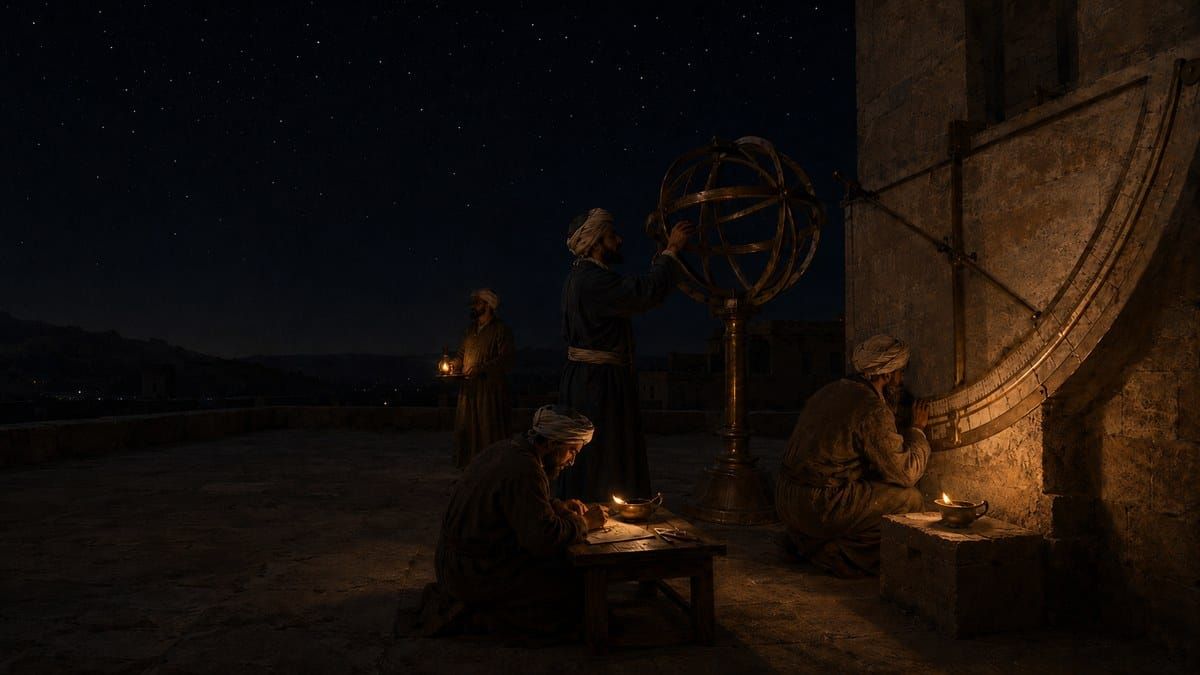
For roughly 700 years, the most careful eyes on the night sky belonged to the scholars of the Islamic world. Working in Baghdad, Cairo, Córdoba, Maragha, Samarkand, and Istanbul, these Muslim astronomers did far more than preserve Greek learning through Europe’s early Middle Ages. They tested Ptolemy against the real sky, corrected him where he was wrong, invented new mathematics to describe the heavens, and left their language written permanently across the stars.
When you photograph Betelgeuse, Aldebaran, or Vega tonight, you are using names these observers gave. This guide ranks twelve of the greatest, explains what each actually discovered, and links to the full biographies we have already published. It is the hub for our growing series on the astronomers of the Islamic Golden Age.
Who were the Muslim astronomers of the Islamic Golden Age?
They were the astronomers, mathematicians, and instrument-makers who worked across the Islamic world from about 750 to 1600 CE, writing chiefly in Arabic — though many were Persian, Central Asian, Arab, or Andalusian by origin. Backed by caliphs and sultans who funded translation, observatories, and salaries, they combined Greek, Indian, and Persian astronomy into a single tradition and then pushed it forward with fresh observation.
Their work was practical as well as theoretical. Islam’s ritual calendar depends on the Moon, prayer times depend on the Sun’s position, and the direction of prayer (the qibla) is a problem in spherical geometry. Astronomy answered all three, so precise sky-measurement carried real weight — and attracted serious money and talent.
For a visual companion, this award-winning short film — Omar Sharif’s final performance, produced with UNESCO for the International Year of Light — dramatizes the quest of Ibn al-Haytham, the scholar who tops our list:
How we ranked this list
Ranking scholars across seven centuries is inevitably a judgment call, so here is ours: we weighted lasting scientific impact (did the work change what came after?), originality (new results, not just careful copies), and the strength of the surviving record. That pushes the great optician Ibn al-Haytham and the meticulous observer al-Battani to the top, and places later model-builders like al-Tusi and Ibn al-Shatir higher than their fame alone would suggest.
The figure below shows all twelve in the order they were born. Notice the shape of the era: an early burst around the House of Wisdom in Baghdad, a quieter stretch in the 1100s, then a second flowering that ran from the Maragha observatory through Samarkand to Istanbul.
The 12 greatest Muslim astronomers, ranked
1. Ibn al-Haytham (Alhazen), c. 965–1040
Born in Basra and working in Fatimid Cairo, Ibn al-Haytham is the towering figure of the list. His seven-volume Book of Optics overturned the ancient idea that the eye emits rays, showing instead that vision works because light reflects from objects into the eye. More important than any single result was his method: he insisted that theories be checked against controlled observation and measurement, an approach many historians call the first recognizable scientific method — six centuries before Galileo.
He also explained the camera obscura, studied atmospheric refraction and twilight, and calculated the height of the atmosphere. A crater on the Moon carries his Latin name, Alhazen. Read our full biography of Ibn al-Haytham for the story of the method that changed science.
2. Al-Battani (Albategnius), c. 858–929
From Raqqa on the Euphrates, al-Battani was the Golden Age’s most accurate observer of the Sun and Moon. He measured the length of the solar year at 365 days, 5 hours, 46 minutes, and 24 seconds — wrong by barely two minutes. He refined the value of the precession of the equinoxes, discovered that the Sun’s apogee slowly moves, and replaced clumsy Greek chords with the sine and tangent functions of trigonometry.
His star tables were still being used by Copernicus, Kepler, and Galileo more than 600 years later. Our deep dive into al-Battani’s discoveries traces exactly how his numbers guided the Copernican revolution.
3. Al-Biruni, 973–1048
A Persian polymath of staggering range, al-Biruni wrote roughly 150 works on astronomy, geography, mathematics, and history. His most famous feat was measuring the Earth’s radius from a single mountain in what is now Pakistan, using the dip of the horizon and trigonometry — landing within about 1% of the modern value. He discussed, centuries early, whether the Earth might rotate on its axis and travel around the Sun, and he calculated latitudes and longitudes with new precision.
See al-Biruni’s eight greatest discoveries for the full measure of a mind working a thousand years ahead of its time.
4. Nasir al-Din al-Tusi, 1201–1274
Al-Tusi built and directed the great Maragha observatory in northwestern Iran, the best-equipped research institution of its age and a model for every observatory that followed. There he assembled a team that produced the influential Ilkhanic Tables. His deepest contribution was mathematical: the “Tusi couple,” a clever pairing of two rotating circles that generates straight-line motion from circular motion.
That device let astronomers repair flaws in Ptolemy’s planetary models — and it reappears, unchanged, in the work of Copernicus three centuries later. Al-Tusi is the anchor of what scholars now call the “Maragha revolution.” A full Stellar Nomads biography is on the way.
5. Al-Sufi (Azophi), 903–986
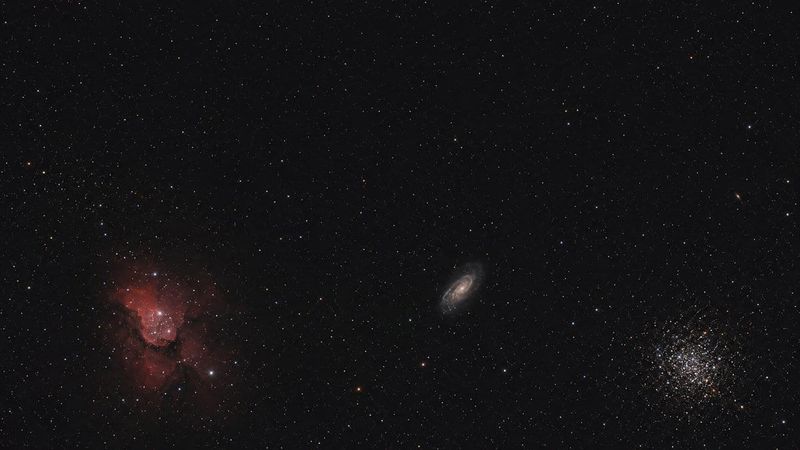
For astrophotographers, al-Sufi may be the most resonant name here. His Book of Fixed Stars (964 CE) updated Ptolemy’s catalogue with corrected magnitudes and beautiful constellation drawings — and recorded two objects invisible to Ptolemy. He described the Andromeda Galaxy as a “little cloud,” the first known written record of a galaxy beyond our own, and he noted the Large Magellanic Cloud from southern Arabia.
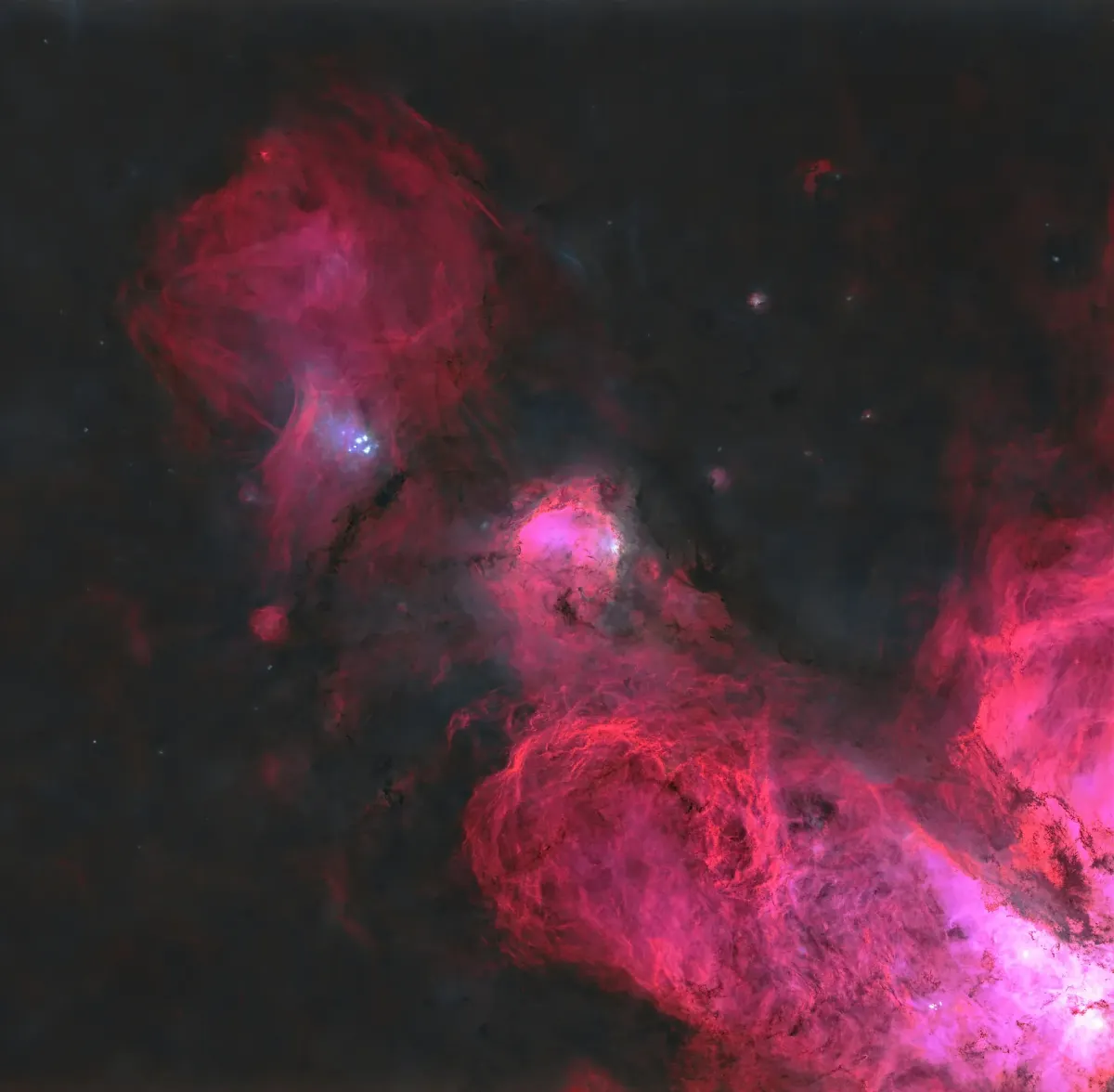
Both are showpiece targets for modern deep-sky imaging, which makes al-Sufi a direct ancestor of what we do from our remote rig in Chile. Many of the star names we still use trace back to his catalogue. His dedicated biography is coming next in this series.
6. Al-Khwarizmi, c. 780–850
Better remembered today for mathematics, al-Khwarizmi was also an astronomer at Baghdad’s House of Wisdom. His Zij al-Sindhind was one of the first major Arabic astronomical handbooks, blending Indian and Greek methods into usable tables of planetary motion. His book on al-jabr gave us the word “algebra,” and the Latin form of his name, Algoritmi, gave us “algorithm.”
He helped introduce the Hindu–Arabic numeral system that every calculation on this website ultimately depends on. Few people have their name embedded so deeply in the tools of science. A full biography is planned.
7. Al-Zarqali (Arzachel), 1029–1087
The finest astronomer of Muslim Spain, al-Zarqali worked in Toledo and Córdoba. He led the compilation of the Toledan Tables, which spread across Europe and were used for centuries. He designed an improved, universal astrolabe (the saphaea) that worked at any latitude, and his careful observations showed that the Sun’s apogee moves against the fixed stars — a subtle result that only precise, sustained measurement could reveal.
Through Toledo, his work flowed directly into medieval European astronomy. A Stellar Nomads biography is on the roadmap.
8. Al-Farghani (Alfraganus), d. c. 870
Al-Farghani wrote the most popular introduction to astronomy of the entire Middle Ages: the Elements of Astronomy, a clear summary of Ptolemy’s system with the Earth’s size and the distances of the planets. Translated into Latin, it taught Europe the shape of the cosmos — Dante leaned on it, and Columbus used its (underestimated) figure for the Earth’s circumference.
He proves that a great explainer can matter as much as a great discoverer. Our biography of al-Farghani covers the book that carried the sky to the West.
9. Ibn al-Shatir, 1304–1375
A timekeeper at the Umayyad Mosque in Damascus, Ibn al-Shatir built the most sophisticated planetary models of the pre-telescopic era. Working from the Maragha tradition, he removed Ptolemy’s awkward “equant” and produced geometric models for the Moon and planets that were more accurate than anything before them.
Here is the remarkable part: his lunar and planetary models are mathematically identical to those Copernicus published nearly two centuries later — minus the Sun-centered rearrangement. The exact route by which his ideas reached Renaissance Europe is still debated, and it is one of the great open questions in the history of science. A full biography is planned for this series.
10. Ulugh Beg, 1394–1449
A grandson of the conqueror Timur, Ulugh Beg was a sultan who preferred the stars to the throne. At Samarkand he built a colossal observatory whose main instrument was a sextant with a radius of about 40 metres, sunk into a hillside for stability. With it his team produced the Zij-i-Sultani (1437), a catalogue of just over 1,000 stars measured to unprecedented accuracy — the first comprehensive star catalogue since Ptolemy’s, 1,300 years earlier.
His measurement of the year and of Earth’s axial tilt stood among the best until the telescope. He was murdered on his son’s orders, and the observatory was later razed. His biography is coming soon.
11. Taqi al-Din, 1526–1585
Taqi al-Din built the Istanbul observatory in 1577 — one of the largest in the world, rivalling the European observatory Tycho Brahe was building at the same moment. He observed the Great Comet of 1577, compiled new astronomical tables, catalogued stars, and designed clocks and automatic machines of real ingenuity.
His observatory’s fate is a cautionary tale: barely three years after it opened, political and religious opposition had it demolished in 1580. It marks, in many accounts, the twilight of the great observatory tradition in the Islamic world. A dedicated biography is planned.
12. Thabit ibn Qurra, 826–901
A member of the Sabian community of Harran, Thabit ibn Qurra was one of the House of Wisdom’s most gifted translators and an original scientist in his own right. He translated key Greek works on mathematics and astronomy, advanced statics and number theory (including a rule for “amicable numbers”), and proposed a theory of “trepidation” to explain slow changes in the equinoxes.
Trepidation later proved to be an error, but his translations and mathematics were foundations that everyone after him built upon. A full biography will follow.
Where did Muslim astronomers work? The great observatories
Golden Age astronomy was concentrated in a handful of extraordinary centres, each backed by a ruler willing to pay for it:
- The House of Wisdom, Baghdad (9th century) — the translation-and-research hub where al-Khwarizmi, al-Farghani, and Thabit ibn Qurra absorbed Greek and Indian astronomy and built the first Arabic star tables.
- Córdoba and Toledo, al-Andalus (10th–11th centuries) — the western gateway, where al-Zarqali’s Toledan Tables and improved astrolabes passed straight into Christian Europe.
- Cairo (10th–11th centuries) — where Ibn al-Haytham wrote the Book of Optics and Ibn Yunus compiled the meticulous Hakemite Tables.
- Maragha, Iran (13th century) — al-Tusi’s purpose-built observatory, the template for the research institution.
- Samarkand (15th century) — Ulugh Beg’s giant sextant and the first great star catalogue since antiquity.
- Istanbul (16th century) — Taqi al-Din’s short-lived but formidable observatory, the tradition’s last flourish.
How Muslim astronomers shaped modern astronomy
Their legacy is not a museum piece — it is written into the sky and into the everyday tools of the science. Three inheritances stand out.
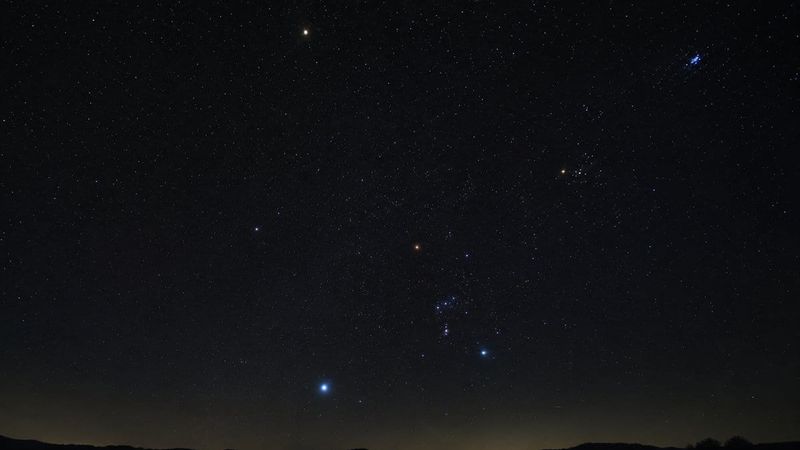
The star names. Look at any star chart and you are reading medieval Arabic. The International Astronomical Union’s official star names are dominated by Arabic-derived words, most of them filtered through al-Sufi’s catalogue:
| Modern star name | From the Arabic | Meaning |
|---|---|---|
| Aldebaran | al-dabarān | “the follower” (of the Pleiades) |
| Betelgeuse | yad al-jauzā | “the hand of the giant” |
| Rigel | rijl al-jauzā | “the foot of the giant” |
| Vega | al-nasr al-wāqi’ | “the swooping eagle” |
| Altair | al-nasr al-ṭā’ir | “the flying eagle” |
| Deneb | dhanab | “the tail” (of the swan) |
| Algol | al-ghūl | “the demon” |
The instruments and mathematics. Muslim astronomers turned the astrolabe into the era’s essential computing device, advanced trigonometry into a full discipline, and gave us “algebra” and “algorithm.” Their precise, sustained observation — over decades, from fixed observatories — set the standard that later European astronomers such as Copernicus would inherit.
The scientific method. Ibn al-Haytham’s insistence on testing ideas against evidence is perhaps the deepest legacy of all. When you calibrate frames, measure your results, and let the data correct your assumptions, you are working in a tradition he helped establish. For the wider story of how we came to measure the cosmos, see our guide to the units astronomers use to measure the universe, and our overview of the 30 most famous astronomers in history, from antiquity to today.
Frequently asked questions
Who is the most famous Muslim astronomer?
Ibn al-Haytham (Alhazen) is the most celebrated, chiefly for his Book of Optics and his pioneering experimental method. Al-Battani and al-Biruni are close behind — al-Battani for his near-perfect measurement of the year, and al-Biruni for measuring the size of the Earth.
What did Muslim astronomers discover?
Among much else, they measured the solar year to within two minutes, calculated Earth’s radius to within 1%, recorded the first known description of the Andromeda Galaxy, detected the motion of the Sun’s apogee, built precise planetary models, and produced the first major star catalogue since Ptolemy. They also created the mathematics — trigonometry and algebra — that made modern astronomy possible.
Why do so many stars have Arabic names?
Because medieval European astronomers learned the sky largely from Arabic texts, above all al-Sufi’s Book of Fixed Stars. When those works were translated into Latin, the Arabic star names came with them and stuck. Names like Aldebaran, Betelgeuse, Vega, and Altair are all Arabic in origin.
What was the Islamic Golden Age of astronomy?
It was the period from roughly the 8th to the 16th century when astronomy flourished across the Islamic world, from Baghdad and Córdoba to Samarkand and Istanbul. Rulers funded translation, observatories, and research, and astronomers combined Greek, Indian, and Persian traditions before advancing well beyond them.
Did Muslim astronomers influence Copernicus?
Almost certainly. Copernicus used mathematical devices — the Tusi couple from al-Tusi and models identical to Ibn al-Shatir’s — that were developed in the Maragha tradition. He also relied on al-Battani’s observations. How exactly these ideas reached him is still studied, but the technical overlap is unmistakable.
The series continues
This hub will grow as we publish a full biography for each astronomer on the list. Four are already live — Ibn al-Haytham, al-Battani, al-Biruni, and al-Farghani — with al-Tusi, al-Sufi, and the rest to follow. Bookmark this page and check back, and the next clear night, when you frame Andromeda or a bright Arabic-named star, remember the observers who saw it first.