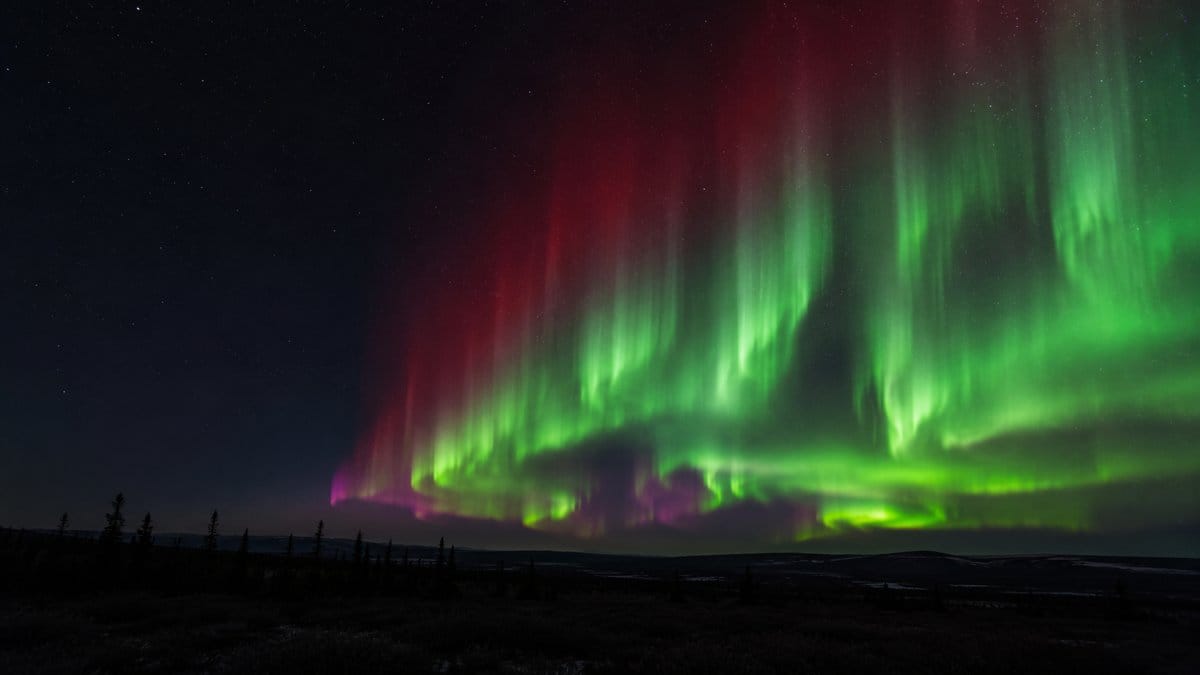
What causes the northern lights? Charged particles from the Sun, guided by Earth's magnetic field, crash into oxygen and nitrogen in the upper atmosphere. Those collisions energize the gas atoms, which release the energy as light — green and red from oxygen, blue and purple from nitrogen — painting the auroras we see.
What causes the northern lights is one of the oldest questions in sky-watching, and the answer connects a storm on the Sun to a glowing curtain over your head three days later. In this guide we walk through the full chain — from the solar wind leaving the Sun at hundreds of kilometers per second, to Earth's magnetic shield funneling particles toward the poles, to the exact atoms that give auroras their colors. We'll also cover where and when you can see the northern lights for yourself, and why 2024–2026 has been the best aurora window in two decades.
What Are the Northern Lights?
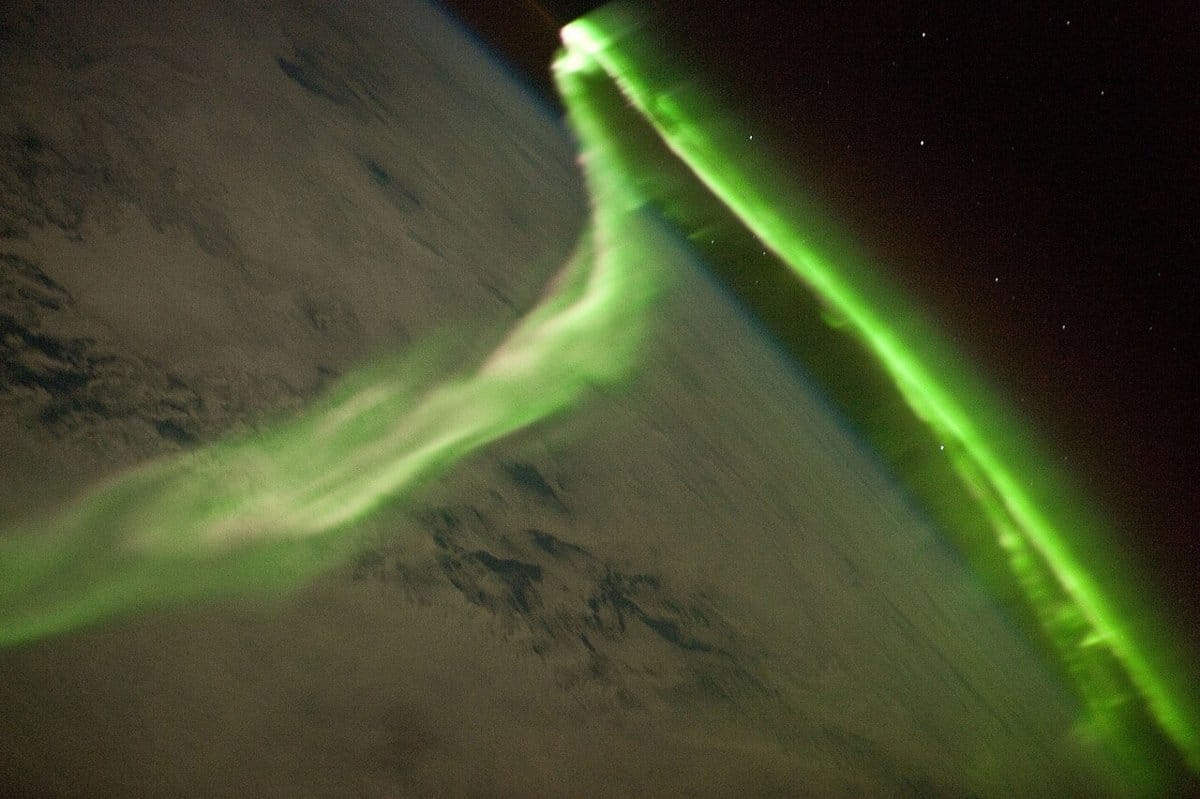
The northern lights — aurora borealis — are shifting curtains, arcs, and rays of colored light that appear in the night sky at high latitudes. They are not reflections, ice crystals, or weather. They are the upper atmosphere itself glowing, between roughly 100 and 600 kilometers (62–370 miles) above the ground — higher than the International Space Station's crew sometimes appears to fly through them.
The same phenomenon occurs around the south magnetic pole, where it is called the aurora australis, or southern lights. Both happen at the same time, in near-mirror-image ovals around Earth's magnetic poles.
What Causes the Northern Lights, Step by Step?
The short answer: the Sun causes them. Here is the full chain of events, from start to finish.
Step 1: The Sun sends out the solar wind
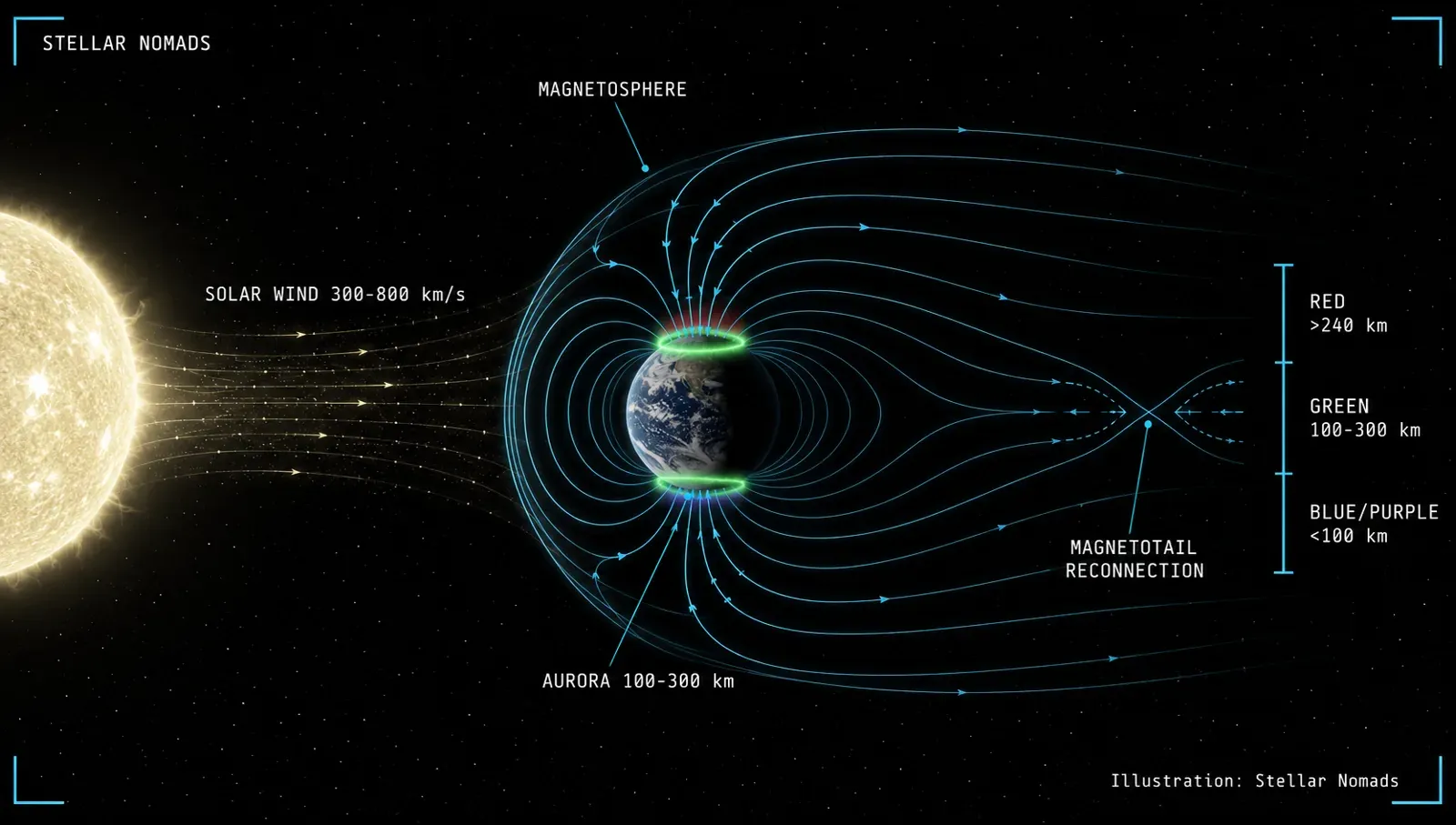
The Sun constantly boils off a stream of charged particles — mostly electrons and protons — called the solar wind. It flows outward in all directions at typically 300 to 800 kilometers per second. During solar eruptions, the Sun can also hurl out billion-ton clouds of magnetized plasma called coronal mass ejections (CMEs), which reach Earth in one to three days and drive the strongest auroral displays.
Step 2: Earth's magnetic field deflects — and funnels — the particles
Earth sits inside a protective magnetic bubble called the magnetosphere. Almost all of the incoming solar wind is deflected around it and streams past into deep space. But the solar wind also stretches the night side of the magnetosphere into a long tail, where magnetic field lines can snap and reconnect — an event called a substorm. Reconnection accelerates electrons and fires them down along Earth's magnetic field lines toward the polar regions, like beads sliding down a wire.
Step 3: Collisions make the atmosphere glow
When those electrons slam into the thin upper atmosphere, they transfer energy to oxygen atoms and nitrogen molecules, kicking their electrons into higher energy states. The excited atoms quickly relax and release that extra energy as photons — particles of light. Billions of these tiny flashes, happening together across the sky, form the glowing curtains we call an aurora. It is the same basic physics that makes a neon sign glow: energized gas emitting light at specific wavelengths.
Why Do Auroras Have Different Colors?
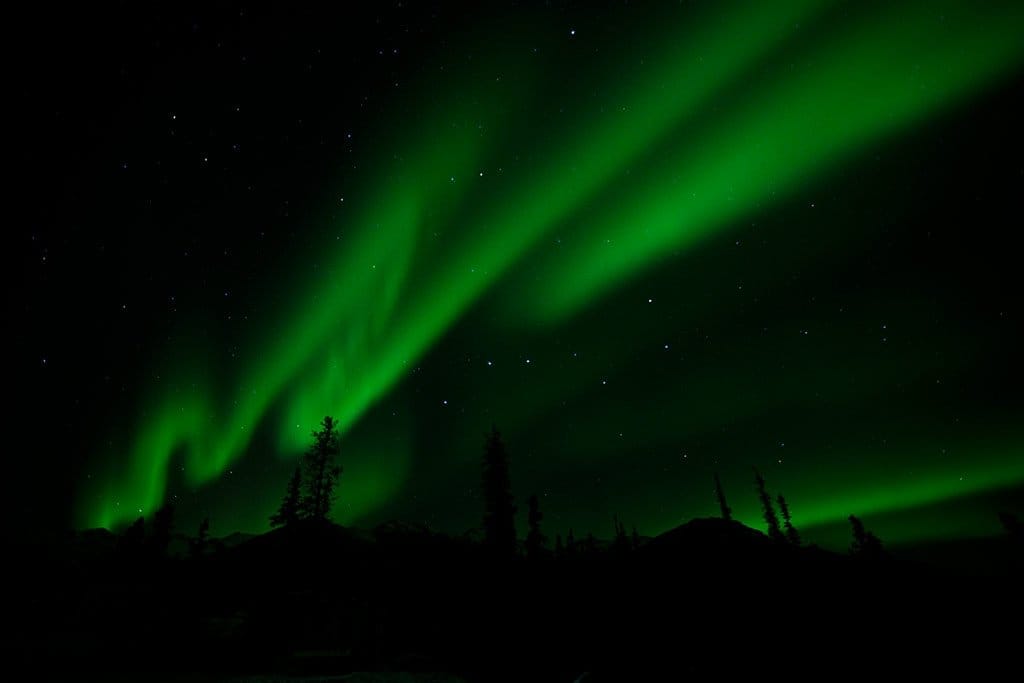
The color of an aurora tells you which gas was hit and at what altitude. Each gas emits light at fixed wavelengths, like a chemical fingerprint:
- Green (557.7 nm) — oxygen atoms between roughly 100 and 300 km. This is the most common auroral color because that altitude band is where incoming electrons deposit most of their energy.
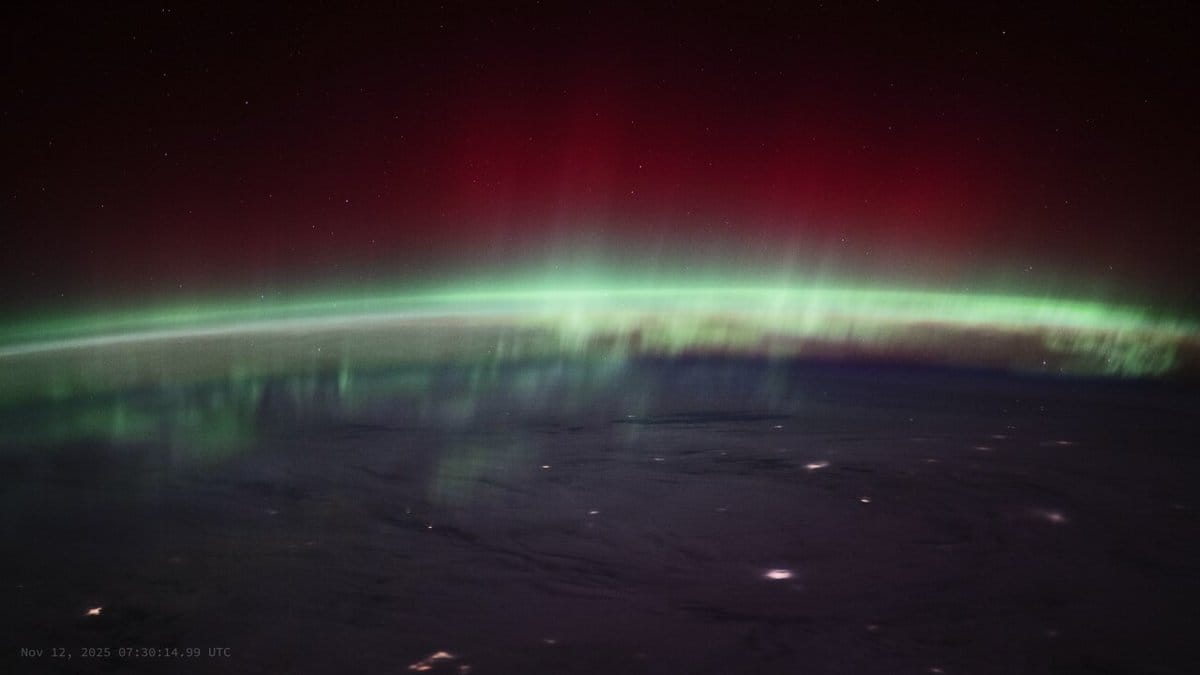
- Red (630.0 nm) — oxygen above roughly 240 km, where the air is so thin that atoms have the seconds of undisturbed time needed to emit this "forbidden" transition. Red crowns often top tall green curtains, and dominate during extreme storms.
- Blue and purple — nitrogen molecules, mostly below about 100 km, lighting up the lower fringes of energetic displays.
- Pink — a blend, where nitrogen's blue-red emission mixes with oxygen green at the curtain's lower edge.
Your eyes undersell all of this. At night, human color vision is poor, so faint auroras often look gray-white to the naked eye while a camera's long exposure reveals vivid green and magenta. If your photos look more colorful than the sky did — that's normal, not fakery.
Where Can You See the Northern Lights?
Auroras concentrate in two ring-shaped zones called the auroral ovals, sitting roughly 60–75° from the equator in magnetic latitude, centered on the magnetic poles rather than the geographic ones. That's why the best viewing sits in a band across:
- Northern Scandinavia — Tromsø and Abisko are classic bases, with Abisko's rain-shadow microclimate famous for clear skies.
- Iceland — the whole island sits under the oval.
- Alaska — Fairbanks is one of the most reliable aurora cities on Earth.
- Northern Canada — Yellowknife and Whitehorse, with long, dark, dry winters.
- Greenland, northern Scotland, and (for the southern lights) Tasmania and southern New Zealand.
During strong geomagnetic storms the ovals expand toward the equator, which is when auroras reach the northern United States, central Europe — and in extreme events much farther. During the May 2024 G5 storm, the strongest to hit Earth since 2003, auroras were photographed from Mexico, Florida, and Spain.
When Is the Best Time to See the Northern Lights?
Four clocks matter, and you want all of them aligned:
- Solar cycle: the Sun's activity rises and falls over roughly 11 years. Solar Cycle 25 peaked through 2024–2025, and activity remains high in 2026 — we are still inside the best aurora window since the early 2000s.
- Season: statistically, auroras favor the weeks around the equinoxes (March and September), when Earth's magnetic geometry couples most efficiently to the solar wind. Practically, you also need long darkness, so September–March is the northern viewing season.
- Time of night: activity typically peaks around magnetic midnight — roughly 10 p.m. to 2 a.m. local time.
- Space weather right now: the Kp index (0–9) summarizes global geomagnetic activity. Kp 3–4 lights up the Arctic; Kp 7+ pushes auroras into the mid-latitudes. NOAA's 30-minute aurora forecast is the tool we check before stepping outside.
And the obvious one: dark, clear skies. A full Moon or city glow will wash out faint displays, so treat aurora hunting like any deep-sky session — get away from light pollution and check the cloud forecast first.
What Do Solar Storms Have to Do With It?
Everyday auroras are fed by the steady solar wind and by fast wind streams from coronal holes. The unforgettable ones are fed by geomagnetic storms — global disturbances of the magnetosphere, usually triggered when a CME's magnetic field slams into Earth's and points southward, letting energy pour in.
Recent examples show the range. The May 2024 "Gannon storm" reached the top G5 (extreme) rating and produced auroras visible to billions of people at latitudes that see them perhaps once in 20 years. The November 11–13, 2025 storm reached G5 again, with the ISS crew photographing blood-red oxygen emission stretching beneath the station. And the benchmark remains the 1859 Carrington Event, when auroras were reported near the tropics and telegraph systems sparked — a reminder that the same physics that paints the sky can also disrupt power grids and satellites, which is why NASA and NOAA monitor the Sun around the clock.
Do the Southern Lights Work the Same Way?
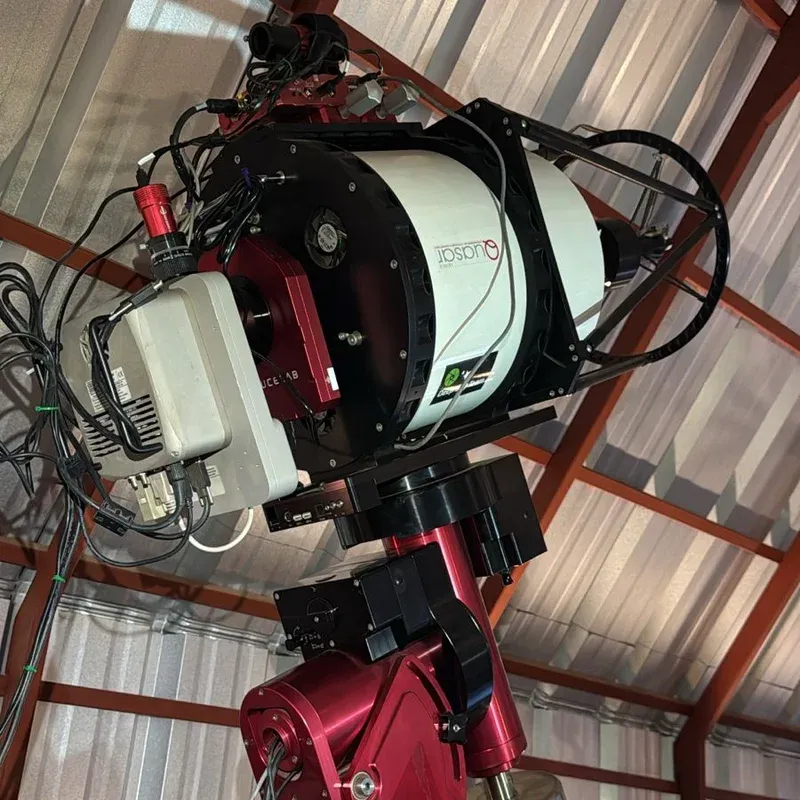
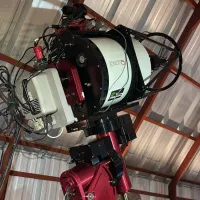
Yes — the aurora australis is caused by exactly the same physics, mirrored around the south magnetic pole. The two ovals light up largely in tandem: satellites have imaged simultaneous displays that are near mirror images of each other. The southern oval is simply harder for most people to reach, sitting mostly over the Southern Ocean and Antarctica; Tasmania, southern New Zealand, and (in strong storms) southern Chile and Argentina get the best land-based views. From our remote rig's home in Chile's Atacama, we're normally far too close to the equator — it took the extreme storms of this solar maximum to push red airglow into view at latitudes like these.
Do Other Planets Have Auroras?
Yes — auroras are a solar-system-wide phenomenon, and comparing them is one of the best tools planetary scientists have for probing magnetic fields they can't visit. The recipe is always the same: a source of charged particles, a magnetic field to steer them, and an atmosphere to light up. Change any ingredient and the aurora changes with it.
Jupiter: the most powerful auroras in the solar system
Jupiter's auroras are permanent, hundreds of times more energetic than Earth's, and brightest in ultraviolet and X-rays rather than visible light. They are only partly driven by the solar wind — most of the material comes from the volcanic moon Io, which feeds about a ton of sulfur and oxygen per second into Jupiter's enormous magnetosphere. Io, Europa, and Ganymede each leave their own glowing "footprints" in Jupiter's auroral ovals, something Earth has no equivalent for.
Saturn and Mars: two very different recipes
Saturn's ultraviolet auroral curtains, studied by Cassini for 13 years, can billow for days and are shaped by both the solar wind and the planet's fast rotation. Mars is the stranger case: it lost its global magnetic field billions of years ago, yet still produces auroras — patchy ultraviolet glows above the magnetized regions of its ancient crust, diffuse planet-wide auroras during solar storms, and proton auroras on its dayside. In 2024–2025 storms, NASA's Perseverance rover even photographed a faint green aurora from the Martian surface — the first aurora ever seen from the ground of another planet.
The ice giants — and a comet
Voyager 2 detected auroras at Uranus and Neptune during its flybys, and in 2023 astronomers confirmed an infrared aurora at Uranus, glowing from its lopsided, off-center magnetic field. The phenomenon doesn't even require a planet: ESA's Rosetta mission found a far-ultraviolet aurora at comet 67P, driven by solar-wind electrons striking the comet's thin envelope of gas. And beyond our solar system, astronomers have picked up radio emissions from brown dwarfs that look remarkably like scaled-up auroral processes — the same physics you watch from a dark field in Iceland, running on objects light-years away.
Can You Photograph the Northern Lights?
Absolutely — auroras are among the most forgiving targets in astrophotography. A camera on a tripod with a wide, fast lens (f/2.8 or faster), ISO 1600–6400, and exposures of 1–10 seconds will capture more color than your eyes can see. Keep exposures short when the aurora is dancing fast, or the structure smears into mush. The fundamentals are the same ones we cover in our astrophotography fundamentals guide: focus carefully on a bright star, shoot RAW, and mind the histogram.
Is STEVE an Aurora?
If you chase auroras long enough, you may meet STEVE — a narrow mauve-and-white ribbon that stretches east–west across the sky, well south of the main auroral oval, sometimes accompanied by a green "picket fence" of vertical stripes. Citizen scientists photographed it for years before researchers formally described it in 2018, keeping the community's tongue-in-cheek name: Strong Thermal Emission Velocity Enhancement.
Strictly speaking, STEVE is not a classic aurora. Instead of particles raining down into the atmosphere, it appears to be a river of hot gas — plasma flowing westward at several kilometers per second and heated to thousands of degrees — glowing from within. It is a useful reminder of how much of near-Earth space is still being mapped, and that amateur photographs genuinely contribute to the science: STEVE is one of the clearest recent wins for pro-am collaboration in amateur–professional astronomy.
How Far in Advance Can Auroras Be Predicted?
Aurora forecasting works on three time scales. Days ahead, forecasters watch the Sun itself: when a CME erupts toward Earth, its one-to-three-day travel time gives you a heads-up to plan a trip to dark skies. About an hour ahead, spacecraft stationed 1.5 million kilometers upstream of Earth — at the L1 point — sample the solar wind before it arrives, turning a guess into a measurement. And roughly 30 minutes ahead, models convert that live solar-wind data into the oval maps you see in aurora apps.
The practical takeaway: treat multi-day forecasts as a reason to get somewhere dark, and the 30-minute nowcast as your cue to step outside. Many of the best displays of the 2024–2025 maximum were caught by people who simply kept an alert app running and dropped everything when Kp spiked.
Northern Lights FAQ
What causes the northern lights, in simple terms?
Particles from the Sun are guided by Earth's magnetic field into the upper atmosphere, where they collide with oxygen and nitrogen and make those gases glow — like a natural neon sign.
Are the northern lights dangerous?
Not to people on the ground. The particles stop 100+ km overhead, and the atmosphere shields us completely. The storms that drive them can, however, affect satellites, GPS accuracy, and power grids.
Why are auroras green most of the time?
Green comes from oxygen atoms at 100–300 km altitude — the band where incoming electrons dump most of their energy — and it's also the color human eyes detect most sensitively.
Can you hear the northern lights?
Occasionally, yes. Finnish researchers have recorded faint claps and crackles during strong displays, likely caused by electrical discharges in a temperature-inversion layer a few hundred meters up — not by the aurora itself.
How often do the northern lights happen?
Auroras occur essentially every night somewhere inside the auroral ovals. What varies is how bright they are and how far toward the equator they spread, which depends on solar activity.
Is 2026 still a good year to see the aurora?
Yes. Solar Cycle 25's maximum ran through 2024–2025, and the declining phase that follows historically produces some of the strongest geomagnetic storms — so the next couple of northern winters remain excellent.
Final Thoughts
The northern lights are the visible end of a chain that starts 150 million kilometers away: solar wind, magnetosphere, substorm, collision, photon. Once you know what causes the northern lights, watching them becomes even better — you're seeing space weather with your own eyes. If you get the chance to stand under the oval on a clear, dark night during this solar maximum, take it. And bring a camera: the sky is more colorful than your eyes will admit.