
A Dyson sphere is a hypothetical megastructure that a super-advanced civilization could build around its star to capture most or all of the star's energy. First proposed by physicist Freeman Dyson in 1960, it is the classic hallmark of a Type II civilization — and one of the few alien technologies we could actually detect from Earth.
Imagine needing so much power that a whole planet's worth of energy is nowhere near enough — so you wrap your entire star in machinery to catch every last photon. That is the audacious idea behind the Dyson sphere, the most famous megastructure in science. This guide explains what a Dyson sphere really is, the surprisingly different forms it could take, whether such a thing could ever be built, and how astronomers are already searching the sky for one.
It is a key branch of our astrobiology series, tied closely to the Kardashev scale and to the Fermi paradox — because if Dyson spheres exist out there, their absence from our telescopes is a genuine puzzle.
What is a Dyson sphere?
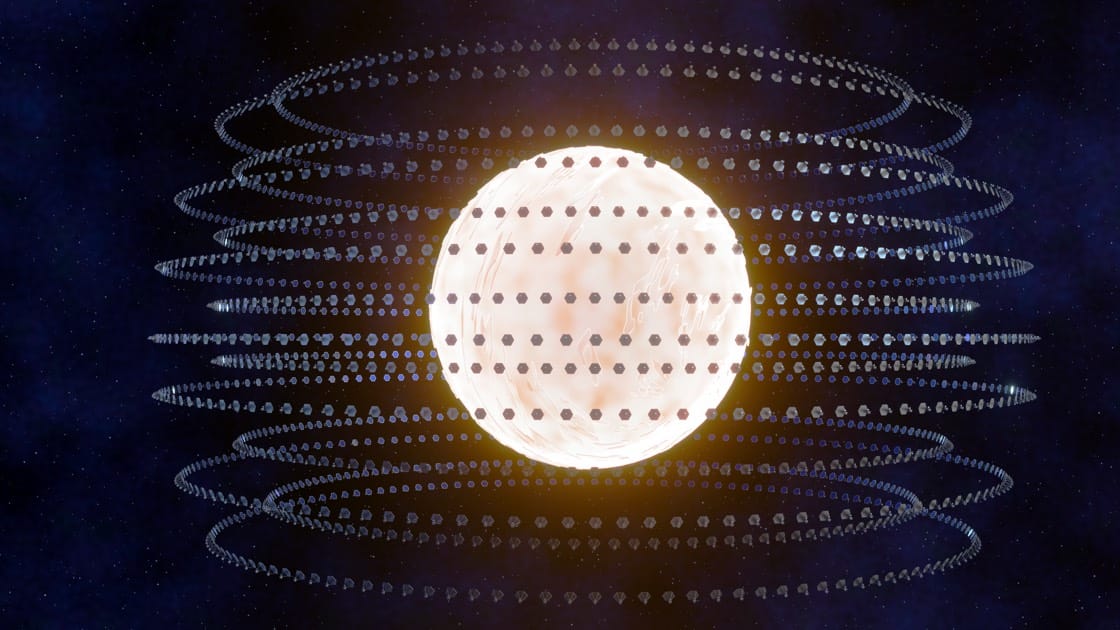
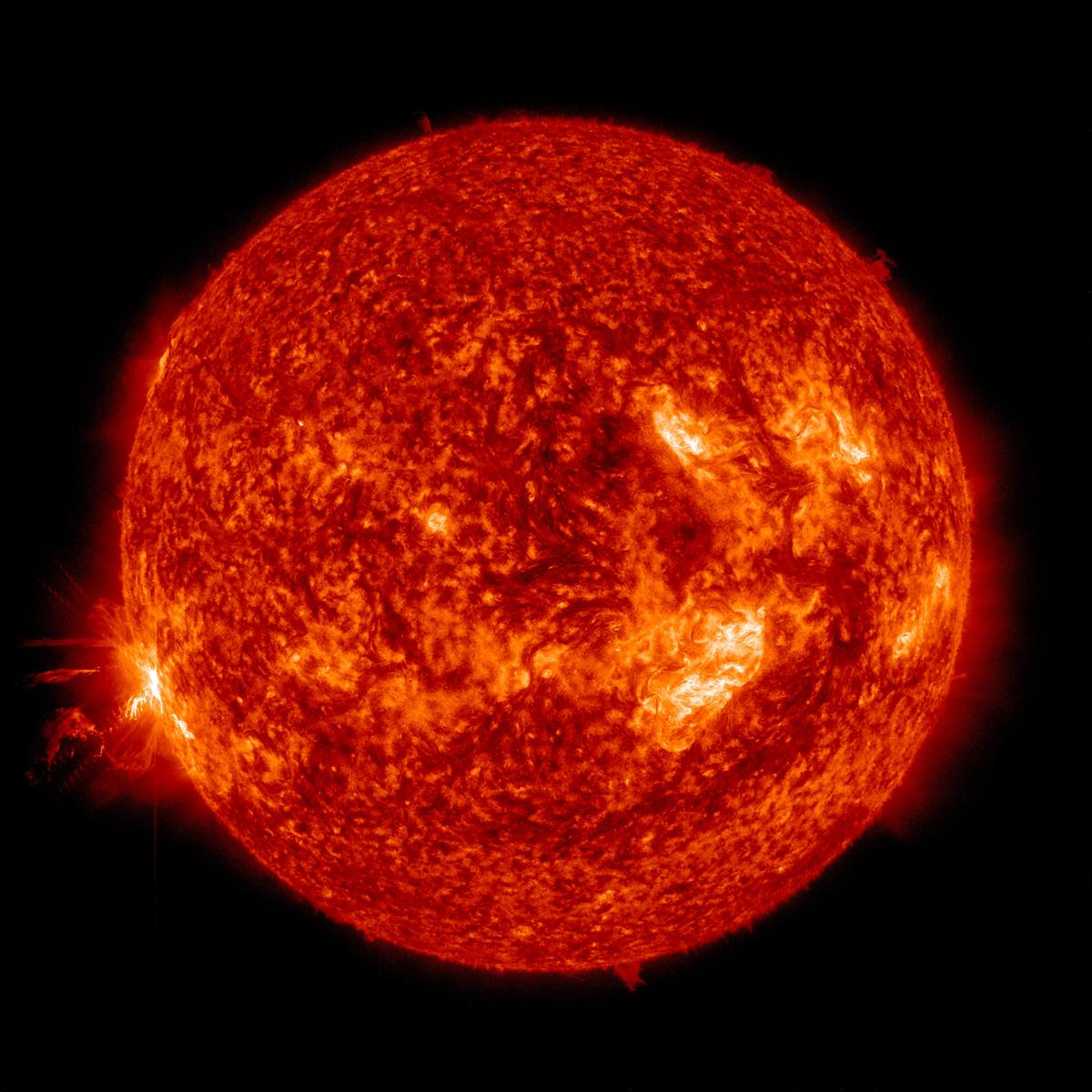
A Dyson sphere is a vast structure, or swarm of structures, built to surround a star and collect a large fraction of the energy it radiates. Our Sun pours out about 400 trillion trillion watts of power every second, and almost all of it streams uselessly into empty space. A civilization that could capture even a sizeable share of that would have energy on a scale we can barely imagine — enough to run computers, propulsion, and industry across an entire solar system.
The core idea is simply energy on the grandest possible scale. As a civilization grows, its appetite for power grows with it. Eventually the only source big enough to satisfy it is the star itself, and the logical way to tap that is to build outward until you have enclosed it.
For a visual companion, this Kurzgesagt explainer pairs well with this guide:
Where the idea came from
The concept is named for the British-American physicist Freeman Dyson, who described it in a short, influential 1960 paper in the journal Science. Dyson was not writing science fiction — he was making a practical point for the search for alien life. He argued that any sufficiently advanced civilization would eventually harness its star's full output, and that the leftover waste heat would glow in infrared light we could detect. In other words, he proposed the Dyson sphere less as a dream to build and more as a signal to hunt for.
Dyson freely credited the inspiration to the 1937 novel Star Maker by Olaf Stapledon, which imagined civilizations enclosing their suns. And he was always careful about the word "sphere." He never meant a solid shell — as we will see, that version runs into serious trouble.
The types of Dyson structures
"Dyson sphere" is really an umbrella term for several very different designs, ranging from the plausible to the physically impossible.
| Type | What it is | Feasibility |
|---|---|---|
| Dyson swarm | A vast cloud of independent solar collectors orbiting the star | The most realistic — buildable in stages |
| Dyson bubble | Non-orbiting sails held up by the balance of gravity and light pressure | Plausible in principle, needs ultralight materials |
| Dyson shell | A single solid sphere fully enclosing the star | Effectively impossible — unstable and impossibly strong |
The Dyson swarm — the realistic version
This is the design Dyson actually favored: not one object, but potentially trillions of them. A Dyson swarm is a huge fleet of solar-collecting satellites, each in its own orbit, together intercepting a growing share of the star's light. Its great advantage is that you can build it incrementally — launch one collector, then a thousand, then a billion — without ever needing a single monstrous structure. Almost every serious discussion of Dyson spheres today really means a swarm.
The Dyson bubble and the Dyson shell
A Dyson bubble replaces orbiting satellites with statites — sails so light that the outward push of sunlight balances the inward pull of gravity, letting them hover in place. The Dyson shell, by contrast, is the version popular culture loves: a seamless solid sphere around the star. Unfortunately it is the least workable. A uniform shell feels no net gravitational pull toward the star it surrounds, so it would drift until one side crashed into the star, and no known material could withstand the crushing stresses involved. The solid Dyson sphere makes for great fiction and terrible engineering.
There is also the idea of a partial or incomplete swarm — one that captures only part of the star's light, which is almost certainly how any real Dyson structure would look for a very long time. Some theorists go further still, imagining a related megastructure called a Shkadov thruster: a lopsided mirror that uses the star's own light pressure to slowly steer the entire solar system through the galaxy, turning a Dyson structure into a stellar engine.
Why build a Dyson sphere?
The answer is one word: energy. On the Kardashev scale, which ranks civilizations by the power they command, a Type II civilization is defined as one that harnesses the entire output of its star — and a Dyson swarm is exactly how it would do that. Earth today intercepts only about one two-billionth of the Sun's energy. A mature Dyson swarm would capture a large fraction of the whole, an increase in available power of many billions of times.
What would a civilization do with that much power? Almost anything: run planet-scale computation, drive starships, engineer new worlds, or simply support an enormous population. The Dyson sphere is, in the end, the physical expression of a civilization that has outgrown its planet and turned to its star.
Could humanity ever build one?
Not for a very long time — but the idea is not forbidden by physics, which is what makes it so tantalizing. The main obstacles are material and time. Building even a modest Dyson swarm would require staggering amounts of raw material; a common thought experiment imagines dismantling a planet like Mercury, which is metal-rich, close to the Sun, and has no atmosphere or life to disturb, and turning it into a fleet of collectors.
Dyson's own reasoning was about growth. He noted that if a civilization's energy use climbed by even a modest percentage each year, then within a few thousand years — a trivial span on cosmic timescales — it would need something close to its star's entire output. A Dyson swarm was, in his view, not an exotic ambition but the almost inevitable endpoint of any civilization that keeps expanding.
The likely path would be gradual. A civilization might start with a single solar-power satellite, scale up to a ring of them, and expand over centuries or millennia into a full swarm. Nothing about that requires new physics — only vast patience, automation, and industrial capacity far beyond ours. That combination of "possible but enormous" is precisely why the Dyson sphere sits at the frontier between engineering and imagination.
How would we detect an alien Dyson sphere?
This is where Dyson's original insight pays off. A structure that soaks up a star's visible light does not make the energy vanish — it re-radiates it as waste heat, glowing in the infrared. So a Dyson sphere would betray itself as a star that looks strangely dim in visible light but unusually bright in infrared, or as an infrared source with no ordinary star to explain it.
The physics is specific enough to be useful. A structure capturing a Sun-like star's light and re-radiating it would glow at a temperature of a few hundred kelvin, peaking in the mid-infrared around ten microns — a band our space telescopes can see. The catch is that ordinary things, such as disks of warm dust around young or dying stars, produce a similar glow, so every candidate must be carefully ruled out before anyone can claim a megastructure.
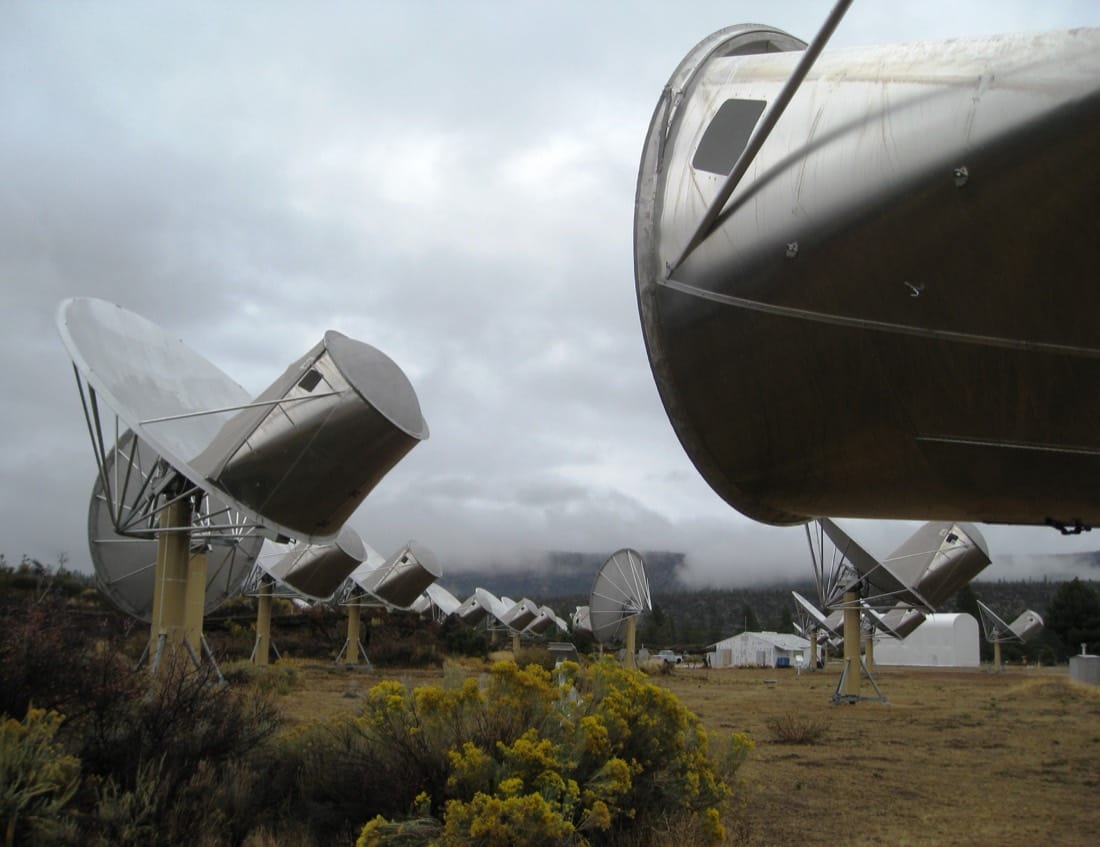
Astronomers have taken this seriously. Infrared surveys such as IRAS and WISE have been combed for candidates, an effort sometimes called Dysonian SETI. In 2024, a search called Project Hephaistos flagged a handful of stars with unexplained infrared excess as possible candidates — though natural causes like warm dust remain the far more likely explanation. The most famous case was Tabby's Star, whose bizarre dimming in 2015 sparked Dyson-swarm speculation before dust emerged as the probable culprit. To understand how we scan the sky for signals like these, see our guide to radio astronomy.
Dyson spheres in fiction and games
The Dyson sphere has become a staple of science fiction, which is partly why the term is so widely searched. Star Trek: The Next Generation famously featured a solid Dyson shell in its 1992 episode "Relics," and Larry Niven's Ringworld explored a related ring-shaped megastructure. More recently, the popular building game Dyson Sphere Program has introduced a new generation to the concept by letting players construct one factory at a time.
These stories usually depict the dramatic solid shell rather than the realistic swarm — but they have done more than any textbook to make the idea famous. This guide is about the real physics behind that fiction: what a Dyson sphere would actually be, and why scientists take the search for one seriously.
The Dyson sphere and the Fermi paradox
Here is the unsettling connection. If advanced, energy-hungry civilizations are common, then over billions of years some should have built Dyson swarms, and the galaxy should be dotted with stars showing that tell-tale infrared glow. Yet decades of searching have turned up no confirmed example. That silence is a specific, physical version of the Fermi paradox — the mystery of why a universe that should be full of company appears empty.
Maybe civilizations rarely reach Type II. Maybe they choose efficiency over vast megastructures. Maybe, as the dark forest theory suggests, the successful ones stay hidden. Or maybe the barrier described by the Great Filter stops almost everyone long before they could wrap a star in metal. The empty infrared sky does not tell us which — only that Dyson spheres, if they exist, are rarer than the simplest assumptions would predict.
Frequently asked questions about the Dyson sphere
What is a Dyson sphere in simple terms?
It is a hypothetical megastructure built around a star to capture its energy. A super-advanced civilization could use it to harness far more power than any single planet could ever provide.
Who invented the idea of the Dyson sphere?
Physicist Freeman Dyson described it in a 1960 scientific paper, crediting inspiration to Olaf Stapledon's 1937 novel Star Maker. Dyson proposed it mainly as something we could search for, not something to build.
What are the types of Dyson spheres?
The main forms are the Dyson swarm (a cloud of orbiting collectors, the most realistic), the Dyson bubble (sails held up by light pressure), and the Dyson shell (a solid sphere, which is essentially impossible).
Could humans build a Dyson sphere?
Not with today's technology, but nothing in physics forbids it. A civilization could build a Dyson swarm gradually, possibly using material from a planet like Mercury, over centuries or longer.
How would we detect a Dyson sphere?
By its waste heat. A Dyson sphere would re-radiate captured starlight as infrared, so astronomers look for stars that are dim in visible light but unusually bright in infrared.
Have we found any Dyson spheres?
No confirmed ones. Searches like Project Hephaistos have flagged candidate stars with odd infrared excess, and Tabby's Star drew attention in 2015, but natural explanations remain far more likely in every case.
Keep exploring the universe
This post is part of our astrobiology cluster, anchored by the Fermi paradox. Continue with the Kardashev scale of civilizations, the Great Filter, and how stars work.
Sources and further reading: SETI Institute, NASA: the search for life, and the Dyson sphere (overview).