The Kardashev scale is a method for ranking a civilization's level of technological advancement by how much energy it can harness, from a single planet's worth (Type I) to an entire galaxy's (Type III). Proposed in 1964, it turns the vague idea of "advanced aliens" into a measurable physical benchmark.
How do you measure how advanced a civilization is? Not by its art or its politics, but by the one thing every technological society needs more of: energy. That is the elegant premise behind the Kardashev scale, the most widely used yardstick for grading civilizations — including our own. This guide explains all three original types, where humanity actually sits today, the famous Dyson sphere, and how the whole idea ties back to the biggest question in the sky.
It is a key branch of our astrobiology series and a direct companion to the Fermi paradox — the puzzle of why a universe full of stars seems so silent.
What is the Kardashev scale?
The Kardashev scale is a classification system that ranks civilizations by their energy consumption. It was introduced in 1964 by the Soviet astronomer Nikolai Kardashev in a paper on how we might detect signals from other civilizations. His insight was simple: any society advanced enough to broadcast across the galaxy must command an enormous amount of power, and power output is something we can actually estimate and measure from a distance.
Kardashev defined three levels, each roughly ten billion times more powerful than the last. The scale is not about weapons or intelligence — it is purely about the energy a civilization can capture and put to use. That makes it one of the few tools in science that lets us talk about hypothetical aliens in concrete, physical numbers.
For a visual companion, this Kurzgesagt explainer pairs well with this guide:
The three types of civilizations
Here are the three original Kardashev types side by side, with the approximate power each commands and a signature achievement for each.
| Type | Energy it harnesses | Approx. power | Signature capability |
|---|---|---|---|
| Type I | All the energy of its home planet | ~1016 watts | Controls planetary weather, harnesses all sunlight reaching the planet |
| Type II | The entire output of its star | ~1026 watts | Builds a Dyson sphere or swarm around its sun |
| Type III | The energy of its whole galaxy | ~1036 watts | Taps the power of billions of stars across the galaxy |
| Humanity (2026) | A fraction of one planet's | ~2 × 10¹³ watts | Roughly Type 0.7 — not there yet |
Type I: a planetary civilization
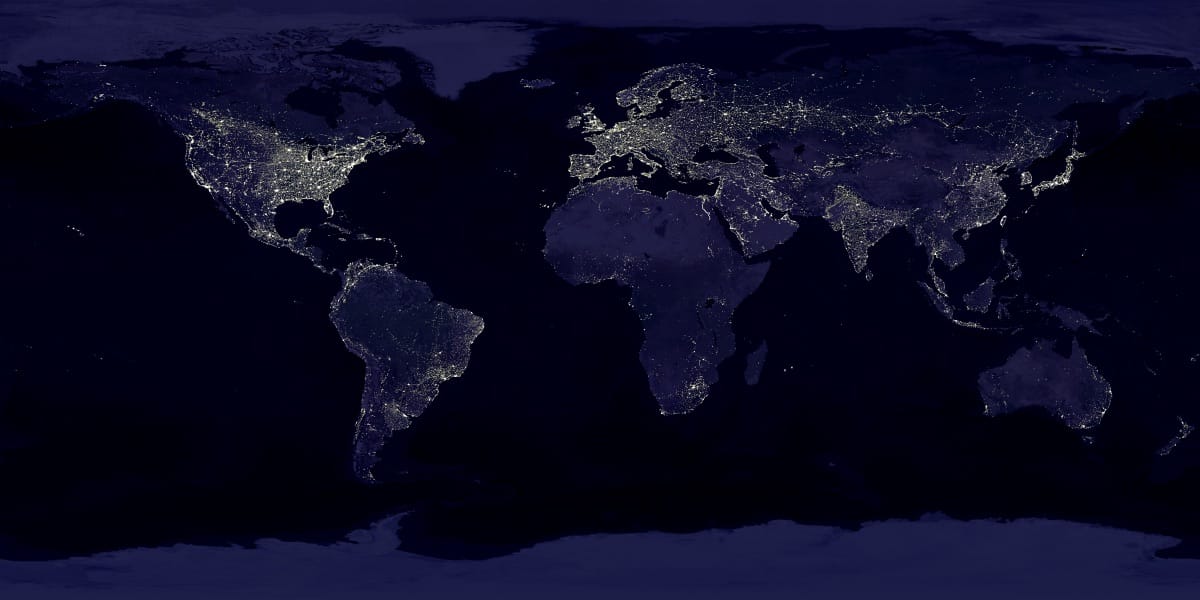
A Type I civilization can access and store all the energy available on its planet. In practical terms that means harnessing the total sunlight striking the world, plus its winds, tides, geothermal heat, and the ability to manage planet-scale systems like climate. A true Type I would treat the energy of an entire planet the way we treat the electricity of a single city. We are close in ambition but not in capability — more on where we stand below.
Reaching Type I would likely mean mastering nuclear fusion, blanketing deserts and oceans with solar collectors, and running a single integrated planet-wide power grid. Michio Kaku has suggested such a civilization could even steer its own weather and blunt natural disasters like hurricanes and earthquakes — not by magic, but by having enough surplus energy to intervene at a planetary scale. Everything we build today runs on a small fraction of that budget.
Type II: a stellar civilization
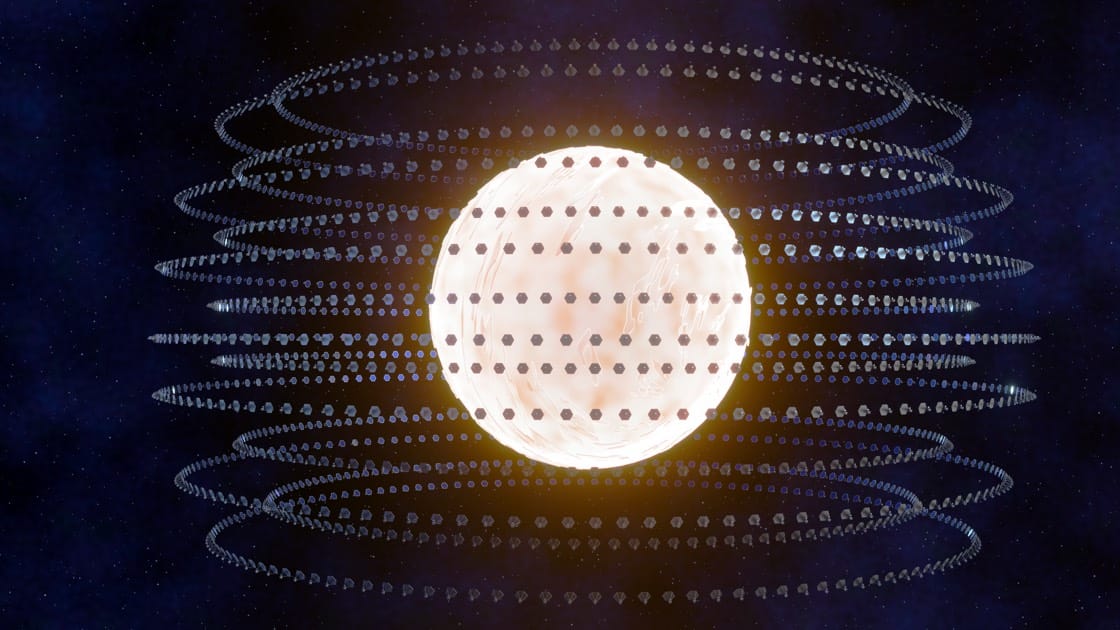
A Type II civilization has outgrown its planet and captures the full output of its star — around a hundred billion times the power of a Type I. Our own Sun radiates roughly 4 × 1026 watts, and almost all of it escapes into empty space. A Type II society would stop that waste, and the classic way to do it is a colossal structure called a Dyson sphere.
Type III: a galactic civilization
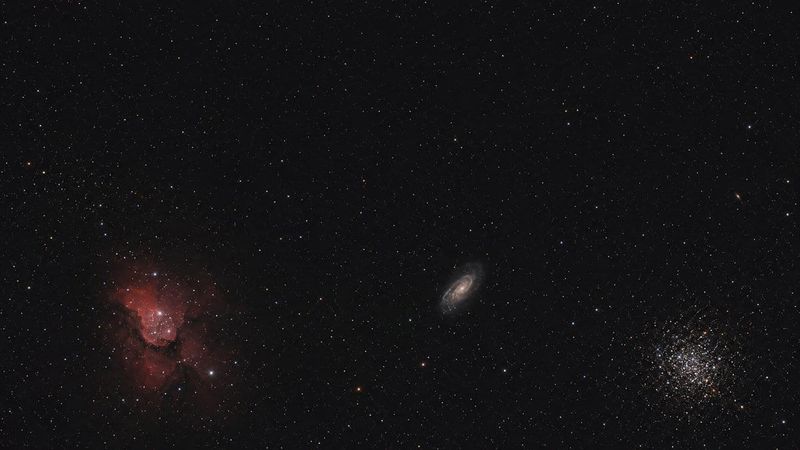
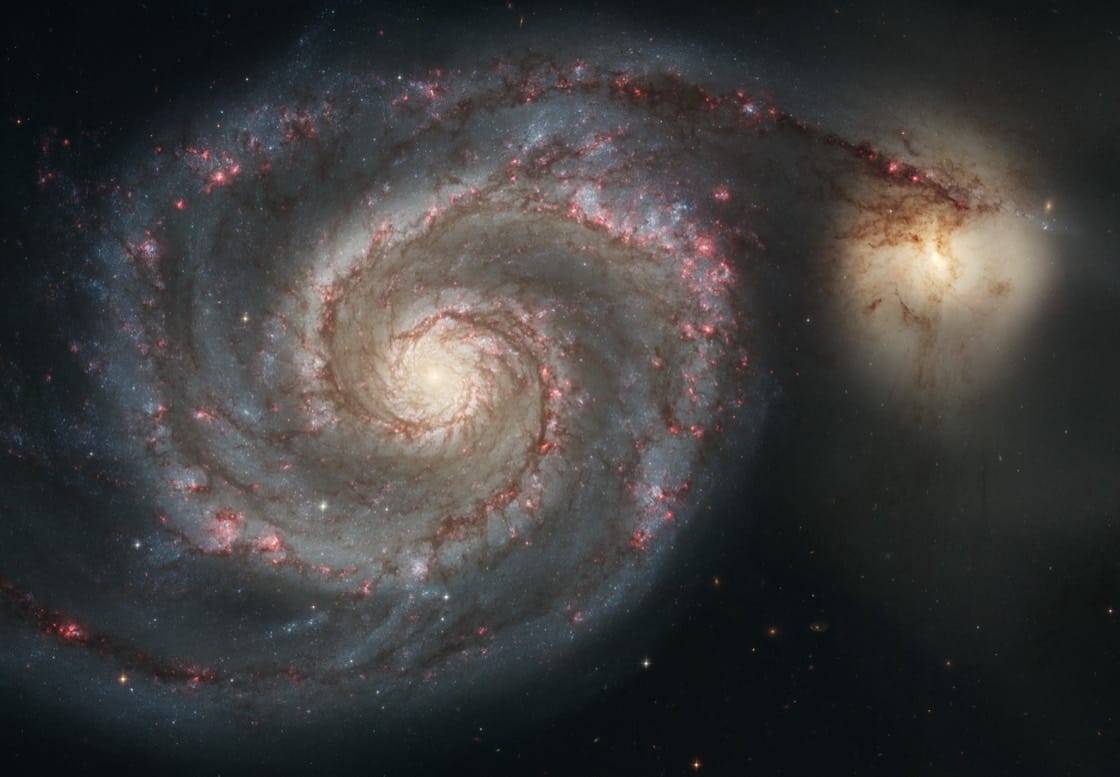
A Type III civilization commands the energy of an entire galaxy — hundreds of billions of stars. This is almost incomprehensibly powerful, another ten-billion-fold jump beyond Type II. Such a civilization might colonize or harvest energy from stars scattered across a spiral like the one below. Because a galaxy-spanning power user would be so bright and so strange, a Type III is exactly the kind of thing our telescopes might one day spot — or should already have spotted, which is where the unsettling questions begin.
What Kardashev level is humanity?
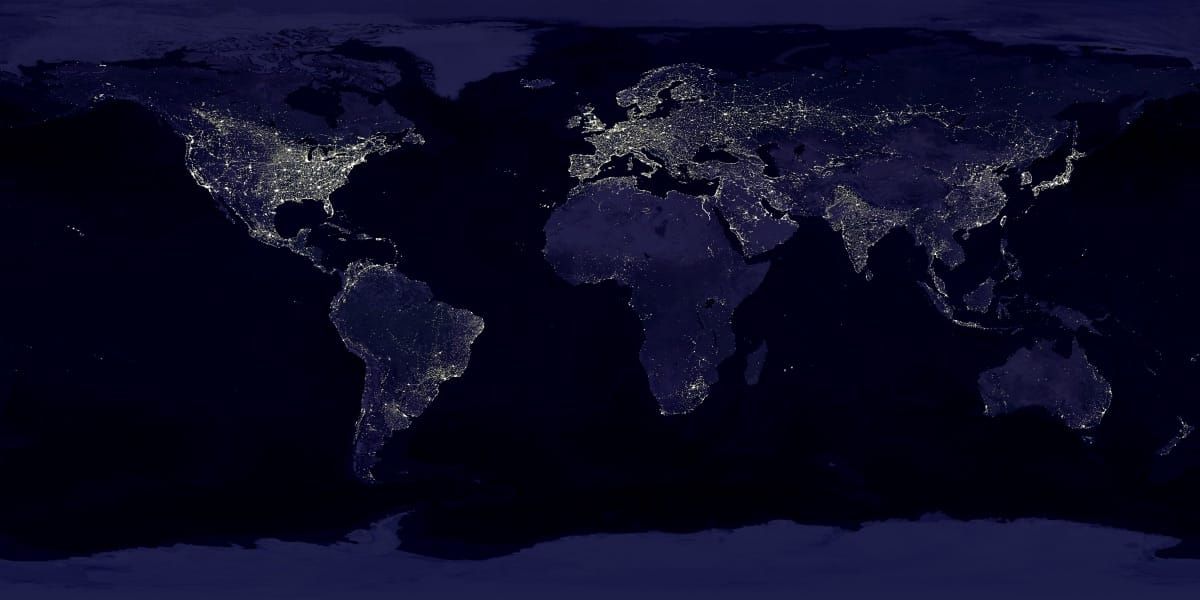
We are not even a Type I yet. Astronomer Carl Sagan refined the scale into a continuous scale so it could measure civilizations in between the whole-number steps. Using his formula and humanity's current output of roughly 2 × 10¹³ watts, Earth sits at about Type 0.73 as of 2026 — most of it still coming from fossil fuels rather than clean, planet-scale sources.
Physicist Michio Kaku, who has done much to popularize the scale, estimates humanity could become a full Type I civilization within 100 to 200 years, reaching Type II in a few thousand years, and Type III in perhaps 100,000 years or more. Getting to Type I is less about inventing new physics and more about whether we can build a stable, planet-wide clean-energy system without destroying ourselves first — a theme that connects directly to the Fermi paradox.
How does a civilization move up the scale?
Climbing the Kardashev scale is fundamentally an energy-source problem. A world moves toward Type I by shifting from burning limited fuels to capturing the constant, vast flow of energy from its star and planet — solar, wind, geothermal, and fusion. The jump to Type II means leaving the planet behind and building in space, harvesting sunlight before it ever disperses into the void. Each step demands not just more power but a completely different scale of engineering, which is why the gaps between types are measured in thousands or millions of years rather than decades.
Beyond Type III: Type IV and Type V
Kardashev stopped at three, but later thinkers extended the ladder. A hypothetical Type IV civilization would harness the energy of an entire universe, and a Type V would command the resources of multiple universes or a multiverse. These levels are pure speculation with no basis in known engineering — they are more thought experiment than science. Cosmologist John Barrow even ran the scale in the opposite direction, ranking civilizations by how finely they can manipulate the very small, down to the subatomic. Both directions make the same point: mastery of energy and matter has a very long way it could still go.
How would we actually detect an advanced civilization?
The real power of the Kardashev scale is that it gives astronomers concrete things to look for, called technosignatures. A Dyson sphere or swarm, for example, would absorb a star's visible light and re-radiate it as waste heat in the infrared — so a star that glows strangely bright in infrared but dim in visible light could, in principle, be an artificial structure. Surveys using infrared telescopes such as WISE and the James Webb Space Telescope have hunted for exactly this signature. A 2024 search flagged a handful of candidate stars with unexplained infrared excess, though natural explanations remain far more likely.
The most famous real-world case is Tabby's Star (also called Boyajian's Star), which stunned astronomers in 2015 with deep, irregular dips in brightness that no ordinary planet could explain. For a while, a partial Dyson swarm was floated as a serious possibility. Later observations pointed to clouds of fine dust as the likelier culprit, but the episode showed exactly how the Kardashev framework turns a strange light curve into a testable question about alien engineering.
Type II and III civilizations should also leak or beam energy we could pick up, which is why the search overlaps with traditional listening efforts. To understand how we scan the sky for these signals, see our guide to radio astronomy and how we observe the universe in radio waves. The Dyson sphere is such a rich topic in its own right that we will give it a dedicated deep dive soon.
The Kardashev scale and the Fermi paradox
Here is the twist that makes the scale so provocative. If advanced civilizations are common, some should have reached Type II or III long ago, and their galaxy-scale engineering ought to be glaringly obvious across the cosmos. Yet we see none. That gap between "they should be everywhere and unmissable" and "we detect nothing" is the heart of the Fermi paradox.
The Kardashev scale sharpens the puzzle in two ways. It suggests that the leap from Type I to Type II may hide a barrier that stops civilizations from ever getting that far — an idea our upcoming guide to the Great Filter explores. And it raises the darker possibility that advanced societies stay deliberately hidden, the premise of the dark forest theory we will cover next in this series. Whether the silence means the filter is real or the neighbors are quiet, the scale frames the stakes.
Criticisms and limits of the scale
The Kardashev scale is powerful but not perfect. Its biggest assumption is that advanced civilizations keep consuming ever more energy — but a mature society might instead become radically efficient, doing more with less rather than building star-swallowing megastructures. Critics also note the scale ignores information, computation, and how wisely energy is used, not just how much is captured. It is best treated as a rough thermometer of raw capability, not a complete measure of how "advanced" a culture truly is.
There is also a subtler critique tied to the Fermi paradox. If the scale is right that advanced civilizations should be energy-hungry and unmissable, their total absence from our skies may mean the core assumption is wrong — perhaps intelligence tends to turn inward and efficient rather than outward and expansive. In that reading, the empty sky is not a mystery to be solved but a hint about how technological life actually behaves.
Frequently asked questions about the Kardashev scale
What is the Kardashev scale in simple terms?
It ranks civilizations by how much energy they can harness: Type I uses all the energy of its planet, Type II all the energy of its star, and Type III all the energy of its galaxy. The more energy, the more advanced.
Who created the Kardashev scale?
Soviet astronomer Nikolai Kardashev proposed it in 1964. Carl Sagan later made it a continuous scale, and physicist Michio Kaku helped popularize it for general audiences.
What Kardashev level is humanity in 2026?
Roughly Type 0.73 — we do not yet control the full energy of our own planet. We currently generate about 2 × 10¹³ watts, mostly from fossil fuels.
What is a Type I, II, and III civilization?
A Type I harnesses all the energy of its home planet, a Type II captures the entire output of its star (often via a Dyson sphere), and a Type III commands the energy of an entire galaxy of hundreds of billions of stars.
What is a Dyson sphere and how does it relate to the Kardashev scale?
A Dyson sphere is a hypothetical megastructure that surrounds a star to capture its energy. It is the classic hallmark of a Type II civilization and one of the technosignatures astronomers actively search for.
Are there Type IV or Type V civilizations?
They are speculative extensions added after Kardashev. A Type IV would harness the energy of a whole universe and a Type V a multiverse — ideas with no basis in known physics, useful mainly as thought experiments.
How long until humanity becomes a Type I civilization?
Estimates from physicist Michio Kaku suggest 100 to 200 years, provided we build a stable planet-wide clean-energy system and avoid self-destruction along the way.
Keep exploring the universe
This post is part of our astrobiology cluster, anchored by the Fermi paradox. From here, branch into the science behind it: how stars actually work, the different types of galaxies, and how radio astronomy searches the sky. Deep dives on the Dyson sphere, the Great Filter, the dark forest theory, and the Drake equation are on the way.
Sources and further reading: SETI Institute, NASA: the search for life, and Kardashev scale (overview).