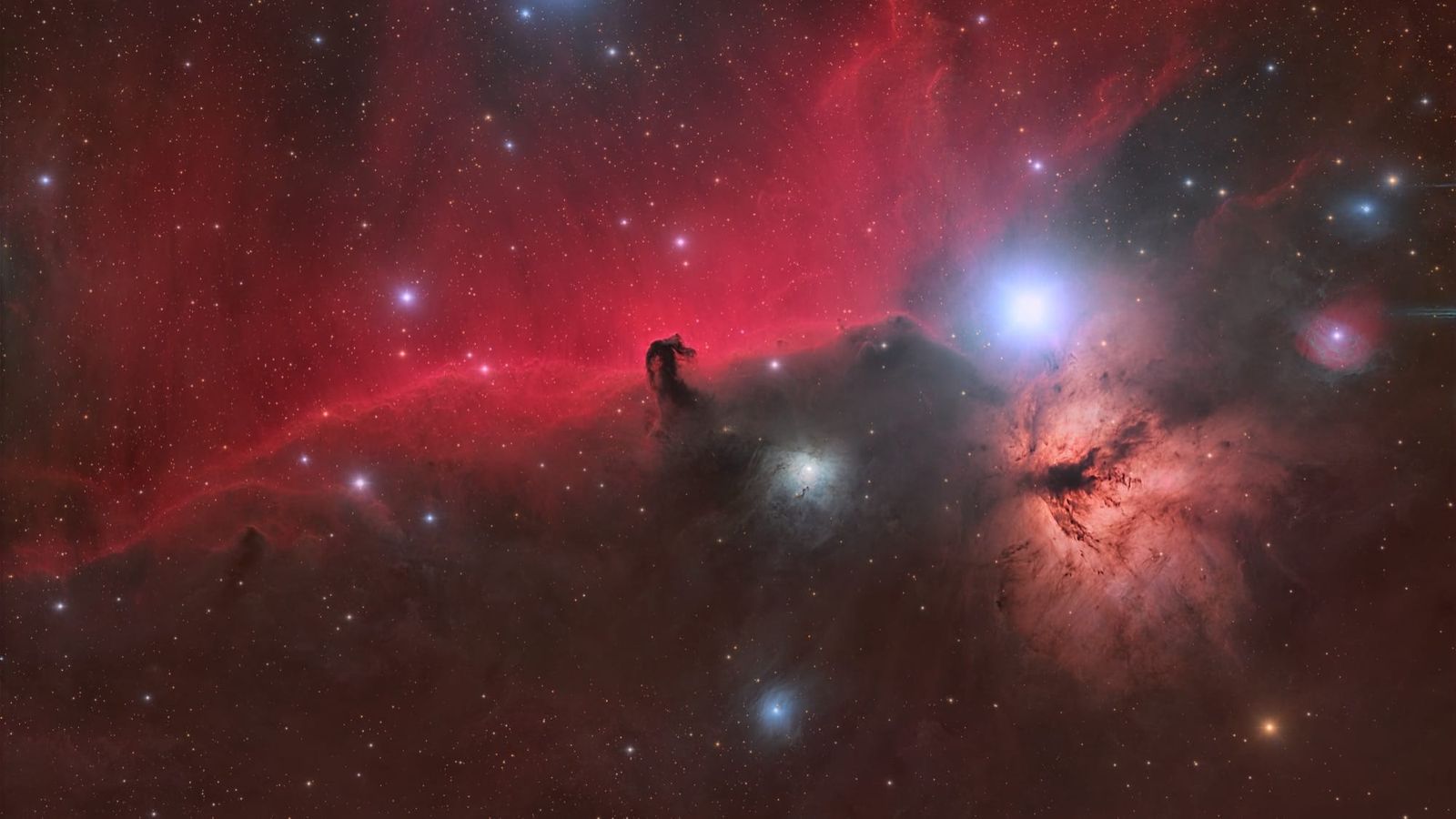
The Horsehead Nebula (Barnard 33) is a dark cloud of cold gas and dust in the constellation Orion, shaped like a horse's head. It is not glowing — we see it as a black silhouette blocking the light of a red emission nebula, IC 434, behind it. It sits near the Belt star Alnitak, about 1,500 light-years away.
| Designations | Horsehead Nebula · Barnard 33 (B33), silhouetted against IC 434 |
|---|---|
| Type | Dark nebula (absorption nebula) |
| Constellation | Orion (just south of Alnitak) |
| RA / Dec (J2000) | 05h 40m 59s / −02° 27′ 30″ |
| Apparent magnitude | None of its own (seen in silhouette against the glow of IC 434) |
| Apparent size | About 6′ × 4′ (the head) |
| Distance | About 1,500 light-years (460 parsecs) |
| Best months | December–February (evening sky) |
| Minimum aperture | Visually about 250 mm (10 in) with an H-beta filter; photographically any small refractor |
Data: position and size from SIMBAD (CDS Strasbourg); distance from NASA/ESA Hubble.
The Horsehead Nebula is one of the most recognisable shapes in the night sky, yet it is one of the hardest famous objects to actually see. Catalogued as Barnard 33, it is a knot of cold, opaque dust silhouetted against a glowing wall of hydrogen just south of Orion's Belt. This guide is written for curious beginners and backyard imagers alike: no jargon you cannot follow, just a clear picture of what the Horsehead is, where to find it, how far away it lies, and how to see and photograph it in 2026.
The Horsehead belongs to the same vast star factory as the more famous Orion Nebula. If you are new to these glowing clouds, start with our explainer on what a nebula is and how the different types form, then meet the Horsehead's brilliant neighbour, the Orion Nebula (M42).
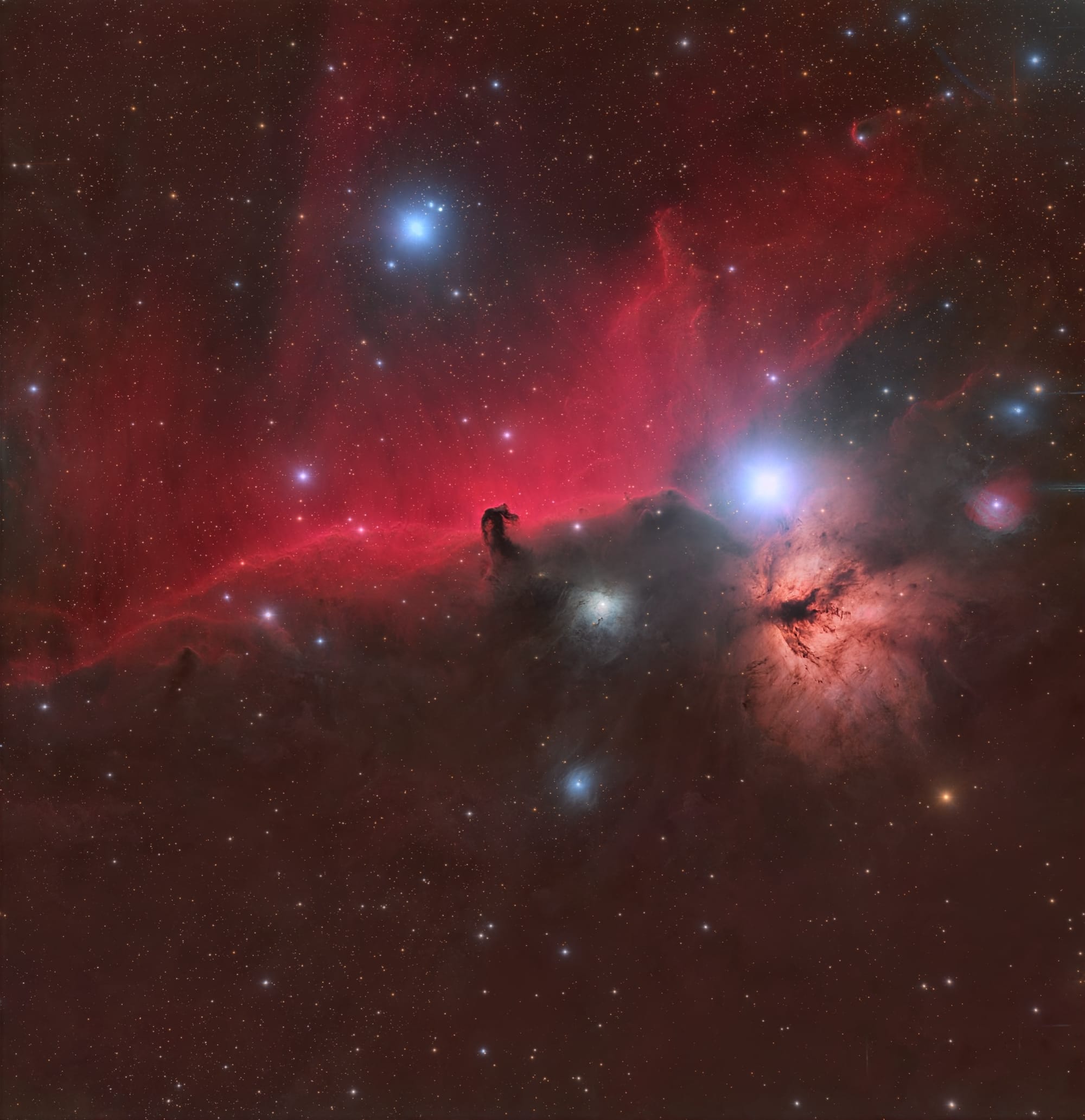
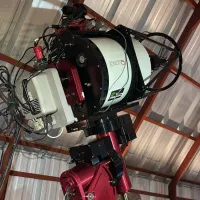
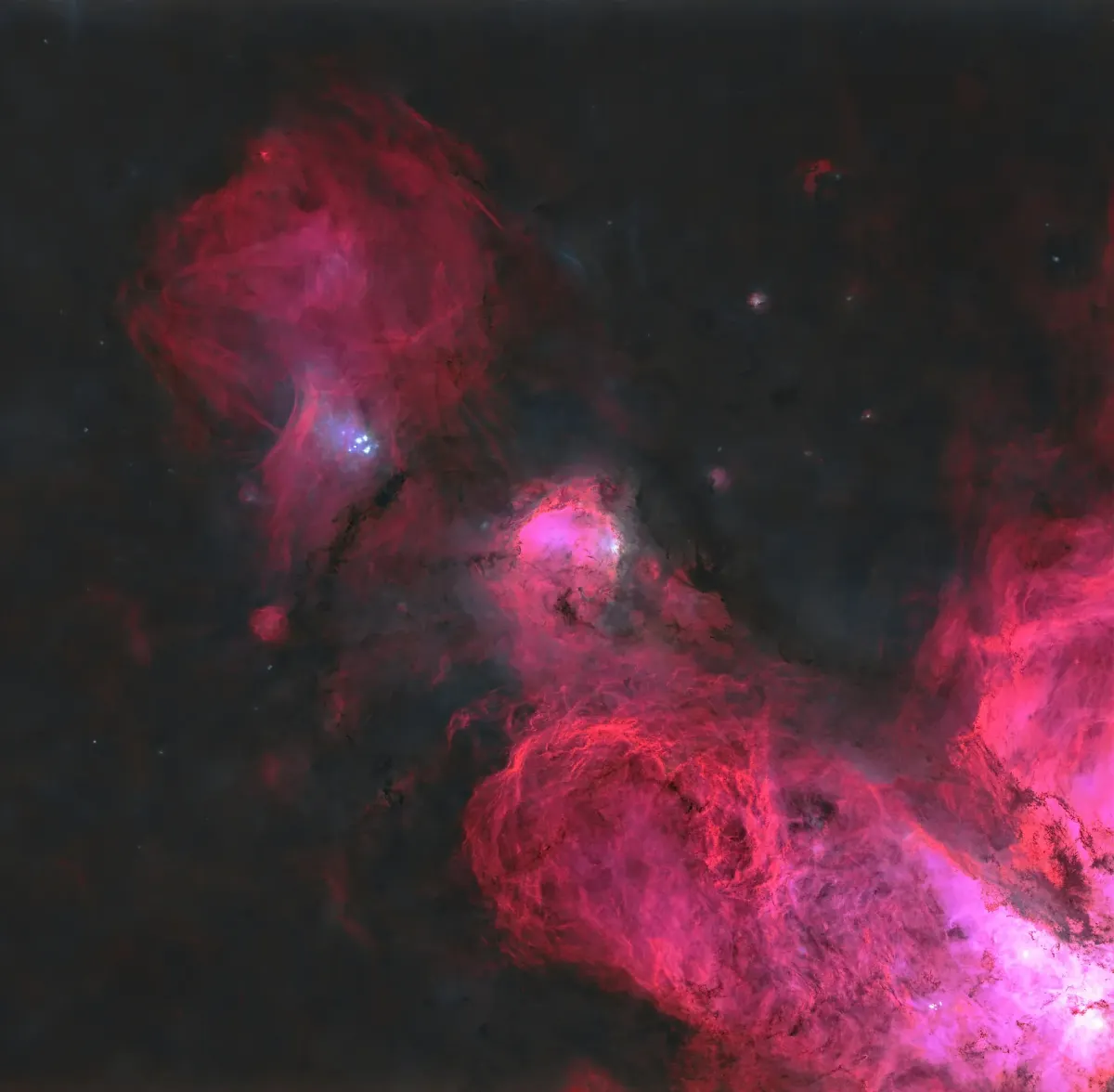
Acquisition: Stellarvue 130 mm refractor (909 mm focal length) · Diffraction Limited monochrome CCD · H-alpha + RGB, 47 × 300 s (about 3.9 hours) · 22–23 January 2026 · Deepsky Chile, Atacama.
What is the Horsehead Nebula (Barnard 33)?
The Horsehead Nebula is a dark nebula — a dense cloud of interstellar dust so thick that it blocks the light of whatever lies behind it. It is one of three kinds of nebula tangled together in this small patch of sky, and telling them apart is the key to understanding the whole scene.
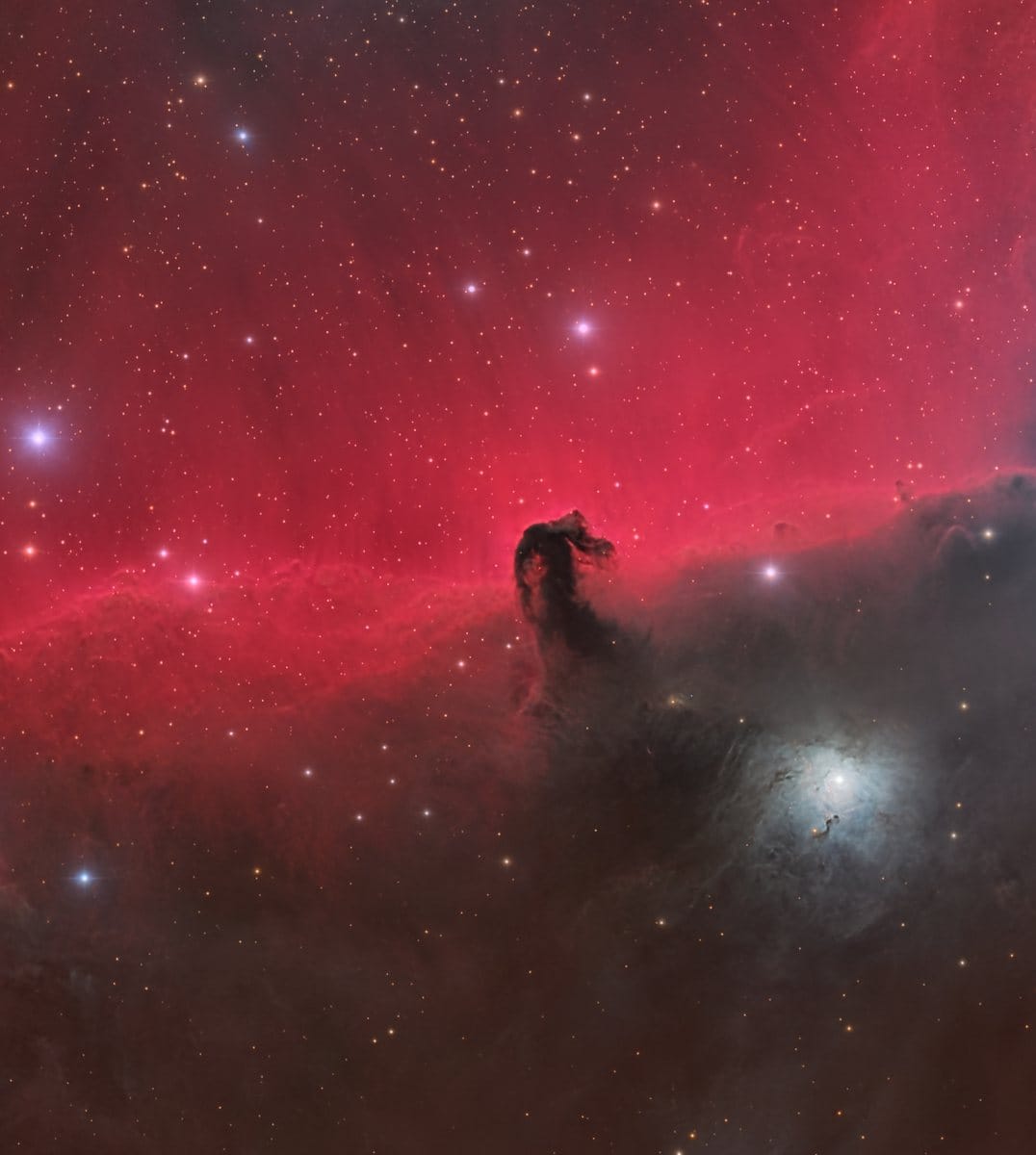
Behind the Horsehead glows IC 434, a curtain of hydrogen gas lit up by the hot star Sigma Orionis. That gas radiates a deep red light, so it acts like a backlit screen. The Horsehead's cold dust sits in front of that screen and lets no light through, so we see its distinctive profile — the arched neck, the blunt muzzle, the flick of a mane — as a black shadow. Nothing about the horse shape is glowing; it is pure silhouette.
The "head" itself is enormous. It spans roughly 3.5 light-years from base to tip, which is tens of trillions of kilometres of gas and dust sculpted by the radiation and stellar winds pouring off nearby young stars. Those same winds are slowly eroding the pillar, and astronomers estimate the shape will be worn away entirely in about five million years — a blink in cosmic terms, but far longer than our species has existed.
Where is the Horsehead Nebula in the sky?
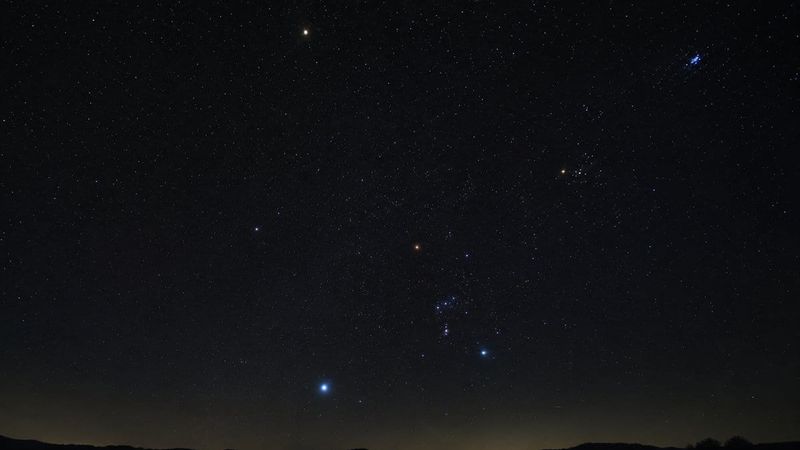
The Horsehead lies in Orion, just below the eastern end of Orion's Belt, close to the bright star Alnitak (Zeta Orionis). If you can find the three Belt stars — Alnitak, Alnilam and Mintaka in a short, near-perfect row — you are already pointing at the right corner of the sky. The Horsehead sits about half a degree south of Alnitak, roughly the width of the full Moon.
The whole scene belongs to the Orion Molecular Cloud Complex, a sprawling nursery of gas and newborn stars that also contains the Orion Nebula and the Flame Nebula. To place the Belt in the wider figure of the Hunter, see our guide to the Orion constellation.
How to find the Horsehead: star-hopping from Alnitak
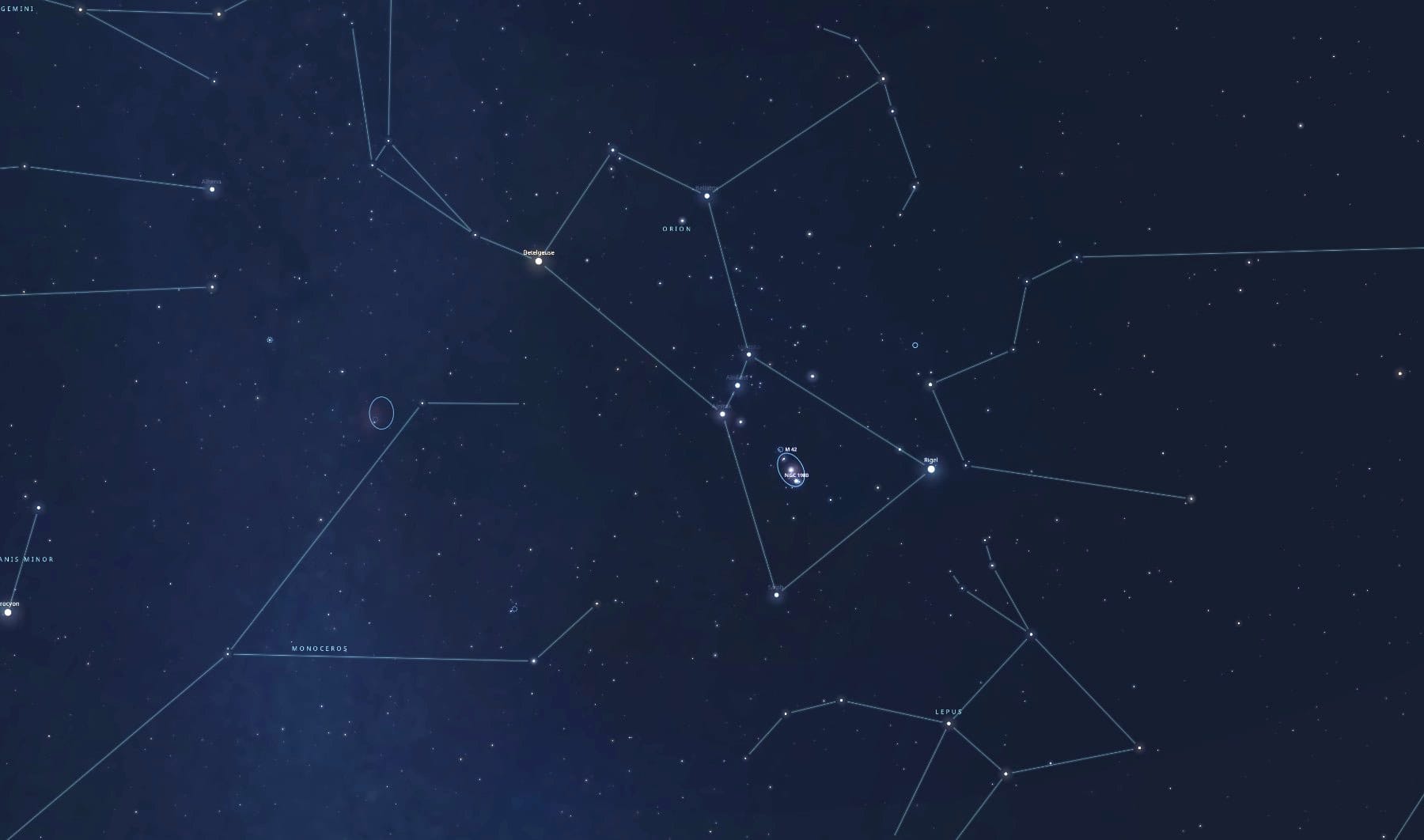
You will not spot the Horsehead with your eyes alone — but you can point a telescope or camera straight at it using Alnitak as a signpost. Here is the star-hop we use:
- Find Orion's Belt and identify Alnitak, the easternmost (left-most, from the Northern Hemisphere) of the three stars.
- Just below and left of Alnitak, the Flame Nebula glows — an easy landmark in a small telescope or a short photo.
- Drop about half a degree south of Alnitak. The Horsehead sits against the faint north–south strip of IC 434. In an eyepiece it is a subtle notch; in a camera it appears after even a short exposure.
Below the Belt, the Sword hangs down and holds the Orion Nebula — a bright target for another night. Once you have Alnitak centred, the Flame and Horsehead are within that same half-degree hop.
How far away is the Horsehead Nebula?
The Horsehead Nebula is about 1,500 light-years from Earth, according to ESA/Hubble. That places it in the same neighbourhood as the Orion Nebula, which sits a little closer at 1,344 light-years — both are pieces of the one great Orion molecular cloud.
A light-year is the distance light travels in a year, close to 9.5 trillion kilometres, so the light reaching your telescope tonight left the Horsehead roughly around the year 500 CE. If you want to get comfortable with these enormous scales, our primer on the units astronomers use to measure the universe breaks them down.
Why is the Horsehead dark, and what is inside it?
The Horsehead looks black for the same reason a storm cloud looks grey against a bright sky: it is full of fine dust that absorbs and scatters the light trying to pass through. Inside that cold, dense cloud, gravity is quietly pulling knots of gas together, and a few of those knots are collapsing into new stars. The Horsehead is not a dead shadow — it is a stalled stellar nursery, shielded from view by its own dust.
When the Hubble Space Telescope imaged the Horsehead in infrared light for its 23rd anniversary in 2013, the dust turned almost translucent and the "head" took on a delicate, wispy glow, revealing structure that visible light hides completely. Infrared cuts through dust, which is why so much of what we know about star birth comes from infrared and radio telescopes rather than ordinary cameras. To understand how these clouds turn into suns, see our explainer on what a star is and how stars form.
The Flame Nebula (NGC 2024): the Horsehead's fiery neighbour
Share a photo of the Horsehead and you almost always catch its neighbour in the same frame: the Flame Nebula, catalogued as NGC 2024. Where the Horsehead is a dark silhouette, the Flame is an emission nebula — gas that glows with its own light, streaked by a dark lane of foreground dust that gives it the look of a burning campfire.
The Flame sits right beside Alnitak, about half a degree from the Horsehead, and lies roughly 1,000 to 1,400 light-years away. Its glow is powered by ultraviolet radiation stripping electrons from hydrogen gas; the leading energy sources are Alnitak's fierce light and a cluster of hot young stars buried inside the cloud, hidden behind that dark central lane. As the electrons recombine with the hydrogen, the gas releases the reddish light we photograph.
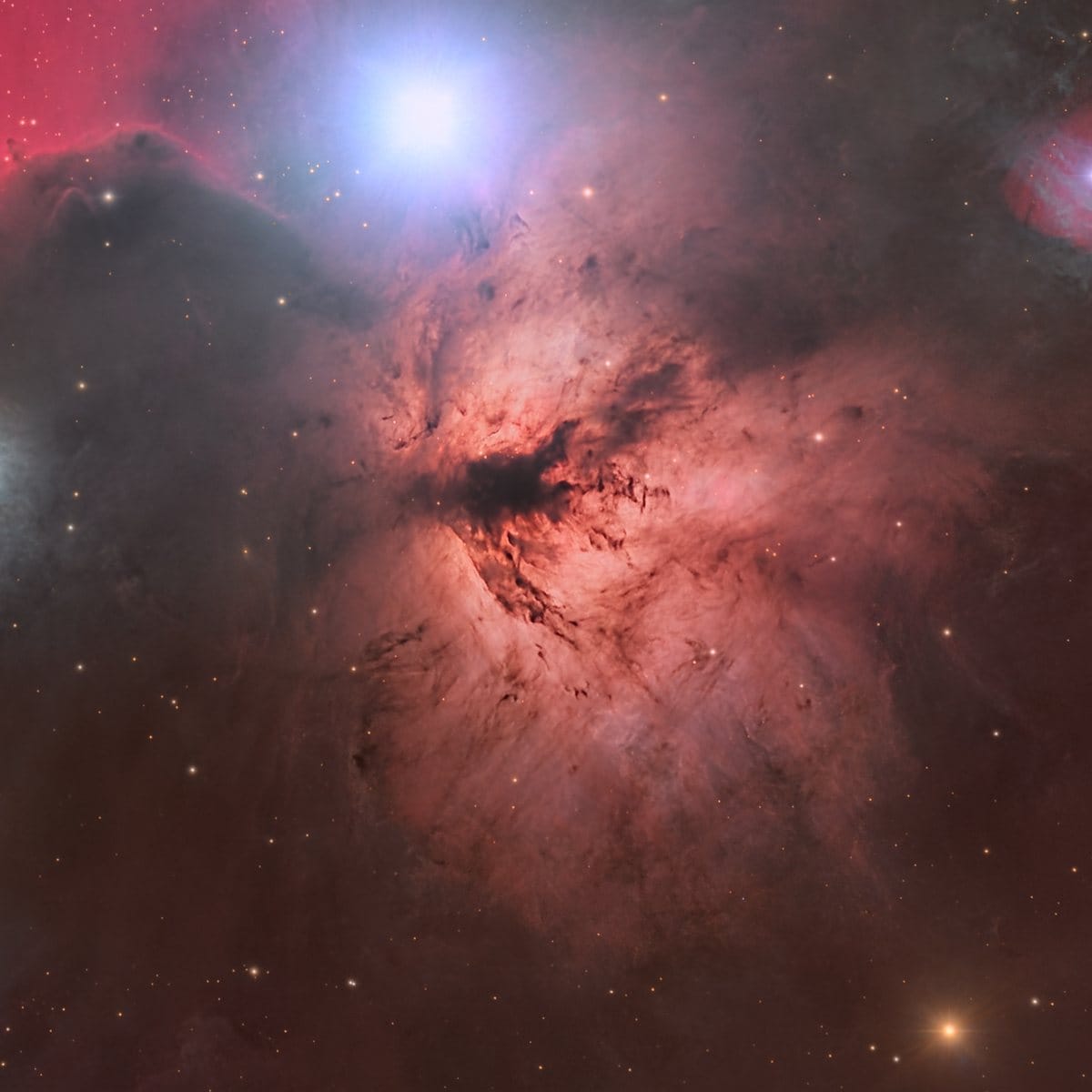
Because the Horsehead and Flame lie so close together, most imagers treat them as a single "Horsehead and Flame" target, framing both alongside Alnitak in one wide-field shot — exactly the view in our own annotated capture above.
Can you see the Horsehead Nebula with a telescope?
Honestly, the Horsehead is one of the toughest visual targets in the sky. You cannot see it with the naked eye or with binoculars, and even through a telescope it defeats most observers. Seeing it visually usually needs a large aperture (around 10 inches or more), a genuinely dark site far from city light, and a Hydrogen-beta filter, which boosts the faint red glow of IC 434 so the dark head shows up against it. Many experienced astronomers have looked for years without ever catching it by eye.
The Flame Nebula is far more forgiving. Under dark skies a modest telescope shows its glow, though the brilliant nearby star Alnitak floods the field and you may need to nudge it just out of view to see the nebula clearly.
The good news: what the eye struggles with, a camera captures easily. This is the great reversal of deep-sky imaging — a long exposure gathers light your eye never can, and the Horsehead rewards even a first attempt.
When is the best time to see the Horsehead Nebula?
The Horsehead follows Orion through the year. It is best placed on December-to-February evenings, crossing the meridian around local midnight in mid-December, around 10 pm in mid-January and around 8 pm in mid-February. At its highest it stands about 48° up from latitude 40° north and about 62° up from 30° south. Dark-sky sites in the Southern Hemisphere, like our remote rig in the Atacama, get it highest and steadiest.
Sky darkness matters far more here than for the Orion Nebula. The Horsehead is not a naked-eye or binocular object at all. Seeing it by eye needs about a 250 mm (10-inch) telescope, an H-beta filter and a genuinely dark site, roughly Bortle 1–3, on a moonless night. A camera is much more forgiving. An H-alpha filter cuts through suburban light pollution well enough to record the Horsehead and IC 434 from a Bortle 5–7 back garden, which is why it is one of the most-photographed objects in the sky and one of the least-seen.
How to photograph the Horsehead and Flame
The Horsehead and Flame are a rite of passage for astrophotographers, and for good reason: they are bright in the wavelengths our cameras love, and they frame together beautifully. Here is how we approach them from our remote rigs.
- Framing. A short refractor or a camera lens around 300–500 mm captures Alnitak, the Flame and the Horsehead in one field. Longer focal lengths crop in on the Horsehead alone — how focal length and sensor size set your framing explains why. Plan the field of view first with our astrophotography field-of-view calculator.
- Exposure. The nebulosity is faint, so total integration time matters more than any single frame. Stacking hours of exposures is what pulls the Horsehead out of the background.
- Filters. A Hydrogen-alpha filter is transformative here: it isolates the red light of IC 434, dramatically raising contrast between the glowing curtain and the dark head, and it works even under moonlight or light pollution.
- Alnitak's glare. Alnitak is so bright it can bloom across your frame. Careful framing and good-quality optics keep its halo from swamping the Horsehead.
We have imaged this region from our remote setups under the pristine skies of the Atacama in Chile and the high desert of New Mexico, where dark, steady air lets the faint hydrogen structure come through cleanly. It is one of those targets that shows a result on the very first night and keeps rewarding you as your processing skills grow.
A short history of the Horsehead
The Horsehead was never discovered by eye — it was found on a photograph. In 1888, the astronomer Williamina Fleming, working at Harvard College Observatory under Edward Pickering, spotted the dark notch cutting into IC 434 on a photographic plate and recorded it. It entered the catalogues as a curiosity: a bite taken out of a glowing cloud.
Decades later the American astronomer Edward Emerson Barnard included it in his landmark catalogue of dark nebulae, giving it the designation Barnard 33 that we still use. Over the twentieth century, as photography and then digital imaging improved, the Horsehead went from an obscure notch to one of the most photographed objects in the sky — a testament to how new technology can turn something nearly invisible into an icon. You can read more about its imaging history at ESA/Hubble and NASA.
Horsehead Nebula: frequently asked questions
What is the Horsehead Nebula?
The Horsehead Nebula (Barnard 33) is a dark cloud of dust and cold gas in the constellation Orion, shaped like a horse's head. It does not glow; we see it as a black silhouette against the red emission nebula IC 434 behind it.
Why is the Horsehead Nebula dark?
It is packed with fine dust that absorbs and blocks light, so no light passes through it. It only becomes visible because a bright cloud of glowing hydrogen, IC 434, sits directly behind it and backlights its shape.
How far away is the Horsehead Nebula?
About 1,500 light-years from Earth, in the Orion Molecular Cloud Complex — the same star-forming region that contains the Orion Nebula and the Flame Nebula.
Can you see the Horsehead Nebula with a telescope?
Only with difficulty. It needs a large telescope (about 10 inches or more), very dark skies, and usually a Hydrogen-beta filter. It is much easier to capture with a camera and a long exposure than to see by eye.
What is the Flame Nebula next to the Horsehead?
The Flame Nebula (NGC 2024) is a glowing emission nebula beside the star Alnitak, about half a degree from the Horsehead. A dark dust lane crosses it, giving it a campfire-like appearance. The two are usually photographed together.
What is the best time to see the Horsehead Nebula?
Winter evenings in the Northern Hemisphere, from about December through February, when Orion rides high in the south. Southern-Hemisphere observers get an excellent view during the southern summer.


%3A%20Orion's%20Dark%20Horse&body=The%20Horsehead%20Nebula%20(Barnard%2033)%3A%20Orion's%20Dark%20Horse%20%E2%80%94%20The%20Horsehead%20Nebula%20(Barnard%2033)%20is%20a%20dark%20cloud%20in%20Orion%2C%20silhouetted%20against%20glowing%20hydrogen.%20What%20it%20is%2C%20where%20to%20find%20it%2C%20and%20how%20to%20see%20and%20photograph%20it.%20https%3A%2F%2Fstellarnomads.com%2Fhorsehead-nebula%2F%20Image%3A%20https%3A%2F%2Fstorage.ghost.io%2Fc%2Fbf%2F0d%2Fbf0d5d59-0433-4995-b3fa-4f41b743ef1b%2Fcontent%2Fimages%2F2026%2F07%2Fhorsehead-nebula-own-capture-banner.jpg)