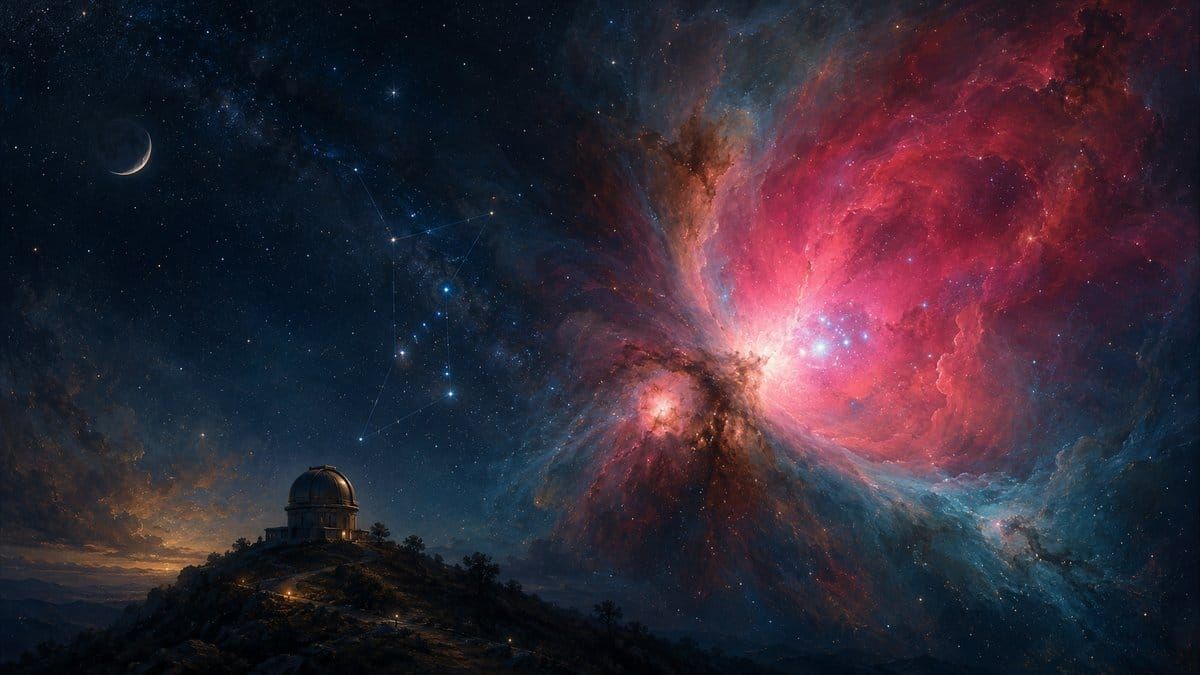
The Orion Nebula (M42) is a giant cloud of gas and dust roughly 1,344 light-years away in the Sword of Orion — the closest large star-forming region to Earth. Bright enough to see with the naked eye, it is a glowing stellar nursery where new stars and planetary systems are being born right now.
| Designations | Orion Nebula · M42 · Messier 42 · NGC 1976 · Great Orion Nebula |
|---|---|
| Type | Emission and reflection nebula (H II region) |
| Constellation | Orion (the Sword, below the Belt) |
| RA / Dec (J2000) | 05h 35m 17s / −05° 23′ |
| Apparent magnitude | 4.0 |
| Apparent size | About 85′ × 60′ including the faint outer wings |
| Distance | About 1,344 light-years (412 parsecs) |
| Best months | December–February (evening sky) |
| Minimum aperture | Naked eye under a dark sky; binoculars show structure |
Data: position from SIMBAD (CDS Strasbourg); distance from VLBA radio parallax; magnitude from NASA; apparent size from the SEDS Messier catalog.
What is the Orion Nebula (M42)?
The Orion Nebula is a vast cloud of glowing hydrogen gas and dust where thousands of new stars are forming. Catalogued in NASA's Messier catalog as Messier 42 (M42) and also known as the Great Nebula in Orion or NGC 1976, it sits about 1,344 light-years from Earth — making it the nearest major stellar nursery we can study in fine detail.
What makes M42 special is that it is an emission nebula: intense ultraviolet radiation from a handful of massive young stars at its heart strips electrons from the surrounding hydrogen, and the gas glows a characteristic red-pink as those electrons recombine. Blended with reflected starlight and dark dust lanes, the result is one of the most photographed objects in the entire sky. To understand how it fits among the other cosmic clouds, see our guide to what a nebula is and the different types.
The nebula spans about 24 light-years across and shines at apparent magnitude 4.0, which is why it is visible without any equipment under a reasonably dark sky. It is the brightest, most accessible piece of a much larger structure called the Orion Molecular Cloud Complex, which also contains the famous Horsehead and Flame nebulae nearby.
Where is the Orion Nebula and how do you find it?
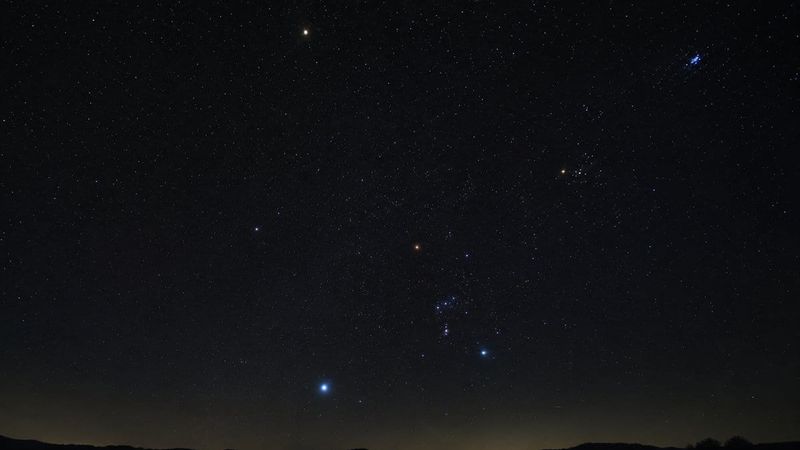
The Orion Nebula sits in the Sword of Orion, the short line of stars hanging below Orion's Belt. If you can find the three bright, evenly spaced Belt stars, you are seconds away from M42 — just look for the fainter vertical string of "stars" beneath them, and the middle one will look slightly fuzzy. That fuzz is the nebula.
Orion is a winter constellation for the Northern Hemisphere, riding highest in the evening sky from December through February. For the full star pattern, the Belt, and seasonal timing, read our companion guide to the Orion constellation and how to find it. Once you know Orion, the nebula is one of the easiest deep-sky objects in the sky to locate.
From the Southern Hemisphere the view is even better: Orion climbs high overhead during the southern summer, and the nebula appears inverted but brilliantly placed for observation and imaging. Our own remote observations of M42 span both hemispheres, and the target rewards patience from any dark site.
How to find the Orion Nebula: star-hopping from the Belt
You don't need a go-to mount for this one — the Orion Nebula is one of the easiest star-hops in the sky, which makes it the perfect target to learn the technique on. Star-hopping just means anchoring on a bright, easy-to-find star and stepping along recognizable patterns until you land on your target.
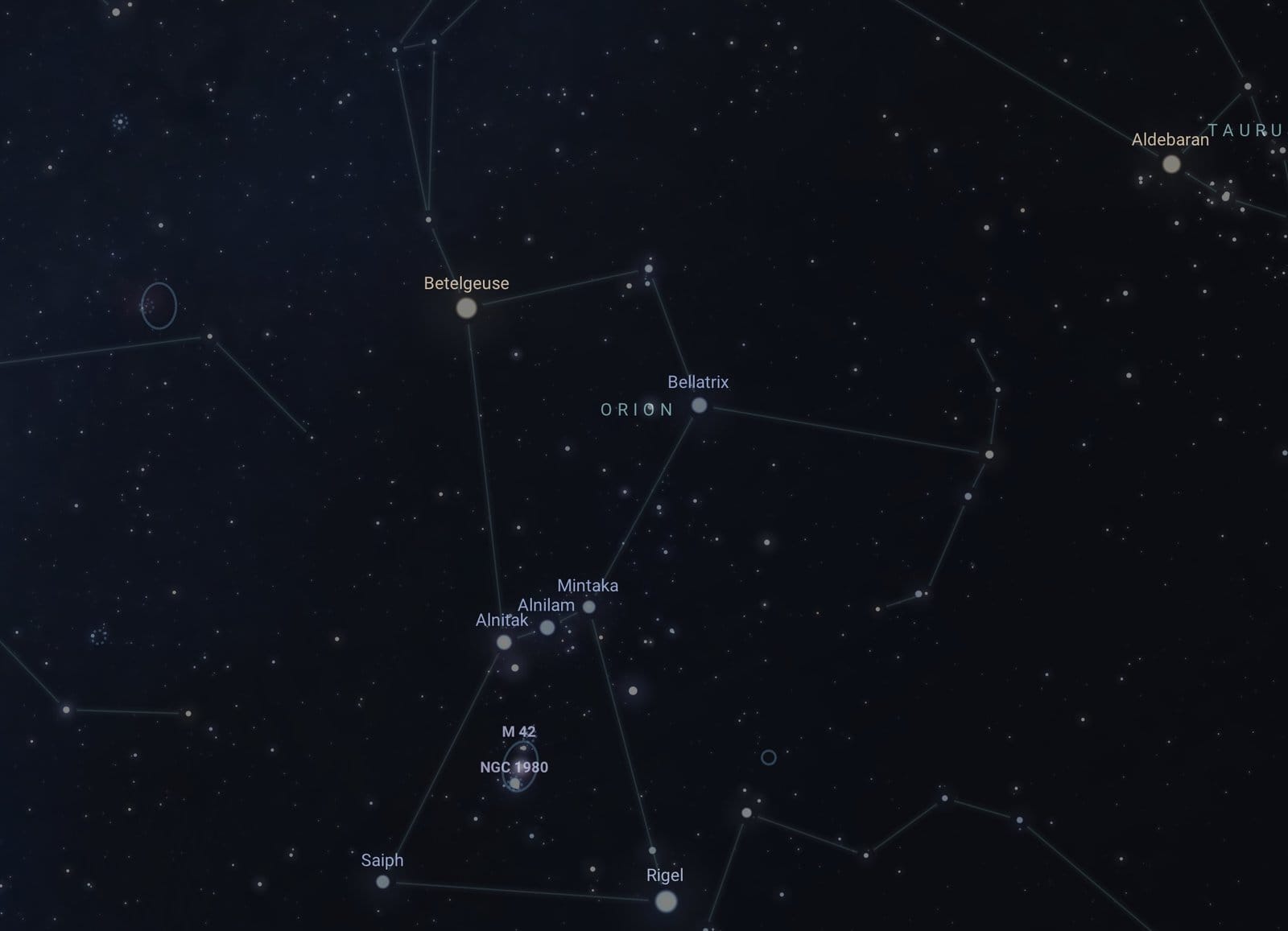
- Start at Orion's Belt. Find the three bright, evenly spaced stars — Alnitak, Alnilam and Mintaka. They are the most recognizable signpost in the winter sky, easy to catch by eye even from the suburbs.
- Drop south to the Sword. From the Belt, hop about 4° south — roughly three fingers held at arm's length. You will land on the short vertical line of the Sword of Orion. In a finderscope or binoculars, the Belt and Sword nearly share the same low-power field.
- Center the fuzzy middle "star." The middle object in the Sword is not a star — it is the nebula. Even at low power it looks soft and glowing rather than sharp and point-like. That is M42.
- Confirm at the eyepiece. Nudge to higher power and the four stars of the Trapezium snap into view, embedded in the nebula's glowing wings — your confirmation that you are on target.
The three Belt stars carry names nearly as old as the star-hop itself, all rooted in Arabic. Alnitak (from an-nitaq) and Mintaka (from al-mintaqah) both mean roughly “the belt” or “the girdle,” while the central star Alnilam (from an-nizam) means “the string of pearls.” Fittingly, the very signpost that leads you to the Orion Nebula is, quite literally, named the belt.
Once you have hopped to M42 this way, you have the core skill for every fainter object: anchor on something bright, then step along familiar patterns to your target. The finder chart below shows the hop from the Belt down to the Sword.
How far away is the Orion Nebula?
The Orion Nebula lies about 1,344 light-years from Earth. That figure comes from precise radio parallax measurements of stars embedded in the nebula, published by Menten and colleagues in 2007 using the Very Long Baseline Array — a refinement on older estimates that ranged from 1,300 to 1,600 light-years.
To put that distance in perspective: light we see from M42 tonight left the nebula around the year 680 CE. Despite that enormous gap, 1,344 light-years is astronomically close — the nebula is essentially in our cosmic backyard, which is exactly why astronomers prize it as a natural laboratory for studying how stars and planets are born. For a sense of the units involved, our explainer on how astronomers measure cosmic distances breaks down the light-year and beyond.
What is inside the Orion Nebula? The Trapezium and a stellar nursery
At the glowing core of M42 sits the Trapezium Cluster — a tight knot of four bright young stars (Theta-1 Orionis A, B, C, and D) arranged in a trapezoid shape. These stars are only around one to two million years old, mere infants compared with our 4.6-billion-year-old Sun, and their fierce radiation is what lights up the entire nebula.
Surrounding the Trapezium, astronomers have identified hundreds of protoplanetary disks — nicknamed "proplyds" — which are flattened swirls of gas and dust around infant stars. Each one is a solar system in the making, and Hubble Space Telescope images have resolved them in stunning detail. In other words, M42 shows us a live preview of the process that built our own planet. If you want the bigger picture on how these objects come to be, see our guide to how stars form and evolve.
The nebula also hides a second lobe of star formation behind the visible cloud, the Orion Molecular Cloud 1, where deeply embedded protostars are detectable only in infrared and radio light. New stars are quite literally switching on inside M42 as you read this.
The Orion Nebula's neighbors: M43, the Running Man, Horsehead and Flame
M42 does not sit alone. Just to the north, separated by a dark dust lane, is M43 (De Mairan's Nebula), a smaller emission region that is really part of the same complex. A little further north lies the Running Man Nebula (NGC 1973, 1975 and 1977), a delicate blue reflection nebula that makes a gorgeous wide-field pairing with the main nebula.
A few degrees away, near the Belt star Alnitak, sit two more icons of the Orion Molecular Cloud Complex: the dark silhouette of the Horsehead Nebula and the glowing filaments of the Flame Nebula. The same Belt that guides you to M42 points straight to them — the Horsehead sits just south of Alnitak, the easternmost Belt star, and is one of the most photographed dark nebulae in the whole sky. All of these clouds are physically connected, part of the same enormous nursery that dominates this region of the sky. Because they share the frame so beautifully, they are perennial favorites for astrophotographers building a portfolio of the winter sky.
Can you see the Orion Nebula with the naked eye?
Yes. Under a dark sky, the Orion Nebula is visible to the unaided eye as a soft, fuzzy patch in the middle of Orion's Sword — one of the very few nebulae you can spot without any equipment. It will not show color to your eye (human night vision is nearly colorless), but the misty glow is unmistakable once you know where to look.
Here is what different equipment reveals:
- Naked eye (dark sky): a faint fuzzy "star" in the Sword.
- Binoculars (7x50 or 10x50): an obvious grey-green glow with a brighter core and hints of structure.
- Small telescope (60–100 mm): the Trapezium's four stars snap into view, set against wispy nebulosity.
- Larger telescope (150 mm and up): sweeping wings of nebulosity, dark lanes, and a subtle greenish tint from doubly ionized oxygen.
Even light-polluted suburban skies show M42 well, which is part of why it is the single best "first deep-sky object" for new observers. If you are choosing gear, our astrophotography calculators can help you match a telescope and camera to targets like this one.
When is the best time to see the Orion Nebula?
The Orion Nebula is a winter target for the Northern Hemisphere and a summer one for the Southern. It is best placed from December through February, when it stands high in the evening sky. It crosses the meridian around local midnight in mid-December, around 10 pm in mid-January and around 8 pm in mid-February. By April it is sinking into the western twilight. It returns to the pre-dawn sky in late summer.
At its highest, M42 sits about 45° up from latitude 40° north and about 65° up from 30° south. That is high enough to clear most horizon haze from either hemisphere. Because it lies just south of the celestial equator, it is visible from every inhabited continent.
This is one of the most forgiving targets in the sky. It is a naked-eye object from a rural or dark-suburban site (roughly Bortle 5 or darker), an easy binocular target almost anywhere, and a bright telescope target even from a light-polluted city at Bortle 7–8. If you can see Orion's Sword, you can find the nebula. The Orion constellation guide covers the rest of the season's sky.
How to photograph the Orion Nebula
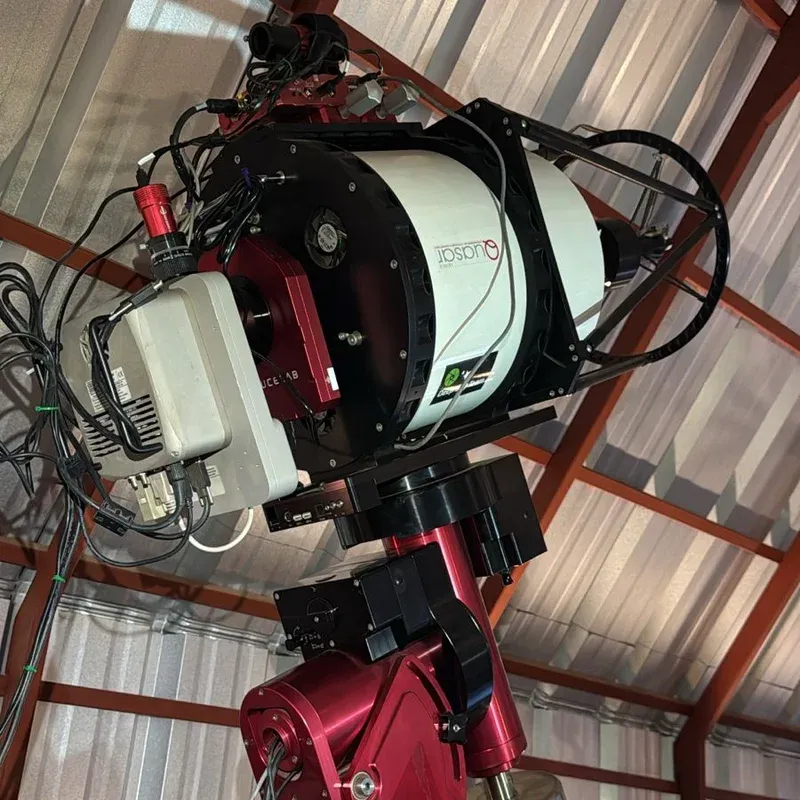
The Orion Nebula is famously the easiest bright nebula to photograph — and also one of the trickiest to photograph well, because its core is thousands of times brighter than its faint outer wings. We have imaged M42 repeatedly from our remote rigs, and the same few lessons come up every time.
The core challenge is dynamic range. A single long exposure that captures the faint outer nebulosity will completely blow out the bright Trapezium core to featureless white. The standard solution is to shoot two exposure sets — long subframes for the faint outer structure and short subframes for the bright core — then blend them with a high-dynamic-range (HDR) combination during processing. In our workflow this is handled entirely in PixInsight, using the HDR Multiscale Transform to recover the Trapezium detail hiding inside the glare.
A few practical notes from our own sessions:
- Keep total exposures modest. M42 is bright; you need far less integration time than for a faint galaxy. A couple of hours produces a clean result.
- Protect the core. Always capture short subs (30–60 seconds) alongside your longer ones so you have unsaturated Trapezium data to blend back in.
- Watch your gradients. Because Orion rides fairly low for northern imagers, light-pollution gradients are common — calibrate and background-model carefully.
Will M42 fit your frame? With its outer wings the nebula spans roughly 85 × 60 arcminutes, close to three full Moons across, so short focal lengths capture the whole cloud while long ones crop into the Trapezium core. Before you image, check your camera and telescope combination in our telescope field of view calculator, then fine-tune exposure and sampling with the astrophotography calculator.
Because it is so bright and forgiving, M42 is the target we most often recommend to imagers taking their first steps into deep-sky work. It will show a result on the very first night, and it keeps rewarding you as your processing skills grow.
What color is the Orion Nebula?
In deep photographs the Orion Nebula blazes in pinks, reds, blues and subtle greens — but those colors tell a physical story, and they are not quite what your eye sees at the eyepiece. The hues come from specific atoms glowing at specific wavelengths, which is exactly why M42 is such a useful teaching object.
The dominant red and magenta comes from hydrogen gas emitting at the hydrogen-alpha wavelength as electrons recombine with protons — the signature of an emission nebula. Threaded through it, cooler blue regions are reflection nebulosity, where fine dust simply scatters the light of nearby hot stars, much as our sky scatters sunlight blue. Near the bright core, a delicate teal-green glow comes from doubly ionized oxygen, a color so faint it puzzled astronomers for decades before its source was identified.
To the human eye through a telescope, though, M42 usually looks grey with a greenish tinge, because our night vision is nearly colorless and cannot register the faint reds that cameras accumulate over long exposures. That gap between eye and sensor is one of the most common surprises for new observers — and one of the best reasons to try imaging. For more on why cosmic clouds take the colors they do, our overview of nebula types breaks down emission, reflection and dark nebulae side by side.
A quick history of M42
Although Orion's Sword was known to ancient sky-watchers as a fuzzy region, the nebula itself went unremarked until the telescope arrived. The French scholar Nicolas-Claude Fabri de Peiresc is generally credited with the first recorded telescopic observation in 1610. Over the following centuries astronomers including Christiaan Huygens sketched its structure, and in 1769 Charles Messier added it to his famous catalogue as object number 42 — the designation we still use today.
In 1880, M42 became the first nebula ever photographed, by Henry Draper, opening the era of astrophotography that amateurs like us continue today. It has since been imaged by every major observatory, from ground-based giants to the Hubble and James Webb space telescopes, each revealing new layers of a nebula humanity has been staring at for over four hundred years.
Orion Nebula: frequently asked questions
Is the Orion Nebula the same as M42?
Yes. "Orion Nebula," "M42," "Messier 42," "NGC 1976," and "the Great Nebula in Orion" all refer to the same object — the bright star-forming cloud in the Sword of Orion.
How far is the Orion Nebula from Earth?
About 1,344 light-years, based on radio-parallax measurements published in 2007. Older estimates placed it between 1,300 and 1,600 light-years.
Can you see the Orion Nebula without a telescope?
Yes. Under a dark sky it is visible to the naked eye as a fuzzy patch in Orion's Sword, and binoculars reveal an obvious glowing cloud with a bright core.
What is the best time to see the Orion Nebula?
For the Northern Hemisphere, winter evenings from December through February, when Orion rides high in the south. Southern-Hemisphere observers get an excellent overhead view during the southern summer.
Why is the Orion Nebula important to astronomers?
Because it is the closest large star-forming region to Earth, M42 lets astronomers watch stars and protoplanetary disks form in unmatched detail — a live look at the process that created our own Solar System.
What telescope do I need to see the Orion Nebula?
Almost any telescope shows it. A small 60–100 mm refractor reveals the four Trapezium stars against glowing nebulosity, while a 150 mm or larger scope shows sweeping detail in the nebula's wings.


%3A%20A%20Complete%20Guide%20to%20Messier%2042&body=The%20Orion%20Nebula%20(M42)%3A%20A%20Complete%20Guide%20to%20Messier%2042%20%E2%80%94%20The%20Orion%20Nebula%20(M42)%20is%20the%20closest%20star-forming%20region%20to%20Earth.%20What%20it%20is%2C%20where%20to%20find%20it%2C%20how%20far%20away%20it%20is%2C%20and%20how%20to%20see%20and%20photograph%20it.%20https%3A%2F%2Fstellarnomads.com%2Forion-nebula%2F%20Image%3A%20https%3A%2F%2Fstorage.ghost.io%2Fc%2Fbf%2F0d%2Fbf0d5d59-0433-4995-b3fa-4f41b743ef1b%2Fcontent%2Fimages%2F2026%2F07%2Forion-nebula-hero.jpg)