Quick answer: A reflection nebula is a cloud of interstellar dust that glows by scattering and reflecting the light of nearby stars, instead of producing light of its own. Because dust scatters short blue wavelengths most efficiently, reflection nebulae usually shine a soft blue. The Pleiades and Messier 78 are classic examples.
If you have ever seen a photograph of the Pleiades star cluster wrapped in a ghostly blue mist, you have already met a reflection nebula. These are some of the most beautiful — and most misunderstood — objects in the night sky: dusty clouds that do not burn and do not glow on their own, yet light up in delicate blues wherever a bright star happens to sit nearby.
At Stellar Nomads we chase these faint clouds from our remote rig under the dark Atacama sky in Chile, where a reflection nebula reveals its subtle colour far better than it ever does from a light-polluted city. In this guide we will explain what a reflection nebula actually is, why it glows blue, how it differs from the other kinds of nebulae, and which ones you can find and photograph yourself.
Think of this as the deep dive that sits under our broader explainer on what a nebula is. If you want the big picture across every cloud type first, start there — then come back here for reflection nebulae in detail.
What is a reflection nebula?
A reflection nebula is an interstellar cloud of dust and gas that is visible because it reflects and scatters the light of one or more nearby stars. It makes none of its own light.
The comparison we keep coming back to is fog around a streetlamp. On a misty night the air itself is invisible, but a lamp turns the fog around it into a glowing halo. A reflection nebula works the same way on a cosmic scale: billions of microscopic dust grains act like tiny mirrors, bouncing a nearby star's light in every direction — including toward your eye or camera.
Three things have to line up for a reflection nebula to appear:
- Dust. A cloud of fine interstellar grains, each a fraction of a micrometre across, made mostly of carbon (soot-like) and silicates (rock-like) material.
- A bright star nearby. The illuminating star sits beside or in front of the cloud, not necessarily inside it. Its light is what we actually see reflected.
- A star that is bright but not too hot. This is the crucial detail. If the star were hot enough to strip electrons from the gas, the cloud would glow on its own as an emission nebula instead. In a reflection nebula, the star simply is not that fierce — so the cloud can only reflect.
Because the light is borrowed rather than generated, a reflection nebula is usually fainter than a bright emission nebula of similar size, which is why dark skies make such a difference when you try to see or photograph one.
For a quick visual tour of every nebula family — reflection, emission, dark and more — this short field guide from NASA is an excellent companion to the read:
How does a reflection nebula form?
A reflection nebula forms when a cloud of leftover interstellar dust drifts close enough to a bright star for that star's light to scatter off the grains.
That dust is not rare. The space between stars is threaded with vast, cold molecular clouds — the same clouds that collapse to build new stars. When a region of one of these clouds condenses into stars, plenty of dust is left over around the newborns. If one of those young stars is luminous but not scorching, the surrounding dust lights up as a reflection nebula.
This is why reflection nebulae so often turn up in star-forming regions and around young star clusters. The dust and the star share a birthplace. In some cases, though, the pairing is a coincidence: a mature star can simply wander through, or sit next to, an unrelated dust cloud and illuminate it in passing. The Witch Head Nebula, lit by the brilliant star Rigel, is often described this way.
The grains themselves are astonishingly small — far smaller than a grain of sand, closer in size to the particles in cigarette smoke. It is their size, relative to the wavelength of visible light, that decides the colour we see next.
Why do reflection nebulae glow blue?
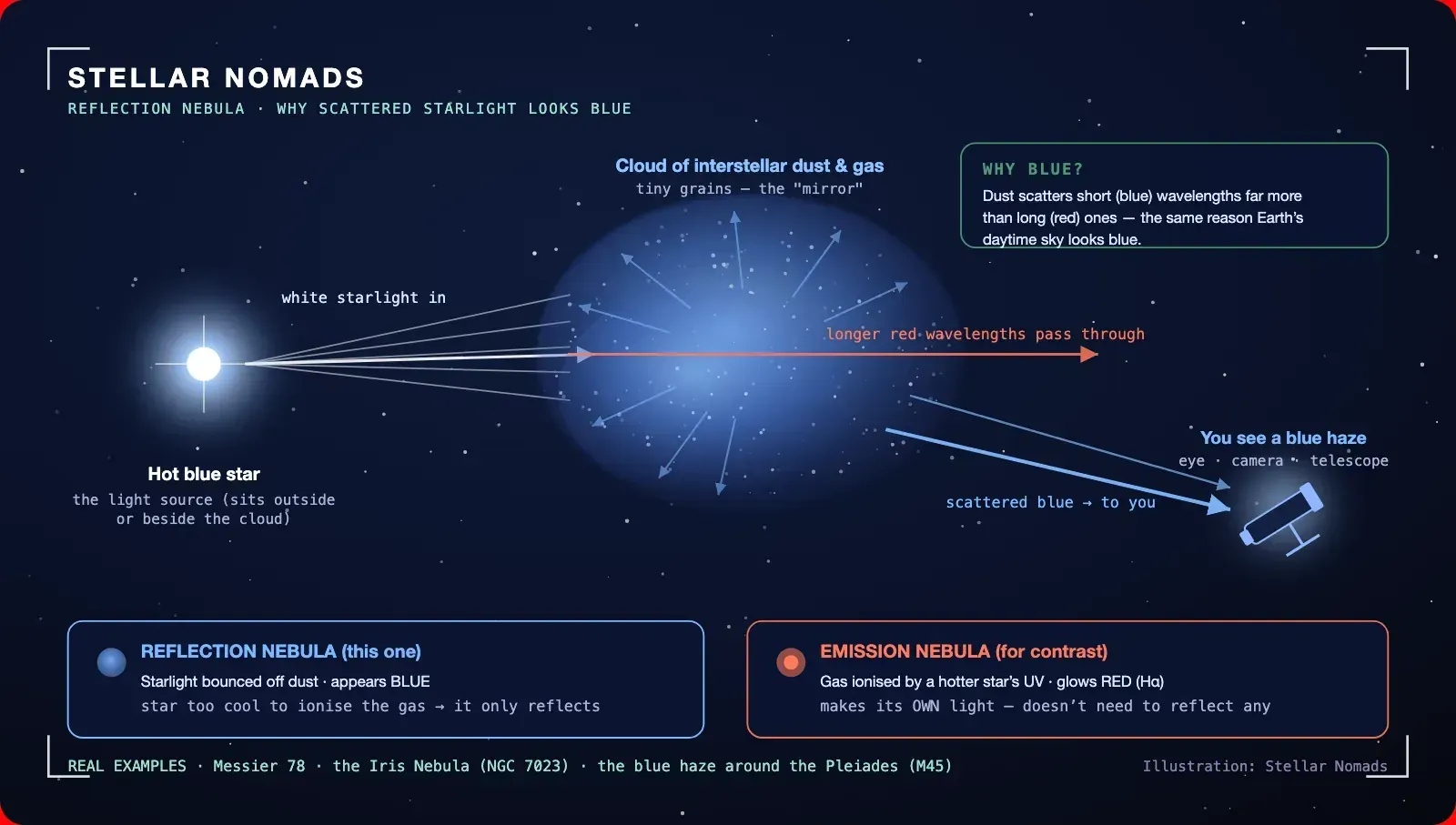
Reflection nebulae look blue because interstellar dust scatters short, blue wavelengths of starlight far more strongly than long, red wavelengths — the very same physics that paints Earth's daytime sky blue.
When starlight hits the cloud, the tiny grains fling blue photons off in all directions while letting more of the red light pass straight through. From wherever you are watching, you catch a shower of that redirected blue light, so the cloud takes on a cool blue glow. It is the astronomical cousin of a blue sky at midday and a red Sun at sunset — both are the atmosphere sorting light by wavelength.
There is a second reason the effect is so blue. The stars that illuminate reflection nebulae are often hot, blue-white stars that already pour out more blue light than red. Bluer light going in, and blue light preferentially scattered out, combine into that signature icy tint. The diagram below traces the whole path — starlight in, blue scattered toward you, red passing through:
Occasionally you will read that a reflection nebula is "just" reflected starlight and should therefore be the same colour as its star. The scattering step is exactly why that is not true: the cloud is almost always noticeably bluer than the star lighting it, and measuring that colour shift is one way astronomers study the size of the dust grains themselves.
Reflection vs emission vs dark nebulae: what is the difference?
A reflection nebula scatters starlight and glows blue; an emission nebula is gas energised to shine on its own, usually red; and a dark nebula is dust so dense it simply blocks the light behind it. All three are clouds of gas and dust — the difference is in how they interact with light.
| Type | How it appears | Typical colour | What is happening | Example |
|---|---|---|---|---|
| Reflection nebula | Faint, glowing haze | Blue | Dust scatters a nearby star's light toward us | Messier 78, the Pleiades |
| Emission nebula | Bright, glowing cloud | Red / pink | Ultraviolet from a very hot star ionises the gas, which then glows | Orion Nebula, the Wizard Nebula |
| Dark nebula | A black gap in the stars | None (silhouette) | Dense dust absorbs and blocks background light | The Horsehead, the Coalsack |
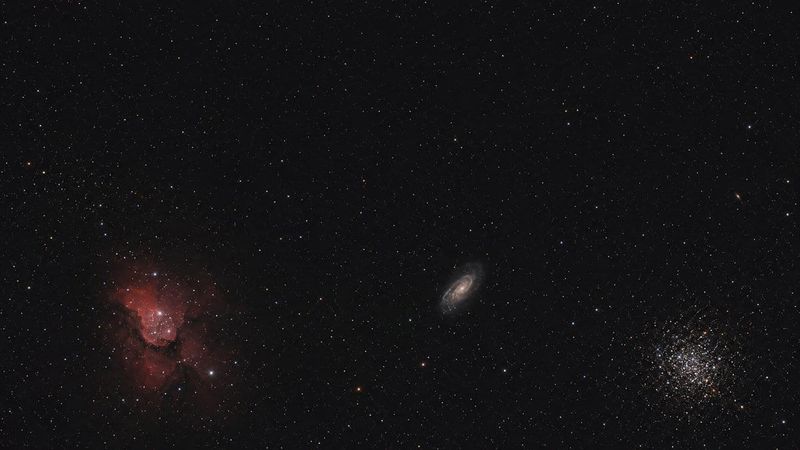
Here is the part that trips people up: a single cloud can do more than one of these at once. In the famous Trifid Nebula, a red emission region sits right beside a blue reflection region, both fed by the same complex of gas and dust. The label depends on where you look and which star is doing the lighting. If you want the full taxonomy — including planetary nebulae and supernova remnants — our guide to the main types of nebulae lays them out side by side.
Famous reflection nebulae you can see
Reflection nebulae are scattered all over the sky, but a handful stand out for their brightness and beauty. Here are the ones we return to most often.
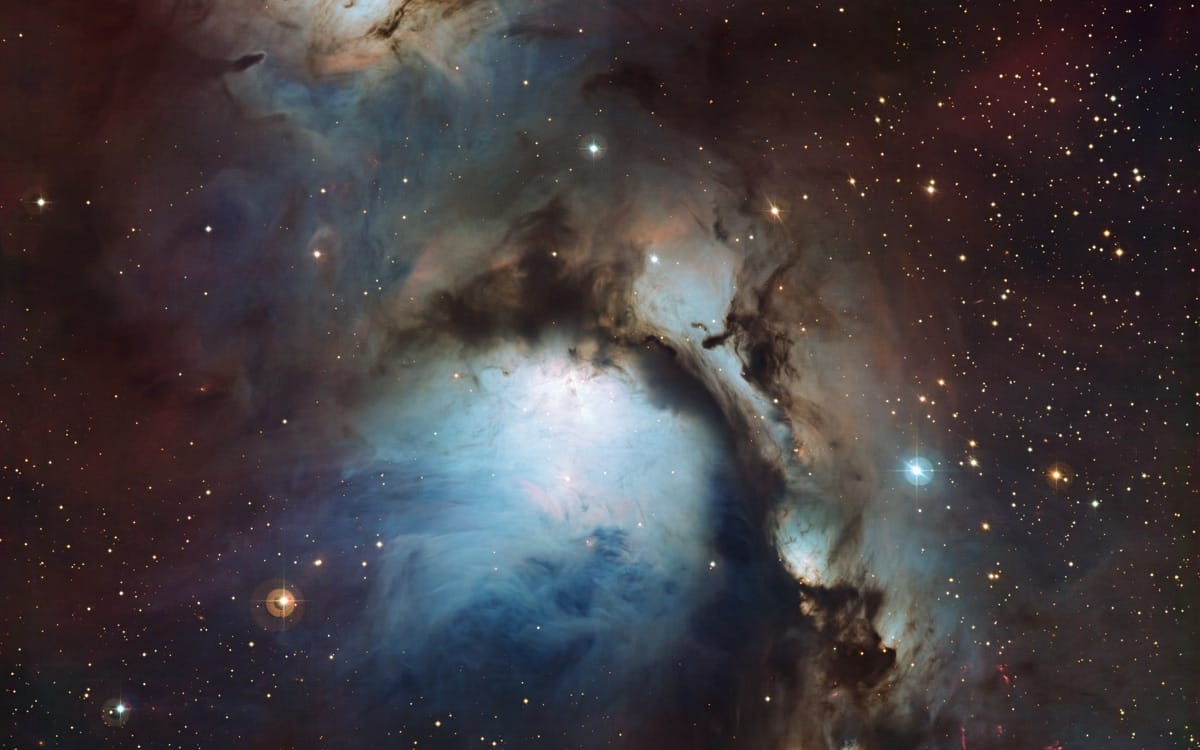
- Messier 78 (M78) — In Orion, about 1,600 light-years away, M78 is the brightest diffuse reflection nebula we can see and a favourite first target. Two hot blue stars light the dust, and the whole region is a busy stellar nursery. NASA maintains a detailed page on Messier 78 if you want the observing data.
- The Iris Nebula (NGC 7023) — A gorgeous deep-blue bloom in Cepheus, lit by the star SAO 19158 sitting in its heart. The Iris is a photographer's favourite because its petals of blue dust fade into dark, dusty lanes at the edges.
- The Witch Head Nebula (IC 2118) — A wispy profile near Orion, illuminated by the brilliant nearby star Rigel. It is extremely faint and a genuine test of a dark sky and patient imaging.
- The Merope / Pleiades Nebula (NGC 1435) — The blue veil draped over the Pleiades (M45). For a long time it was thought to be the cluster's own birth cloud; we now know the cluster is simply drifting through an unrelated patch of dust and lighting it up as it passes.
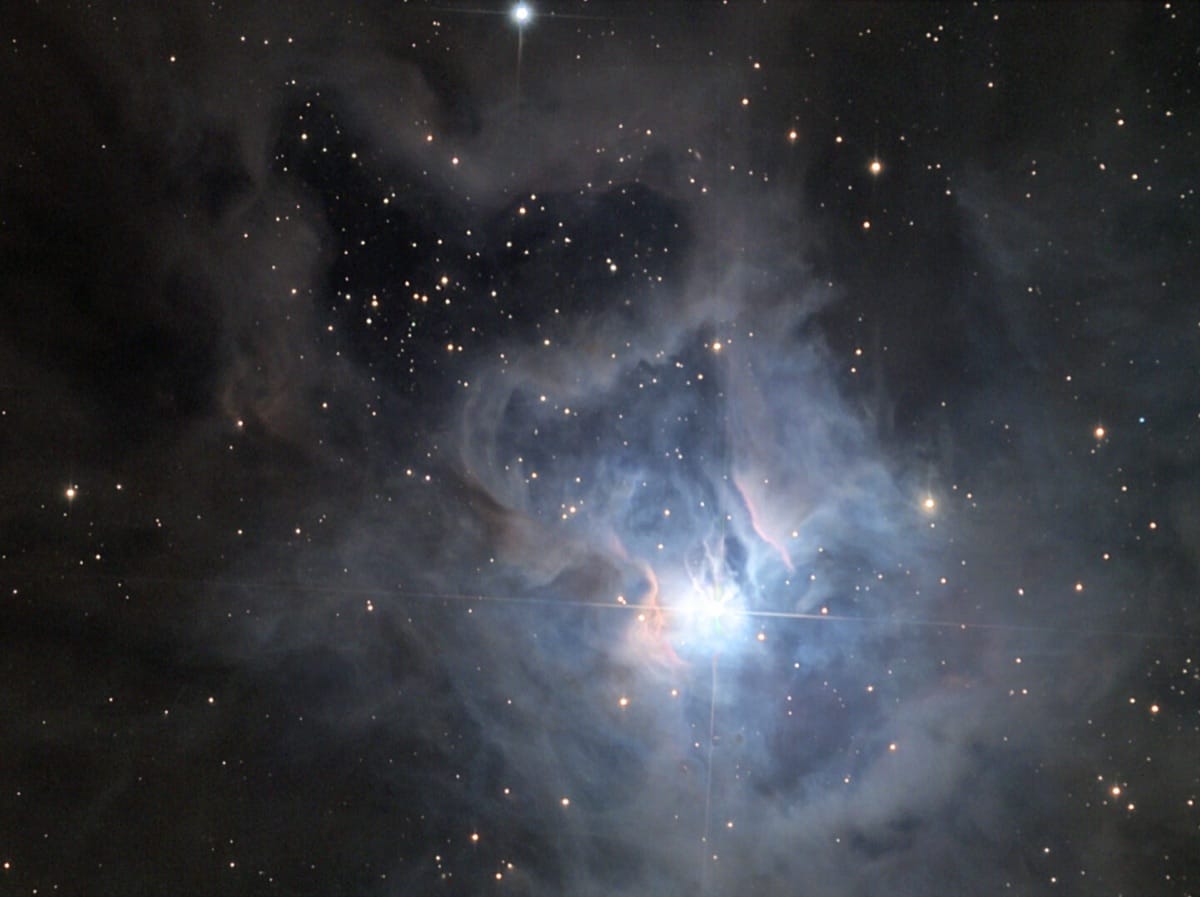
Most reflection nebulae are too faint to show colour to the naked eye or in a small telescope; they read as a soft grey smudge visually, and the blue only emerges in a long-exposure photograph. That is exactly why they reward the patient astrophotographer.
How we photograph reflection nebulae
This section is for readers ready to try imaging one. If you are here for the science, feel free to skip ahead to the FAQ.
A reflection nebula is a broadband target: you capture it through red, green and blue filters (or as luminance plus RGB), because its light is scattered starlight spread across the whole visible spectrum. This is the single most important thing to understand before you point a camera at one.
It also explains a common beginner mistake. Narrowband filters — the Hydrogen-alpha, OIII and SII filters that make emission nebulae pop from a city balcony — do almost nothing for a reflection nebula, because there are no strong emission lines to isolate. The signal is a smooth continuum, not a set of glowing colours. Reach for narrowband on a reflection nebula and you will throw away most of the light you came for.
Because you are working in broadband, a dark sky matters enormously. Skyglow competes directly with the faint scattered light, so these are targets we favour from Chile rather than from town. If you are stuck under brighter skies, our guide to astrophotography under light pollution covers the trade-offs. A few practical notes from our own sessions:
- The blue channel carries the story. Give it generous exposure — the nebula's defining colour lives there, and it is the faintest channel to collect.
- Integrate deep. Reflection nebulae reward hours of total exposure, not minutes. Stack many sub-exposures to pull the haze cleanly out of the noise.
- Protect your stars. The bright illuminating star can bloat and dominate the frame, so careful focusing and accurate autoguiding keep it tight and let the dust breathe.
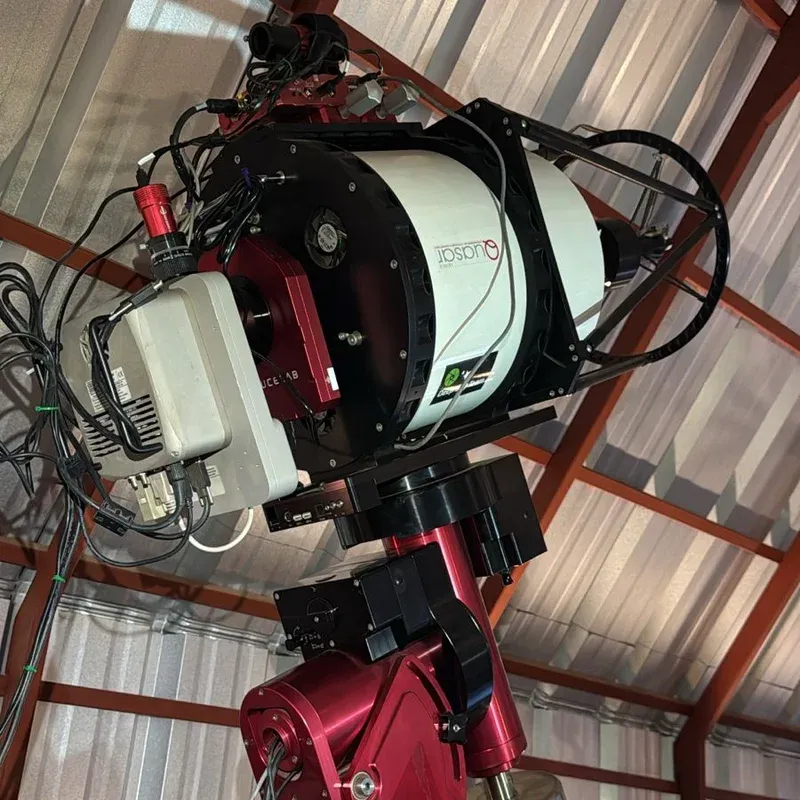
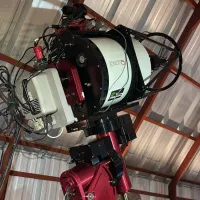
Our own captures come from a remote setup at Deepsky Chile — an Alluna 12.5-inch Ritchey–Chrétien on a Paramount mount — but a modest refractor and a cooled colour camera under a dark sky will show the blue of the brighter reflection nebulae beautifully. The physics does not care how big your telescope is; it cares how dark your sky is and how long you are willing to wait.
Reflection nebulae and star formation
Reflection nebulae often mark stellar nurseries: they are the leftover dust of star birth, lit up by the very young stars that condensed out of the same cloud.
That connection makes them more than pretty scenery. When astronomers study the blue glow around a young star, they are reading the dust that may one day help build planets, and measuring how starlight and grains interact in the earliest chapters of a star system's life. In that sense a reflection nebula is a snapshot of the raw material of worlds. If you are curious how those young stars ignite in the first place, our explainer on what a star is and how stars work picks up the thread. You can read more on the underlying scattering physics on Wikipedia's reflection nebula page.
Frequently asked questions
What is a reflection nebula in simple terms?
It is a cloud of space dust that glows because it reflects light from a nearby star, like fog lit up around a streetlamp. It makes no light of its own, and it usually looks blue.
Why are reflection nebulae blue?
Because dust grains scatter short blue wavelengths of starlight much more efficiently than long red ones, so more blue light is redirected toward us. It is the same reason the daytime sky is blue. The hot blue-white stars that light many reflection nebulae reinforce the effect.
What is the difference between a reflection nebula and an emission nebula?
A reflection nebula shines by scattering a nearby star's light and looks blue; an emission nebula is gas that has been energised by a very hot star's ultraviolet light and glows on its own, usually red. Reflection borrows light, emission produces it.
What is the most famous reflection nebula?
The blue nebulosity around the Pleiades star cluster is the most widely recognised, while Messier 78 in Orion is the brightest diffuse reflection nebula and the Iris Nebula (NGC 7023) is a favourite among astrophotographers.
Can you see a reflection nebula through a telescope?
The brighter ones, such as Messier 78, show as a faint grey haze through a modest telescope under dark skies, but the blue colour only appears in long-exposure photographs — your eye is not sensitive enough to register the faint colour.
Is the Pleiades a reflection nebula?
The Pleiades is a star cluster, but the blue haze surrounding it is a reflection nebula. The cluster is currently passing through an unrelated cloud of interstellar dust and illuminating it, rather than lighting up the cloud it was born in.